How Palani Subramania Pillai’s mridangam playing was a lesson in accompaniment
The Hindu
Palani Subramania Pillai and his unique style of playing mridangam
Quite a lot has been spoken about mridangam legend Palani Subramania Pillai as his 115th birth anniversary was celebrated last April. Musicians have enthusiastically recalled how Subramania Pillai’s mridangam accompaniment blended seamlessly with the music. This effect mesmerised certain star vocalists such as Madurai Mani Iyer, who once while singing Tyagaraja’s ‘Enduku peddala’ stopped midway during the niraval at the phrase ‘Veda shastra’ just to listen to Subramania Pillai’s playing. This was a heart-warming display of mutual admiration between the vocalist and percussionist.
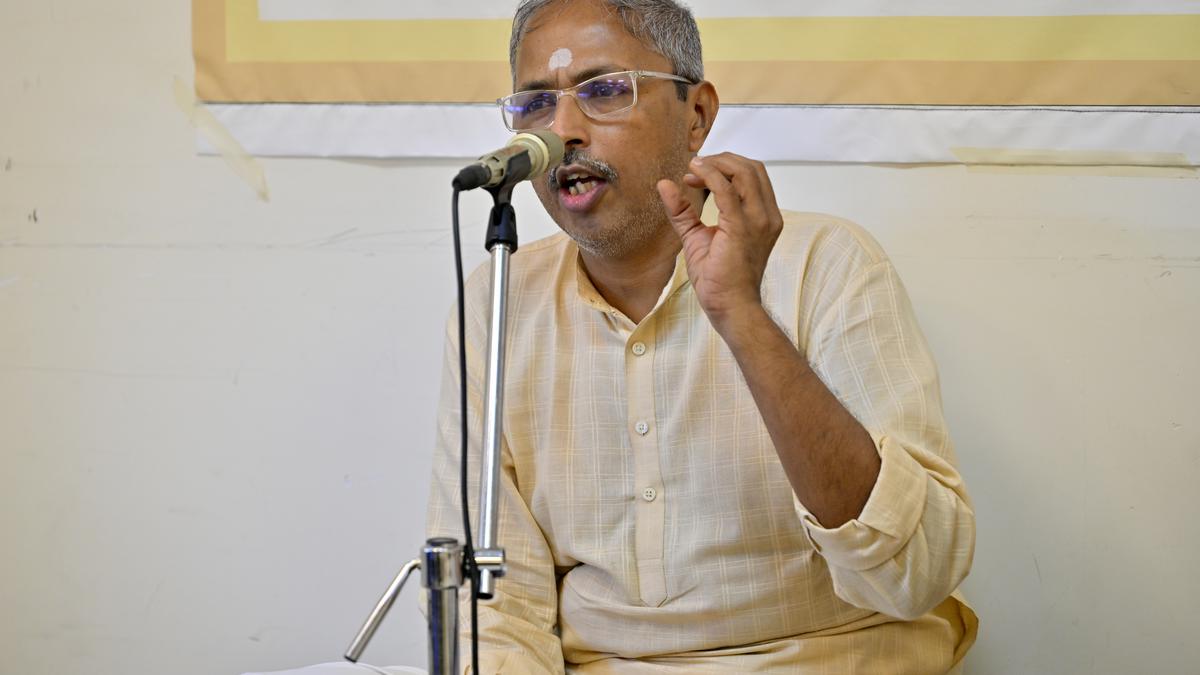
In a listening session organised by Gaanapriya Foundation in association with Rasika Ranjani Sabha, ace mridangam player K. Arun Prakash took listeners through several rare recordings of yesteryear masters to decipher and re-experience the Palani magic. Arun, who hails from the Palani School through his guru Ramanathapuram M.N. Kandaswami, conducted the session with much finesse as his approach was experiential and straightforward.
When listening to Musiri Subramania Iyer singing the kriti ‘Amba nadu vinnapamu’, one could hear Subramania Pillai’s mridangam becoming one with the music. Arun chose to categorise this as a musical mridangam experience — the mridangam completely entered the zone of Todi, showing how much knowledge of music Subramania Pillai possessed, to submerge himself with the vocalist and violinist. Palani Subramania Pillai was hailed as a ‘tyagi’ (someone who sacrifices themselves) by Madurai Mani Iyer because he would never highlight himself when accompanying other musicians. In the olden days, this was traditionally defined as ‘pakka vadhya dharma’.
Arun Prakash elaborated that Subramania Pillai had to balance his virtuosity with the music being sung to optimally bring out the best aesthetic experience. As a mridangam player, who regularly inserted complex patterns almost spontaneously, Subramania Pillai’s sollus were traditionally handed down to him. Being one of the few left-handed mridangam players of his generation, Subramania Pillai’s journey was not easy as he had to prove himself as a worthy accompanist. He never gave up despite facing rejection and many other obstacles in his career.
Continuity is an important concept when playing the mridangam on stage. As the vocalist progresses, sangati by sangati, the mridangam artiste needs to sail along uninterruptedly. However, Subramania Pillai demonstrated that even silence maintained continuity.
Arun Prakash excellently observed that Subramania Pillai’s mridangam expressed itself louder during the pauses, accruing significance and depth to the music by toning itself down gracefully. This can also be called ‘going with the laya of the music’ as the mridangam never overpowered the vocalist but instead added a layer of sound to the grand tapestry of music visualised by the vocalist.
Arun Prakash also pointed out that maintaining the kaalapramana is a lost art today as the percussionists who accompany vocalists invariably tend to alter the speed in many kutcheris. Kaalapramanam adherence was one of Palani Subramania Pillai’s hallmark qualities that distinguished himself from other yesteryear mridangam artistes.


Actor-director Amol Palekar will receive META's Lifetime Achievement award for 2026 on March 25 in New Delhi.

India's artists unite against rising censorship, advocating for creative freedom and support for marginalized voices in the arts.

Written and directed by Kunal, the film also stars Sparsh Shrivastava and Vanshika Dhir

This year, Bharatnatyam artistes will present the Tyagaraja Aradhane as a dance performance

This year, Bharatnatyam artistes will present the Tyagaraja Aradhane as a dance performance

The actor, along with director Sushant Shah, speak about their upcoming series ‘Chiraiya’, Divya’s process of working on the dialect, Sushant’s approach to telling a story about women, and more

An independent video, ‘Feel the Spark’ by Raleigh Rajan with vocals by Ciera Dumas that celebrates Tamil literary giants, garnered 1.4 million views in less than 36 hours.

In ‘Jack Ryan: Ghost War’, John Krasinski is back as the savvy CIA analyst, diving headfirst into a high-stakes mission that unravels a deadly conspiracy and pits him against a rogue black-ops unit

Shriram Bharatiya Kala Kendra’s Shankarlal festival showcased rare ragas, radiant artistry, and inclusive performances, from Pt Madhup Mudgal’s serene morning ragas to Ramana Balachandran’s Saraswati veena.

Explore "Threads that Bind: The Kantha Project," an exhibition in Delhi reimagining kantha as a medium of repair and renewal.

Sean Penn skips the Oscars to meet Ukraine's Zelenskyy, who praises him as a "true friend" amid the war.

The teaser of Tamil star Suriya’s much-awaited film with director Venky Atluri, titled Vishwanath and Sons, was unveiled by the makers on Monday

A 'Golden' moment for a K-pop track at the Oscars.