Primary Country (Mandatory)

Other Country (Optional)

Set News Language for United States

Primary Language (Mandatory)
Other Language[s] (Optional)
No other language available

Set News Language for World

Primary Language (Mandatory)
Other Language(s) (Optional)

Set News Source for United States

Primary Source (Mandatory)
Other Source[s] (Optional)

Set News Source for World

Primary Source (Mandatory)
Other Source(s) (Optional)
  • Countries
    • India
    • United States
    • Qatar
    • Germany
    • China
    • Canada
    • World
  • Categories
    • National
    • International
    • Business
    • Entertainment
    • Sports
    • Special
    • All Categories
  • Available Languages for United States
    • English
  • All Languages
    • English
    • Hindi
    • Arabic
    • German
    • Chinese
    • French
  • Sources
    • India
      • AajTak
      • NDTV India
      • The Hindu
      • India Today
      • Zee News
      • NDTV
      • BBC
      • The Wire
      • News18
      • News 24
      • The Quint
      • ABP News
      • Zee News
      • News 24
    • United States
      • CNN
      • Fox News
      • Al Jazeera
      • CBSN
      • NY Post
      • Voice of America
      • The New York Times
      • HuffPost
      • ABC News
      • Newsy
    • Qatar
      • Al Jazeera
      • Al Arab
      • The Peninsula
      • Gulf Times
      • Al Sharq
      • Qatar Tribune
      • Al Raya
      • Lusail
    • Germany
      • DW
      • ZDF
      • ProSieben
      • RTL
      • n-tv
      • Die Welt
      • Süddeutsche Zeitung
      • Frankfurter Rundschau
    • China
      • China Daily
      • BBC
      • The New York Times
      • Voice of America
      • Beijing Daily
      • The Epoch Times
      • Ta Kung Pao
      • Xinmin Evening News
    • Canada
      • CBC
      • Radio-Canada
      • CTV
      • TVA Nouvelles
      • Le Journal de Montréal
      • Global News
      • BNN Bloomberg
      • Métro
How mitochondria adapted to living within cells

How mitochondria adapted to living within cells

The Hindu
Saturday, March 26, 2022 02:42:47 PM UTC

Billions of years ago, a prokaryotic organism called archaea captured a bacterial endosymbiont

An organism that has been around from 2 billion years ago has given biologists from Centre for Cellular and Molecular Biology, Hyderabad (CCMB), a clue as to how mitochondria became an inseparable part of animal and plant cells. The researchers, led by Rajan Sankaranarayanan, identify two key transformations, one in the molecule known as DTD for short and another in the transfer-RNA (tRNA).

“Our lab works on a molecule called D-aminoacyl-tRNA deacylase (DTD). We observed some unexpected biochemistry of eukaryotic DTD that could be explained based on endosymbiotic origin of complex eukaryotic cell organelles.” Endosymbiosis is an intense form of symbiosis when one of the organisms is captured and internalized by the other.

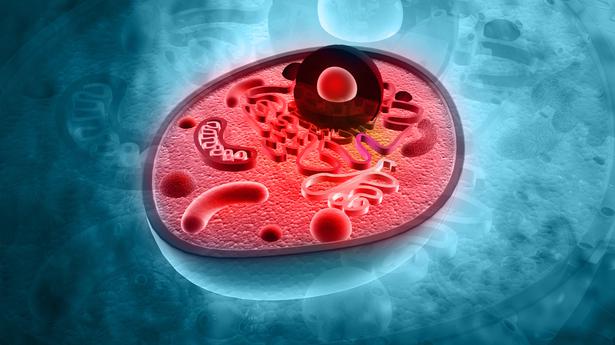
Today, mitochondria are well known to be integral parts of the eukaryotic cell. They are dubbed the power houses of the cell, because they help in generating energy in the form of ATP within the cell, powering it. But they were not always part of the animal and plant cells. Once, about two billion years ago, a prokaryotic organism (without a nucleus) called archaea captured a bacterial cell. The bacterial cell learnt to live within the archaea as an endosymbiont. How this happened has been an important question among biologists. “In the late 19th century, microscopists observed that organelles like chloroplast [and later mitochondria] undergo division inside eukaryotic cells that resembles bacterial division, which led them to suspect that these organelles might have arisen from bacterial endosymbionts,” say Jotin Gogoi and Akshay Bhatnagar from CCMB and the first authors of the paper published in Science Advances.

By studying an organism known as jakobid, which has been around since before animals and fungi branched off from plants and algae in the process of evolution, the researchers have identified two adjustments that had to take place to facilitate the integration of the two organisms. These adjustments were made in the process of optimisation when the two organisms merged together, evidently for compatibility. The researchers show that these changes, in a protein (DTD) and a tRNA (carrying an amino acid glycine for protein synthesis) are crucial for the successful emergence of mitochondria.

Amino acids come with two types of handedness – left-handed and right-handed. Accordingly, their names have a prefix of L or D. All life forms function with only the L-amino acids, in addition to achiral glycine, in proteins. Performing the role of a proofreader, the protein DTD removes D-amino acids from entering protein synthesis. Before it got incorporated into the eukaryotes, when it was part of the bacterial cell, DTD would not act on glycine which is essential for protein synthesis. This preference was changed so that it would be compatible with the eukaryotic cell. “Eukaryotic DTD has changed its recognition code preference in order to avoid untoward removal of glycine, which is a crucial ingredient required for the same. We show in our study that this switch in the recognition code is important without which DTD will be toxic to the eukaryotic cell,” says Rajan Sankaranarayanan of CCMB, who led the work and in whose lab the research was carried out.

The other change identified by the researchers is that mitochondrial tRNA(Gly) has changed its critical nucleotide base from U73 to A73, in order to be compatible with eukaryotic DTD. “This switch in the so-called discriminator base of mitochondrial tRNA(Gly) is important for avoiding removal of glycine and thus stopping protein synthesis in mitochondria – which can be toxic,” says Dr Sankaranarayanan. This means that before the change took place in the nucleotide base, glycine would be removed, which would have been toxic for the cell as protein synthesis would not take place without glycine.

Next, the researchers plan to investigate these evolutionary dynamics in plant cells. Plant cells have two DTDs and two organelles equipped with translation apparatus of their own. “The work for first time shows how such molecular optimisation strategies are essential, when derived from different ancestors like archaea and bacteria, for the successful emergence of mitochondria and hence all of eukaryotic life as we see today including humans,” says Dr Sankaranarayanan.

Read full story on The Hindu
Share this story on:-
More Related News
Tata Sierra review — The icon returns with purpose, poise and personality

Explore the complete review of the 2025 Tata Sierra, India’s reborn SUV icon. From its standout design and premium cabin to refined petrol and diesel engines, advanced tech and competitive pricing, this in-depth breakdown reveals why the new Sierra is poised to lead the midsize SUV segment.

SpaceX to pursue 2026 IPO raising above $30 billion: Report

Elon Musk’s SpaceX is moving ahead with plans for an initial public offering that would seek to raise significantly more than $30 billion and target a valuation of about $1.5 trillion, Bloomberg News reported

Aditya-L1 in a global effort reveals why the 2024 solar storm behaved unusually

Aditya-L1 and U.S. satellites uncover why the May 2024 solar storm behaved unusually, revealing significant magnetic field dynamics.

Harley-Davidson X440T launched: Refined midsize motorcycle with modern rider features

Harley-Davidson X440T introduces updated rider aids, refined performance and refreshed styling, offering a modern, city-focused evolution of the successful X440.

How can India benefit from neurotechnology? | Explained

Explore how neurotechnology, including BCIs, can transform healthcare and enhance India's capabilities in addressing neurological disorders and beyond.

On zoos and magnets: the physics behind sounds Premium

Explore the fascinating physics of sound waves and their enchanting presence in nature and everyday life.

Parambriyam reopens in Anna Nagar, showcasing South Indian culinary heritage

Parambriyam reopens in Anna Nagar, offering a vibrant dining experience celebrating South India's rich culinary traditions and flavors.

Fossils, genomes clash as scientists debate the mosquito’s origins Premium

Scientists debate mosquito origins as fossil evidence and genomic studies clash, revealing new insights into their evolutionary timeline.

A guide to going sustainable this Christmas

From Christmas trees fashioned out of books to real spices as ornaments

How new DGCA rules put human limits at the centre of air safety Premium

Explore how DGCA's new fatigue regulations prioritize human limits to enhance aviation safety amidst recent airline disruptions.

India needs a diversified portfolio of future-ready power system technologies, say experts

Experts advocate for a diversified energy strategy in India to enhance reliability and support the 500 GW non-fossil capacity target.

Bakelite, the first synthetic plastic Premium

On December 7, 1909, Belgian-American chemist Leo Baekeland’s process patent for making Bakelite was granted, two years after he had figured it out. Bakelite is the first fully synthetic plastic and its invention marked the beginning of the Age of Plastics. A.S.Ganesh tells you more about Baekeland and his Bakelite…

Unlocking the potential India’s research in medicine Premium

Explore the challenges and opportunities in enhancing India's medical research ecosystem to unlock its potential for groundbreaking discoveries.

How is Asia-like artemisinin resistance emerging in Africa? Premium

Study reveals rising artemisinin resistance in Africa, echoing Asia's past, urging urgent action to prevent widespread crisis.

The Michelin Guide enters the world of wine with The Michelin Grappe, a new distinction

Michelin launches The Grappe, a new wine distinction, recognizing excellence with one to three grapes, starting with the Burgundy and Bordeaux regions

Inside a scientific experiment that transformed skin cells into embryo-forming eggs Premium

A groundbreaking experiment transforms skin cells into egg-like cells, offering hope for infertility treatments amidst ethical considerations.

Niraba brings sabai grass weaving to contemporary furniture design

Discover Niraba, a collaboration merging Odisha's sabai grass weaving and dhokra craft into contemporary furniture and lighting design.

The story behind Goa’s 18-foot crochet Christmas tree

How do you create a Christmas tree with crochet? Take notes from crochet artist Sheena Pereira, who co-founded Goa-based Crochet Collective with crocheter Sharmila Majumdar in 2025. Their artwork takes centre stage at the Where We Gather exhibit, which is part of Festivals of Goa, an ongoing exhibition hosted by the Museum of Goa. The collective’s multi-hued, 18-foot crochet Christmas tree has been put together by 25 women from across the State. “I’ve always thought of doing an installation with crochet. So, we thought of doing something throughout the year that would culminate at the year end; something that would resonate with Christmas message — peace, hope, joy, love,” explains Sheena. 

Science Quiz: Remembering Max Born, quantum physics architect Premium

Max Born made many contributions to quantum theory. This said, he was awarded the Nobel Prize for physics in 1954 for establishing the statistical interpretation of the ____________. Fill in the blank with the name of an object central to quantum theory but whose exact nature is still not fully understood.

‘Moms of Kochi’ to organise Purple Carnival, a lifestyle exhibition

Join the Moms of Kochi for the Purple Carnival, a vibrant lifestyle exhibition featuring stalls, competitions, and entertainment on December 13-14.

Why human-rating matters as India prepares for Gaganyaan Premium

Human-rating emerges as a crucial process ensuring that space systems like LVM-3 can safely carry humans by adding redundancy, robust abort capabilities, and rigorous testing

The snail as a model for restoring vision in humans Premium

Discover how golden apple snails' eye regeneration offers insights into restoring human vision through genetic understanding and CRISPR technology.

Why do microwave ovens sometimes overheat water? Premium

Discover how microwave ovens can superheat water, leading to unexpected boiling when disturbed. Stay safe while heating.

Manhattan’s hot new INDN Bar: Butter chicken cocktails, keema pav, zero kids 

INDN has launched in NYC’s NoMad. Indian food goes 21+ here, with savoury cocktails, nostalgic small plates and a bar that refuses desi clichés — much to one dad’s horror

2025 to be second or third-hottest year on record: EU scientists

EU scientists predict 2025 will be among the hottest years on record, highlighting urgent climate change concerns and inadequate global action.

© 2008 - 2025 Webjosh  |  News Archive  |  Privacy Policy  |  Contact Us