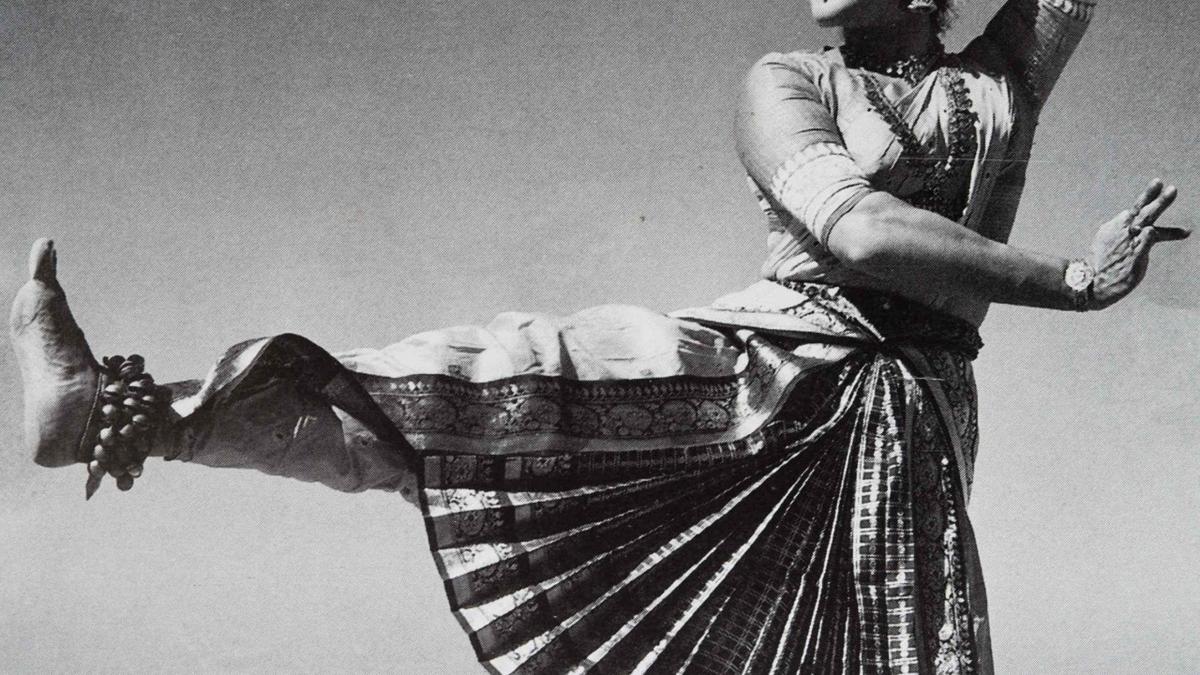
How Kamala set the Bharatanatyam stage for the future
The Hindu
Kumari Kamala, the 'Queen of Dance', inspired generations and left a lasting legacy worldwide.
Bharatanatyam as a dance form in the post-revival years was popularised greatly by someone so famous that many parents named their daughters after her. She inspired girls from middle-class families to take up the dance form at a time when women from non-hereditary caste locations were discouraged to do so.
Described as the ‘Queen of Dance’ by none other than Pandit Jawaharlal Nehru, Kumari Kamala (now Kamala Lakshminarayanan), a child prodigy, blazed a Bharatanatyam trail across the country and beyond with her electrifying performances in the Vazhuvoor style. The legendary dancer, who moved to the U.S. in 1980, turned 90 this June.
Initially trained in Kathak by Shambu Maharaj and Lachhu Maharaj, Kamala, aged just four, started performing small items in the recitals of senior artistes. After witnessing her debut performance at the Asthika Samajam in Bombay, film producer and director Chandulal Shah offered her a contract of Rs 500 a month to dance in all his films.
Later, Kamala and her family had to move back to the South during the World War. Thus began her tryst with Bharatanatyam. Kamala’s first teacher was Kattumannarkoil Muthukumaraswamy Pillai. He later introduced Kamala to Vazhuvoor Ramaiah Pillai, paving the way for a brilliant collaboration. Being one of Vazhuvoor’s earliest disciples, Kamala helped him take his choreography to the masses through her foray into films as an actor.
In the 1940s and 1950s, Kamala attained great heights for executing never-before-seen pieces such as the snake dance with her signature back bend, which later went on to become an arangetram staple. During the freedom movement, Kamala’s special film numbers such as ‘Aaduvome pallu paaduvome’ and ‘Vetri ettu dhikku’ were powerful tools of resistance against the imperial government.
A thillana dance sequence in the film Chori Chori (1956) was one of Kamala’s best on-screen performances back then and continues to fascinate lovers of classical music and dance even today. M.L.Vasanthakumari, who lent her voice even appears on the screen as a lead singer in the orchestra that accompanies the dancer.
While film roles poured in, Kamala simultaneously performed on stage. Dancer and scholar Lakshmi Viswanathan who once interviewed Kamala for The Hindu wrote that Kamala’s early exposure to a certain discipline moulded her into a great artiste. “The crisp and quick movements meant to fit into a particularly short cine-musical piece, as well as the sense of drama in elegant poses to be captured by the camera, shaped Kamala’s formative years. It is no surprise that when she reached the top as a stage artiste, she faced her audience with an enviable elan,” she wrote.


South African naturalist Steve Boyes speaks on ghost elephants, ancestral tracking, and Werner Herzog’s documentary exploring Angola’s elusive highland giants

Actor-director Amol Palekar will receive META's Lifetime Achievement award for 2026 on March 25 in New Delhi.

India's artists unite against rising censorship, advocating for creative freedom and support for marginalized voices in the arts.

Written and directed by Kunal, the film also stars Sparsh Shrivastava and Vanshika Dhir

This year, Bharatnatyam artistes will present the Tyagaraja Aradhane as a dance performance

This year, Bharatnatyam artistes will present the Tyagaraja Aradhane as a dance performance

The actor, along with director Sushant Shah, speak about their upcoming series ‘Chiraiya’, Divya’s process of working on the dialect, Sushant’s approach to telling a story about women, and more

An independent video, ‘Feel the Spark’ by Raleigh Rajan with vocals by Ciera Dumas that celebrates Tamil literary giants, garnered 1.4 million views in less than 36 hours.

In ‘Jack Ryan: Ghost War’, John Krasinski is back as the savvy CIA analyst, diving headfirst into a high-stakes mission that unravels a deadly conspiracy and pits him against a rogue black-ops unit

Shriram Bharatiya Kala Kendra’s Shankarlal festival showcased rare ragas, radiant artistry, and inclusive performances, from Pt Madhup Mudgal’s serene morning ragas to Ramana Balachandran’s Saraswati veena.

Explore "Threads that Bind: The Kantha Project," an exhibition in Delhi reimagining kantha as a medium of repair and renewal.

Sean Penn skips the Oscars to meet Ukraine's Zelenskyy, who praises him as a "true friend" amid the war.

The teaser of Tamil star Suriya’s much-awaited film with director Venky Atluri, titled Vishwanath and Sons, was unveiled by the makers on Monday