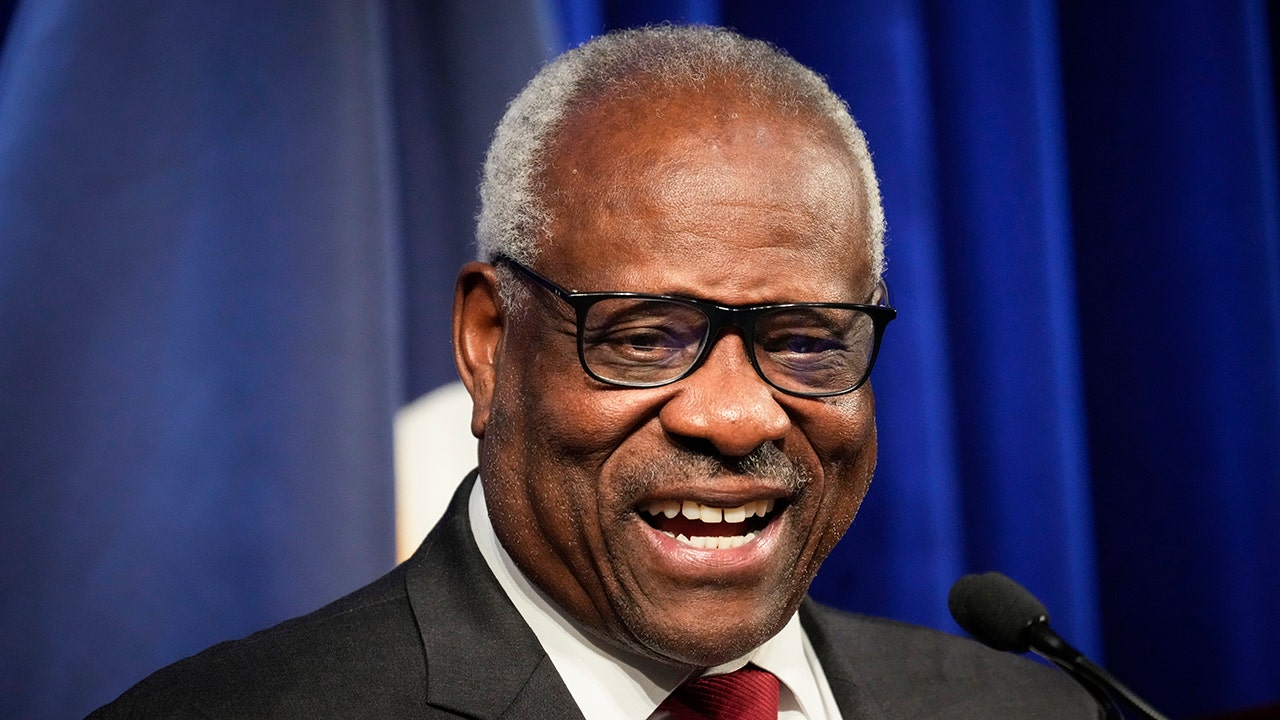
How Justice Clarence Thomas led SCOTUS to kill DEI
Fox News
Supreme Court unanimously rejects special standards for majority-group discrimination claims, reflecting Thomas's view that American law protects individual rather than group rights
Scott Douglas Gerber is the author of, among other books, "First Principles: The Jurisprudence of Clarence Thomas." He is currently completing a legal thriller entitled "The Trafficker: A Novel."
Justice Thomas has reiterated that American law protects individual rather than groups rights throughout his three-and-a-half decades on the nation’s highest court. In 1995's Missouri v. Jenkins, for instance, Thomas became the first Supreme Court justice to directly criticize Brown v. Board of Education (1954). Although he called state-mandated segregation "despicable," he said that the Court was wrong in 1954 to rely on disputable social science evidence to declare segregation unconstitutional rather than invoking the "constitutional principle" that "the government must treat citizens as individuals, and not as members of racial, ethnic or religious groups."
Justice Thomas has made similar pronouncements in many other judicial opinions. His concurring opinion in 2007's Parents Involved in Community Schools v. Seattle School District No. 1 is perhaps the strongest articulation of his conception of equality: "The dissent attempts to marginalize the notion of a colorblind Constitution by consigning it to me and Members of today’s plurality. … But I am quite comfortable in the company I keep. My view of the Constitution is Justice Harlan’s view in Plessy: ‘Our Constitution is color-blind, and neither knows nor tolerates classes among citizens.’" More recently, Justice Thomas wrote in a concurring opinion in the Supreme Court’s 2023 decisions holding that colleges and universities cannot consider race in admissions decisions that "While I am painfully aware of the social and economic ravages which have befallen my race and all who suffer discrimination, I hold out enduring hope that this country will live up to its principles so clearly enunciated in the Declaration of Independence and the Constitution of the United States: that all men are created equal, are equal citizens, and must be treated equally before the law."


Secret Service agents detained a driver of a suspicious vehicle located near the White House in Washington, D.C., on Wednesday morning.

Drone attack strikes U.S. Baghdad Diplomatic Support Center as suspected pro-Iranian militias launch six drones at major American facility in Iraq.

After being detained over his political activism, Mahmoud Khalil warns that punishing lawful speech under the guise of immigration enforcement sets a precedent that could erode constitutional protections for everyone.

Jeremy Carl, President Donald Trump's nominee for assistant secretary of state, withdrew his nomination Tuesday after facing bipartisan criticism over past comments.

Trump should ramp up fulfilling campaign promise of largest deportation effort in American history, targeting close to 20 million illegal aliens.

Former Rep. Bob Good slammed President Donald Trump's endorsement track record, declaring in a post on X, "you would literally do better by using Trump’s endorsement to know who NOT to vote for."

Sen. Tom Cotton, R-Ark., charged that the Biden administration drained strategic oil reserves for political gain, leaving national stockpile at 40-year low amid as the Iran war rages.

Trump administration tackles prescription drug costs and vaccine access, but balances public health with personal choice for American families.

Senate Republicans pass Mardi Gras resolutions while the SAVE America Act stalls. We're in the House Freedom Caucus and we want action on voter ID and citizenship verification measures.

Secretary of State Marco Rubio designated Afghanistan as a state sponsor of wrongful detention and demanded the Taliban release Americans in its custody.

ISIS terror plot suspects Emir Balat and Ibrahim Kayumi allegedly bought fireworks fuse before throwing explosive devices at protesters outside Gracie Mansion, facing federal charges.

The complaint sparked fierce backlash from DOJ officials, who argued that the DC Bar has unfairly targeted Trump's allies while overlooking former Democratic administrations.

Speaker Mike Johnson says President Donald Trump will help turn out Republican voters in the November midterm elections.