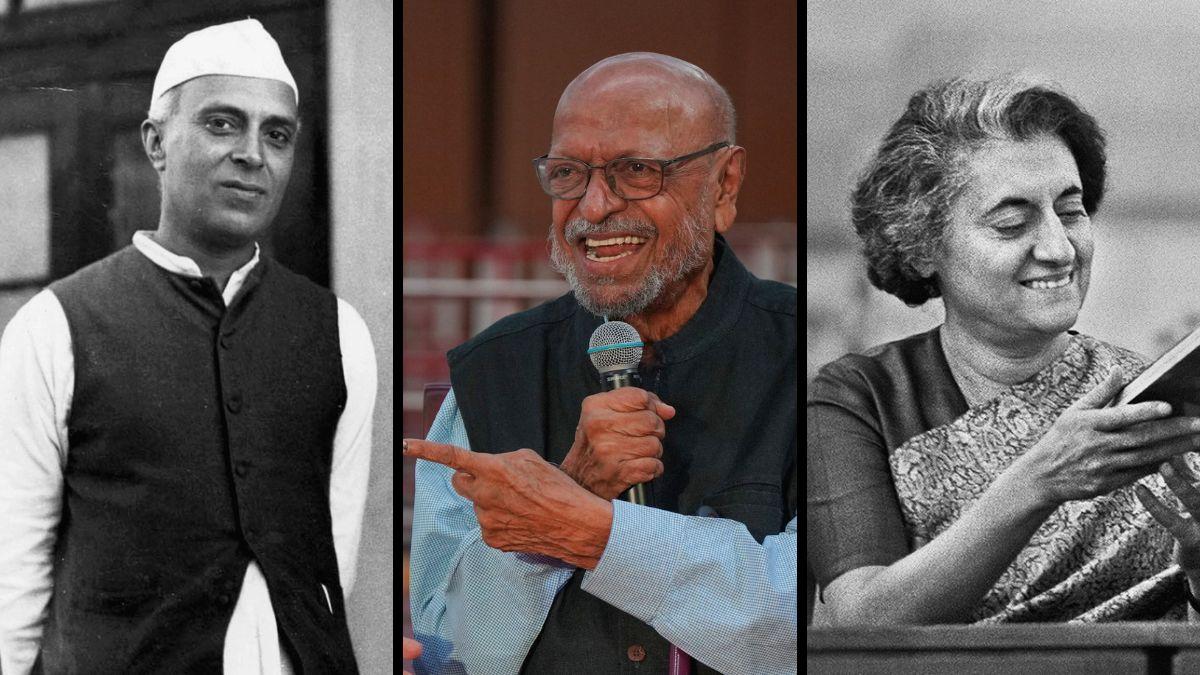
How Jawaharlal Nehru, Indira Gandhi influenced the late Shyam Benegal’s filmography
The Hindu
A chance encounter with the Nehru and the saving grace of his divisive Indira Gandhi proved formative for the revolutionary stalwart for India’s Parallel Cinema movement
The passing of Shyam Benegal, a titan of Indian parallel cinema, marks the end of an era. Known for his ability to weave his extraordinary oeuvre with a biting social realism, Benegal’s career was deeply intertwined with the political and cultural fabric of India. His encounters with Jawaharlal Nehru, Indira Gandhi, and the Indian political scene seemed to have been influential in shaping his work.
Benegal often spoke of his first meeting with Jawaharlal Nehru in the mid-1950s at a youth festival. The Prime Minister’s unassuming charm and connection with young people left an impression on the young filmmaker. “He asked if he could join us at the lunch table,” Benegal recounted in an interview with Unfiltered by Samdish. “His attractiveness was undeniable. That’s why I made Bharat Ek Khoj.” This 53-episode series, based on Nehru’s The Discovery of India, became a landmark television project, exploring India’s rich history and mythology.
The filmmaker’s interactions with Nehru’s daughter, Indira Gandhi, seem to have been more layered. While Benegal admired her keen aesthetic sense and support for the arts, he also witnessed the darker side of her political tenure during the Emergency (1975–77). Describing the period as “a terrible time,” he criticised the authoritarian atmosphere and police brutality that curtailed freedoms.
Yet, it was during this turbulent period that Indira Gandhi played an unexpected role in saving Benegal’s film Nishant. A critique of feudalism set against the Telangana rebellion, the film had been banned by the Censor Board despite being India’s official entry to the Cannes Film Festival. After a private screening, Gandhi questioned the ban, stating that it made the government appear “insensitive and petty.” Her intervention ensured the film’s release, a pivotal moment that preserved Benegal’s burgeoning career.
Benegal also acknowledged her public struggles and loneliness as a child, shaped by Nehru’s frequent absences due to imprisonment and political duties. “She was very shy,” he reflected, dismissing the derogatory label of goongi guddiya (dumb doll) attached to her early political years.
The veteran filmmaker passed away due to kidney-related ailments in Mumbai on Monday (December 23, 2024). He was 90.


Khalid Rahman is reuniting with Malayalam superstar Mammootty after Unda (2019). The Thallumaala director has teamed up with the veteran for Mattancherry Mafia.

Bollywood actor Akshay Kumar paid tribute to the martial arts grandmaster and Hollywood’s action star, Chuck Norris, who passed away on Thursday, March 19, 2026.

Renowned Odissi dancer Madhumita Raut, aged 59, dies of cardiac arrest, leaving behind a legacy of artistic achievements.

Chuck Norris, iconic martial arts master and actor, dies at 86, leaving behind a legendary legacy and internet memes.

South African naturalist Steve Boyes speaks on ghost elephants, ancestral tracking, and Werner Herzog’s documentary exploring Angola’s elusive highland giants

Actor-director Amol Palekar will receive META's Lifetime Achievement award for 2026 on March 25 in New Delhi.

India's artists unite against rising censorship, advocating for creative freedom and support for marginalized voices in the arts.

Written and directed by Kunal, the film also stars Sparsh Shrivastava and Vanshika Dhir

This year, Bharatnatyam artistes will present the Tyagaraja Aradhane as a dance performance

This year, Bharatnatyam artistes will present the Tyagaraja Aradhane as a dance performance

The actor, along with director Sushant Shah, speak about their upcoming series ‘Chiraiya’, Divya’s process of working on the dialect, Sushant’s approach to telling a story about women, and more

An independent video, ‘Feel the Spark’ by Raleigh Rajan with vocals by Ciera Dumas that celebrates Tamil literary giants, garnered 1.4 million views in less than 36 hours.

In ‘Jack Ryan: Ghost War’, John Krasinski is back as the savvy CIA analyst, diving headfirst into a high-stakes mission that unravels a deadly conspiracy and pits him against a rogue black-ops unit