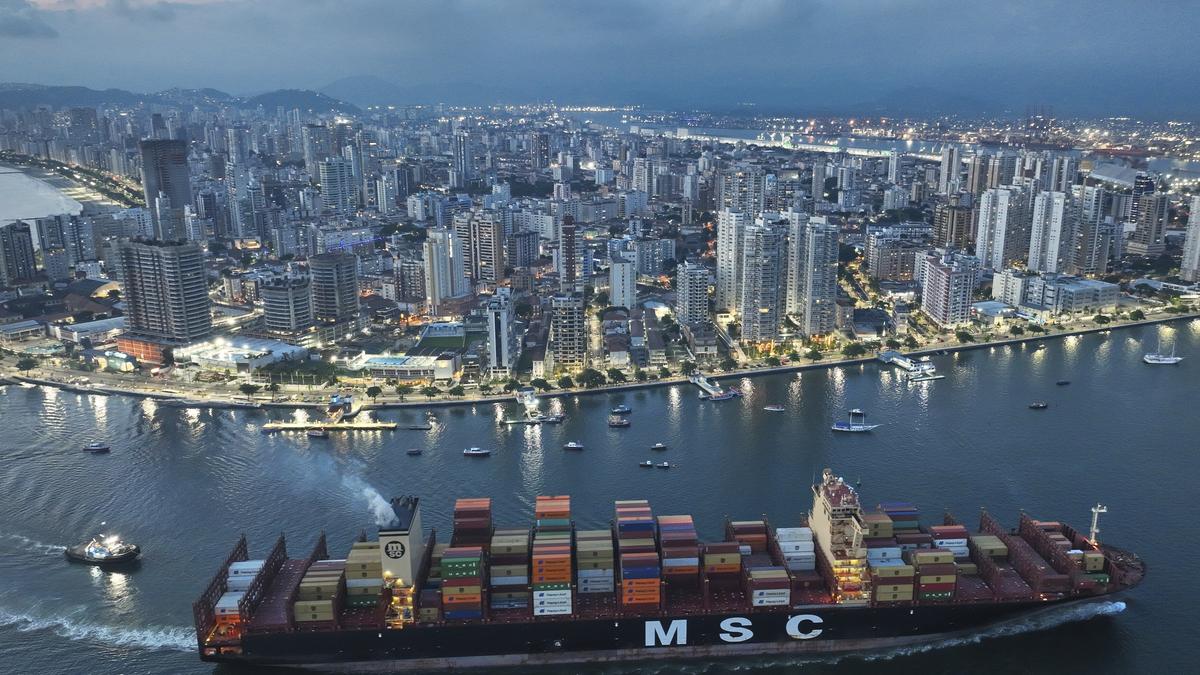
How is the shipping industry tackling emissions? | Explained
The Hindu
IMO's MEPC-83 session navigates towards a consensus on a global shipping emissions levy, balancing environmental and economic concerns.
The story so far: After a decade of deliberations towards decarbonising the maritime industry, at its 83rd session, the Marine Environment Protection Committee (MEPC-83) of the International Maritime Organization (IMO) was faced with the challenge of coming to a consensus on a proposed emissions levy on global shipping. The session’s objective was to adopt a Market-Based Measure (MBM) that balanced environmental effectiveness with economic fairness.
Five distinct proposals were tabled in the meeting. The first was by the International Chamber of Shipping which advocated for a fixed levy per every tonne of CO₂ emitted. Secondly, China proposed a market-driven approach where ships could trade compliance units and invest in alternative fuels. The European Union suggested a fixed Greenhouse Gas (GHG) levy, managed by an IMO-administered fund while India propositioned a ‘bridging mechanism’, which would target only under-compliant ships to bear the financial burden, while rewarding those using Zero or Near-Zero (ZNZ) fuels. Finally, Singapore also joined the fray by proposing an enhanced version of India’s model, involving a GHG Fuel Standard (GFS) and a tiered system rewarding surplus emission units and requiring the purchase of remedial units for underperformance.
Even before the debate on MBMs could fully unfold in the IMO, geopolitical tensions took centre-stage. The U.S. Trump administration, which had already withdrawn from the Paris Agreement and stripped the agency that responds to disasters from their climate work related responsibilities, did not participate in the IMO deliberations. It warned of “reciprocal measures” if the EU-backed uniform carbon levy were passed.
The MPEC-83 of IMO voted 63 to 16 in favour of accepting Singapore’s hybrid model based on India’s proposal as the IMO’s Net Zero Framework, making international shipping the first global industry to adopt a mandatory emissions levy framework. Having piloted a compromise formula amidst extremely divergent views, both India and Singapore have claimed credit for the successful outcome.
However, the decision of the MEPC-83 is not final yet. Despite the vote, the path to implementation is far from straightforward. The MEPC-83’s decision, having approved the Net Zero Framework, now needs to amend Annex VI of the MARPOL convention, which governs air pollution from ships. The amendment will undergo a six-month circulation period among all contracting parties to MARPOL. For final adoption, it requires a two-thirds majority of votes from members present and voting; this means that if all 101 parties participate, at least 67 must support the measure. Even if adopted, the amendment could still be blocked, should one-third of the parties — provided they account for at least 50% of global shipping tonnage — formally object in writing.
Currently, with 63 votes in favour, 16 against, and 22 abstentions, the outcome remains uncertain. The process ahead is critical and could reshape the dynamics of global shipping regulation for decades to come.
The wide range of positions expressed during the MEPC-83 underscores the enduring dominance of national interests in global climate diplomacy. Oil-exporting countries, led by Saudi Arabia, opposed any significant transition to green fuels, prioritising the protection of their fossil fuel markets. In contrast, small island nations and least developed countries advocated for steep carbon levies, seeking to redirect revenues into broader green development initiatives.


OpenAI on Tuesday announced key leadership appointments for its nonprofit arm and committed to investing at least $1 billion through the division

EU antitrust chief Teresa Ribera, who has voiced concerns about Big Tech extending its dominance into artificial intelligence, will meet the CEOs of Alphabet, Meta Platforms and OpenAI

OpenAI is close to securing about $10 billion in fresh funding from investors, boosting its valuation to $850 billion, including the money raised, a person familiar with the matter said, confirming an earlier report in Bloomberg News

Discover the key changes in the New Income Tax Rules 2026, simplifying compliance and enhancing deductions for taxpayers.

Palantir, which won a contract to supply AI systems to Britain’s Financial Conduct Authority, will not have access to regulatory intelligence, an FCA official said

Arm Holdings announced a new artificial intelligence data centre chip on Tuesday which it said will add billions of dollars of revenue

Amazon said on Monday its Amazon Web Services region in Bahrain has been “disrupted” amid the current conflict in the Middle East

Petroleum Ministry directs reforms to enhance natural gas infrastructure, streamline approvals, and ease transition from LPG to PNG.

The Sora decision means the end of a blockbuster $1 billion deal between Disney and the ChatGPT maker that was announced a little more than three months ago.

Regulator mandates city gas distributors to provide piped gas to educational institutions within five days, supporting India's transition from LPG to PNG.

NHAI's Raajmarga InvIT listed on BSE, enhancing investor participation in highway infrastructure with strong demand and oversubscription.

HDFC Life Insurance faces ₹172 crore Income Tax order for alleged violations, plans to appeal the decision.

Air-conditioner makers in India are looking forward to FY27 with hope as the war in West Asia threatens to impact plastic component availability and consumer sentiment, adding to the challenges around raw material price and new energy label, a senior executive of a leading company has said.