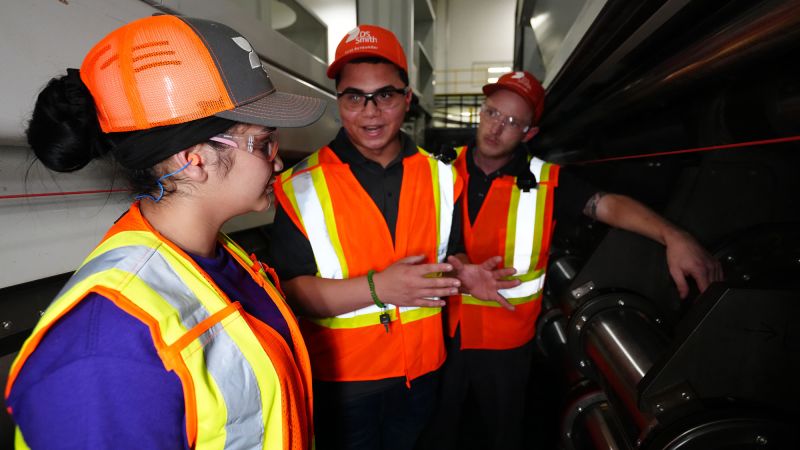
How interpreters are helping this Indiana plant address its labor shortage
CNN
Like many manufacturers, DS Smith sorely needed more workers in 2022.
Like many manufacturers, DS Smith sorely needed more workers in 2022. The multinational packing company’s corrugated box plant in Lebanon, Indiana, tried billboards, yard signs, jobs fairs and flyers at churches and fast-food restaurants but found it still took an average of three months to fill roles. That meant existing employees had to put in a lot of overtime, including some Saturday shifts. Then, the facility’s human resources manager, Becky Gordon, had a novel idea. She had noticed that the plant, which opened in 2019, had to turn away a growing number of job candidates who spoke only Spanish because it did not have bilingual personnel to interview, train and manage them. “In order to diversify and bring in more talent, we needed to be able to speak with people whose first language is not English,” Gordon said, noting the growing communities of recent Venezuelan and Nicaraguan immigrants in the nearby cities of Indianapolis and Frankfort. So she decided to hire a full-time interpreter, then added two more. That has enabled the plant to boost its Spanish-speaking workforce to 92, or 42% of its staff, up from eight people, or 6%, in 2022. The facility, which pays $20 an hour to start, can now fill jobs in less than half the time. DS Smith launched the interpreter program as manufacturers were coming under pressure from all sides. The pandemic-fueled spike in online deliveries boosted demand for cardboard boxes, but the tight labor market made it hard for companies to find enough employees. At the same time, an influx of asylum seekers, many from Spanish-speaking countries, were looking for work.


Stocks soared and oil prices fell after President Donald Trump on Monday said the United States would postpone further strikes on Iran’s energy infrastructure, pending the outcome of negotiations.

The national average price for a gallon of regular unleaded gasoline is on the verge of hitting $4 for the first time since 2022.

Oil prices rose Monday after the United States and Iran threatened fresh attacks on energy facilities in the Middle East, including power plants, signaling that the conflict may yet escalate.

The war in Iran is pushing up prices for already-strained farmers, with higher costs for fertilizer and energy on top of last year’s tariffs. And the increasing pressure on American agriculture could lead to even bigger price tags at the grocery store.

If you only watched Fox News over the weekend, you didn’t hear about President Donald Trump’s widely condemned reaction to Robert Mueller’s death.

Oil prices rose Sunday after President Donald Trump threatened to “obliterate” Iran’s power plants if the Strait of Hormuz is not reopened by Monday evening.

Defense Secretary Pete Hegseth has been taking steps to thwart news coverage of the Pentagon for more than a year. Now he has finally met some resistance.

Defense Secretary Pete Hegseth has been taking steps to thwart news coverage of the Pentagon for more than a year. Now he has finally met some resistance.

Gerald Rodriguez, the general manager of an NPR affiliate in rural Colorado, expected federal funding for public media to shrink. He didn’t expect it to disappear almost overnight.

The much-touted new tax breaks for tips, overtime, seniors and car loan interest have a lot of income tax filers expecting a big bump in their refunds this year – or a big cut in their tax bill.

Looking out his shop window, across the street, just to the right, Paloma Clothing co-owner Mike Roach sees one of Portland, Oregon’s, most expensive gas stations.

Oil and liquefied natural gas tankers moving through the Strait of Hormuz carry around 20% of the world’s supply. But for countries on the Persian Gulf, the waterway is more than just an energy route – it’s a lifeline for more than 100 million people.

A California jury has largely sided with Twitter shareholders who accused billionaire Elon Musk of defrauding them by intentionally driving down the social media company’s stock ahead of his $44 billion acquisition in 2022.