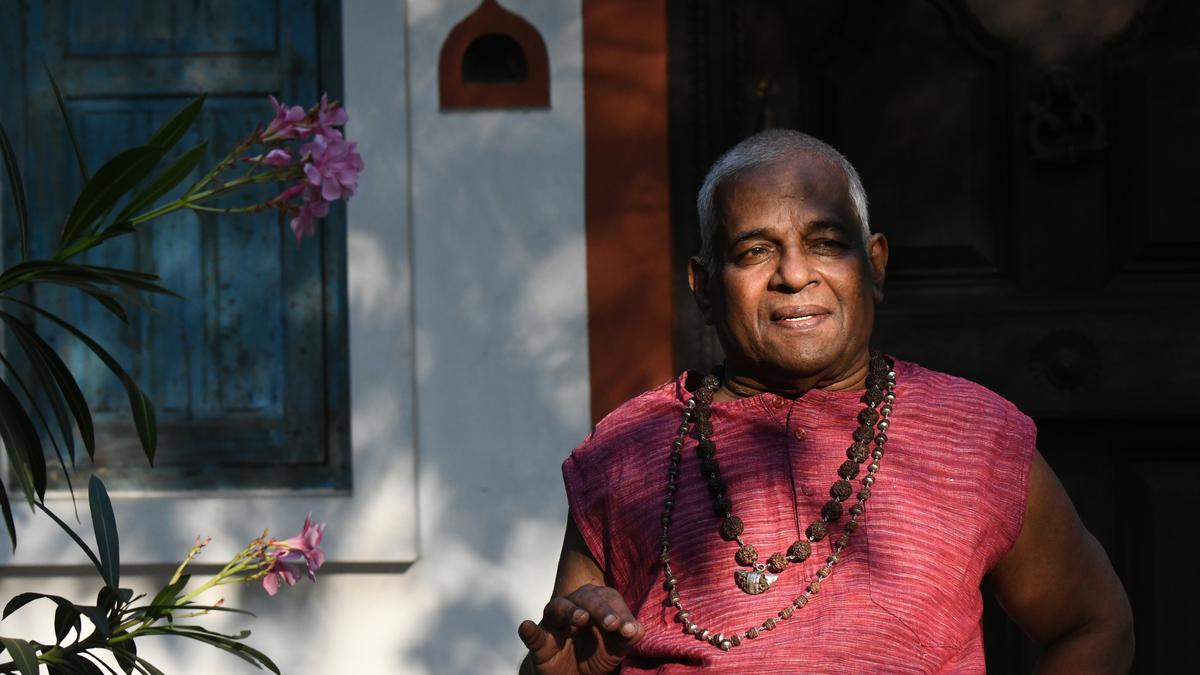
How G. Venu built Natana Kairali, a reputed training and performance institute
The Hindu
Koodiyattam exponent G. Venu receives the Kerala Kalamandalam Fellowship
Kerala Kalamandalam (Deemed-to-be-University) recently created history by selecting a non-Chakyar for its Fellowship in Koodiyattam. G. Venu, an accomplished performer, skillful choreographer, prolific writer and venerated guru is the chosen one.
While sea changes in society have been compelling the traditional performers or Chakyars to migrate to other vocations, Venu, a consummate performer of Kathakali, groomed by doyens such as Chengannur Raman Pillai and Guru Gopinath, plunged headlong into the world of Koodiyattam after watching a performance by maestro Ammannur Madhava Chakyar at Sree Vadakkunnathan Temple, Thrissur.
The theatrical potentialities of the centuries-old Sanskrit drama and the scope of abhinaya it offered left a profound influence on him. So much so, at the age of 37, Venu resigned his permanent job at the School of Drama and Fine Arts, University of Calicut, shifted his residence to Irinjalakuda and joined the Ammannur Kalari as the first non-Chakyar student of Ammannur Madhava Chakyar.
Since his initiation, he has been following his acharya like a shadow, taking care of his needs in the capacity of both a disciple and impresario. In turn, Madhava Chakyar groomed him as his protégé. The credit for starting Ammannur Chachu Chakyar Smaraka Gurukulam in 1982 also goes to Venu.
An ardent advocate of the traditional system of training, he has produced quite a number of young outstanding artistes, an achievement that no other institution can boast of.
While he donned numerous veshams such as Ravana (Thoranayudham), Soorpanakha (Soorpanangham) and Bhima and Hanuman (Kalyanasaugandhikam), Kalidasa’s Sakuntalam, a 11-hour production is his magnum opus in choreography. This was staged at many international festivals . His other notable choreographies include Vikramorvaseeyam (First half –three Acts) and Oorubhangam.
The Ammanur Gurukulam, under the leadership of Madhava Chakyar, was instrumental in the revival of Nangiarkoothu, an exclusive preserve of women. Venu, who was also part of this endeavour, choreographed Narasimhavatharam, Sitaparithyagam and Soundaryalahari.


Sean Penn skips the Oscars to meet Ukraine's Zelenskyy, who praises him as a "true friend" amid the war.

The teaser of Tamil star Suriya’s much-awaited film with director Venky Atluri, titled Vishwanath and Sons, was unveiled by the makers on Monday

A 'Golden' moment for a K-pop track at the Oscars.

Parvathi Nayar’s new exhibition, The Primordial, in Mumbai, traces oceans, pepper and climate change
Opened on March 12, the exhibition marks the artist’s first solo show in Mumbai in nearly two decades. Known for her intricate graphite drawings and multidisciplinary practice spanning installation, photography, video, and climate change, her artistic journey has long engaged with the themes of ecology, climate change and the natural world. In this ongoing exhibition, these strands converge through a series of works centred on water, salt, and pepper — materials that carry natural and historic weight across centuries.

Explore the highlights and key winners of the 98th Academy Awards, featuring memorable moments and historic achievements from Oscars 2026.

Spring season celebrated at Ramakrishna Mission Institute, Kolkata, with ‘Evening of Basant’

The Spirit of the Land, a solo show by artist Shivakumar Sunagar, is a vista of Nature-inspired emotions

Tal Fry is all set for an exciting new performance season

Netflix is making a bold move by snagging InterPositive, the AI filmmaking company founded by Ben Affleck, in a deal that could hit $600 million

Watch the eerie trailer for 'Hokum,' where Adam Scott faces a witch haunting in a mysterious Irish inn.

Oscars 2026 security heightened amid FBI warnings of a potential Iranian drone threat ahead of the Hollywood ceremony.

Directed by Rahul Pandey, the series also stars Naila Grewal, Nidhi Bisht, Anant Joshi, Anjum Batra and Kusha Kapila

A tribute to the versatile actor and comedian V.K. Ramasamy in his birth centenary year.