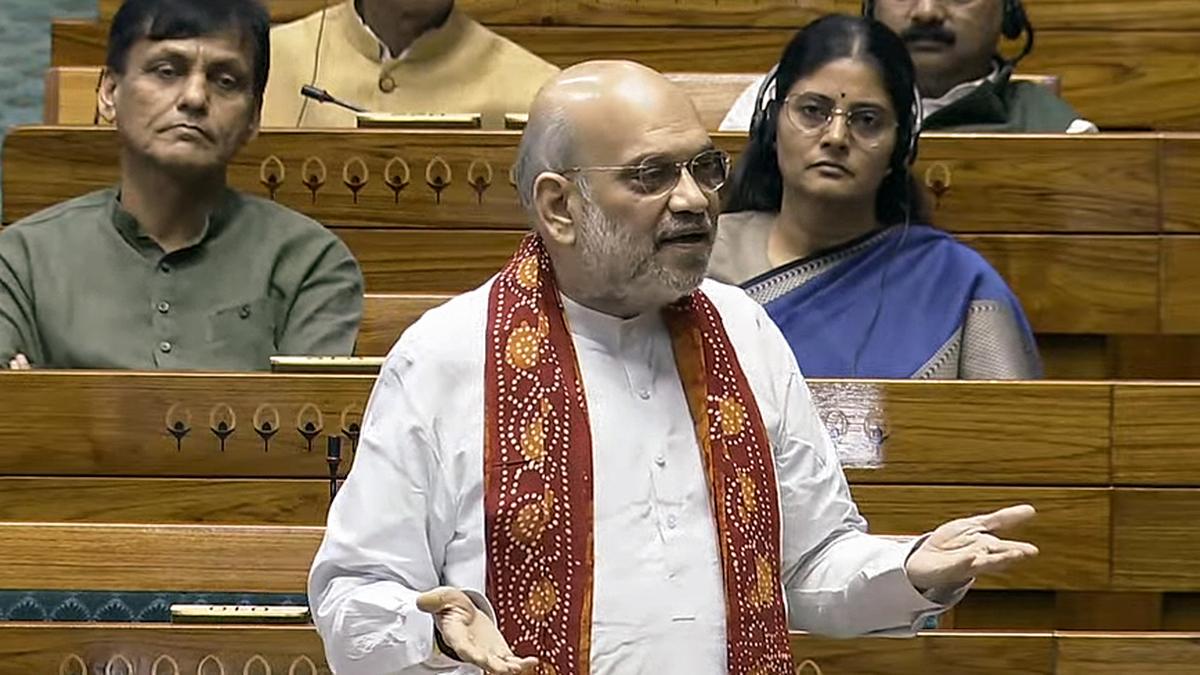
How accurate were Amit Shah’s claims of early warning to Kerala before Wayanad landslides?
The Hindu
A red alert for July 30 was issued in the IMD press release published at 1.10 p.m., after the landslides had occurred. This press release also carried an orange alert for Kerala and Mahe for July 31 and August 1.
Parliament on Wednesday took up a discussion on Wayanad landslide under a ‘calling attention’ motion. In his response, Union Home Minister Amit Shah made several claims on early warning systems in India and how they were utilised to alert the Kerala government ahead of the tragedy. The Hindu takes a closer look at these claims.
Read Wayanad landslides LIVE updates here
The India Meteorological Department (IMD) press release dated July 18 issued on outlook for a flash flood risk in northern parts of Kerala (among other places) until 11.30 a.m. of July 19.
The extended range forecast, also issued on the same day for July 18-31, carried no mention of Kerala for the period, however.
The IMD press release published on July 23 warned of “very heavy rainfall at isolated places” in Kerala and Mahe on July 25 (suggesting action), and heavy rainfall over isolated/some places in Kerala and Mahe from July 23-27.
The visual sub-division-wise weather warnings under this forecast carried an orange alert for the State of Kerala for July 25, and a yellow “watch” alert for July July 23, 24, 26, and 27. A yellow alert doesn’t specifically call for action.
The press release published on July 25 said that “scattered to fairly widespread light to moderate rainfall accompanied with thunderstorm and lightning [was] very likely over Kerala & Mahe (and other places) over the next five days”, and heavy rainfall very likely at isolated places over Kerala and Mahe from July 25-29. Visual warnings, as depicted on maps, also showed a yellow alert for Kerala, which doesn’t call for action.


Discover the Minor Planet Centre, the key hub for tracking and verifying observations of small solar system bodies.

Discover the Minor Planet Centre, the key hub for tracking and verifying observations of small solar system bodies.

In this week's Science for All newsletter, XX explains

Test your knowledge with the quiz on Science films at the Oscars through history

Set between the Siwalik hills and the plains, Butwal offers travellers a mix of regional cuisine, pilgrimage trails to Lumbini and the comfort of Hyatt’s new hospitality landmark

Explore 2026's wallpaper trends in India, highlighting botanicals and handmade designs that enhance modern homes with nature-inspired aesthetics.

Mercedes-Benz CLA 250+ with EQ Technology review: design, performance, range and features explained. Discover how the new electric CLA combines advanced AI, long range, fast charging and futuristic styling for the next generation of luxury EVs.

AI tool for sparrow conservation

BTS’s comeback with ‘Arirang’ marks a major global music event. When does the album release, and where can you watch their concert live stream? We have all the details

The 2026 U.S. cholesterol guidelines urge starting screening and treatment at 30 to prevent cardiovascular disease effectively.

Olam Festival 2026 in Thiruvananthapuram returns March 27-29 with 120+ vendors, music, art, and cultural zones.

A few storytellers in Thiruvananthapuram share their journeys, challenges, and evolving methods on World Storytelling Day, inspiring young minds.

76-year-old Kurian Jacob from Kerala triumphs with seven medals, including five golds, at the Open Masters Games in Abu Dhabi.