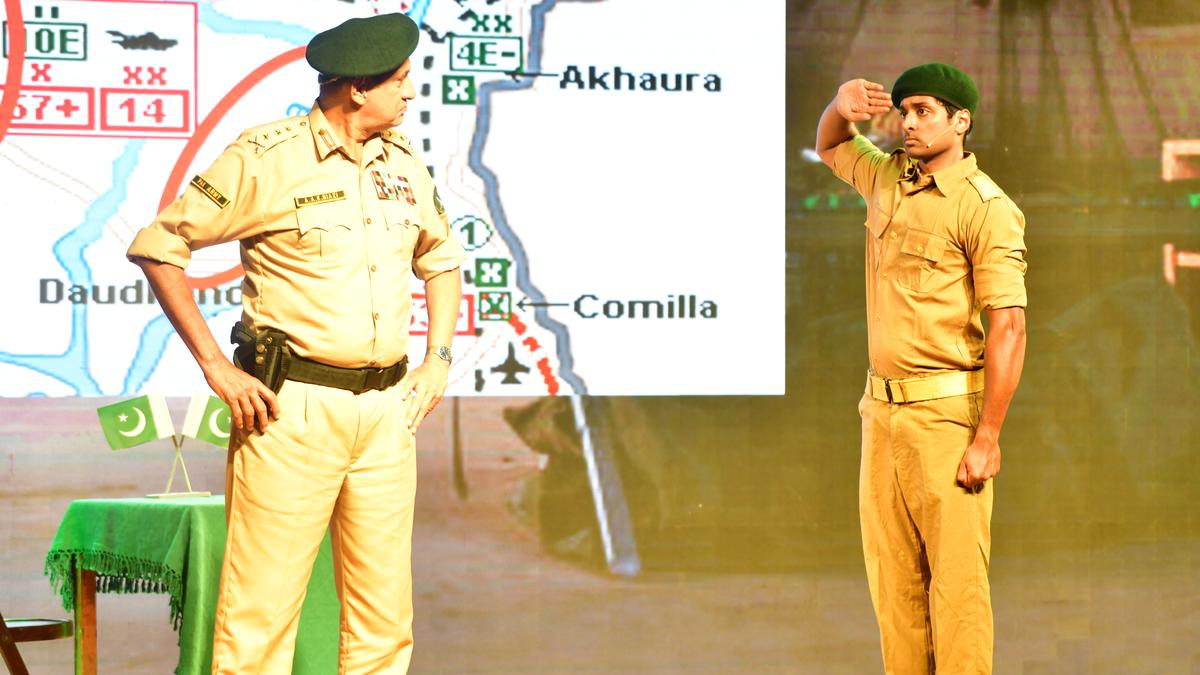
How a street play made it to the auditoriums
The Hindu
In 2021 when fifty years of the 1971 Indo-Pak war was being celebrated with a victory torch, Maj. Gen. M. Indrabalan (retd) figured out a way of keeping that flame alive beyond that celebration
An expert was once a hobbyist -- ask Maj. Gen. M. Indrabalan (retd). Towards the tail-end of his career in the army, theatre began to fascinate him. This fascination was not so much with the process of theatre as with its impact. The interest was not sparked watching a play, but a grand event, one that played out across the nation.
In 2021, the nation was celebrating 50 years of the 1971 Indo-Pak war, with a victory torch going through hands wielding the scepter in all the states of India. The media kept the flame alive.
When Indrabalan saw images of the victory torch doing a parade of the country, having been sent across to governors and chief ministers, he instinctively sensed there could be more to it. The flame of Indian pride could inflame more hearts, young hearts, if only it stayed alive beyond the news cycle. It was not long before he figured out theatre could do that trick. At that time, he was serving as Additional Director General of the National Cadet Corps in Bihar.
“I put together a 20-minute street play on the 1971 war with around 20 NCC cadets as actors. I trained them on how to enact the street play on streets. I asked them to go on a cycle tour of the districts of Bihar and in each district head quarters, they would have to stage the street play on the street. The street play became popular. That is when I realised that it had a potential to create awareness about the war among the masses,” observes Indrabalan, whose father, late Capt. K. Govindan (retd) from 17 Madras Regiment had taken part in the 1971 war.
He continues: “I got hold of a theatre company , a research lasting one full year followed, and we came up with a Hindi script. While it took us one year to write the script, it took almost another one year to stage the play, titled ‘Operation Vijay 1971’ at Patna (in August, 2023).”
Art and theatre group Surangan and non-profit, women’s empowerment organisation Gulmohar Maitri had been instrumental in the process of the play being made and staged.
The play began to travel to other parts of the country, including Chennai.


South African naturalist Steve Boyes speaks on ghost elephants, ancestral tracking, and Werner Herzog’s documentary exploring Angola’s elusive highland giants

Actor-director Amol Palekar will receive META's Lifetime Achievement award for 2026 on March 25 in New Delhi.

India's artists unite against rising censorship, advocating for creative freedom and support for marginalized voices in the arts.

Written and directed by Kunal, the film also stars Sparsh Shrivastava and Vanshika Dhir

This year, Bharatnatyam artistes will present the Tyagaraja Aradhane as a dance performance

This year, Bharatnatyam artistes will present the Tyagaraja Aradhane as a dance performance

The actor, along with director Sushant Shah, speak about their upcoming series ‘Chiraiya’, Divya’s process of working on the dialect, Sushant’s approach to telling a story about women, and more

An independent video, ‘Feel the Spark’ by Raleigh Rajan with vocals by Ciera Dumas that celebrates Tamil literary giants, garnered 1.4 million views in less than 36 hours.

In ‘Jack Ryan: Ghost War’, John Krasinski is back as the savvy CIA analyst, diving headfirst into a high-stakes mission that unravels a deadly conspiracy and pits him against a rogue black-ops unit

Shriram Bharatiya Kala Kendra’s Shankarlal festival showcased rare ragas, radiant artistry, and inclusive performances, from Pt Madhup Mudgal’s serene morning ragas to Ramana Balachandran’s Saraswati veena.

Explore "Threads that Bind: The Kantha Project," an exhibition in Delhi reimagining kantha as a medium of repair and renewal.

Sean Penn skips the Oscars to meet Ukraine's Zelenskyy, who praises him as a "true friend" amid the war.

The teaser of Tamil star Suriya’s much-awaited film with director Venky Atluri, titled Vishwanath and Sons, was unveiled by the makers on Monday