How a political and legal battle halted efforts to conserve Tiruvannamalai temple 25 years ago Premium
The Hindu
More than two decades ago, the Archaeological Survey of India proposed to declare the Arunachaleswara temple a “monument of national importance.” The proposal, however, was shelved after a row fomented by vested interests
The controversy surrounding the Subramaniya Swamy Temple at Thirupparankundram in Madurai has taken a new turn with a plea in the Supreme Court praying for the “takeover and control” of the temple by the Archaeological Survey of India (ASI). But, about 25 years ago, a well-intentioned initiative of the ASI to “take over and control” the Chola-period Arunachaleswara temple in Tiruvannamalai, about 200 km west of Chennai, ended in failure.
The Ancient Monuments and Archaeological Sites and Remains Act and Rules do not permit the ASI to take over or control any temple. At most, the agency can declare a temple a “monument of national importance” and designate areas near a protected monument as prohibited (up to 100 meters) or regulated (up to 200 meters) for the purposes of mining operations and construction.
Devotees at Arunachaleswara temple in Tiruvannamalai | Photo Credit: C. Venkatachalapathy
Perhaps without this basic understanding, a row was fomented by vested interests – both political and commercial – over the ASI’s move to declare the Arunachaleswara temple a “monument of national importance.” Subsequently, those who protested the Central agency’s decision succeeded in blocking the Tiruvannamalai temple from getting developed on the lines of the Vaishno Devi temple in Jammu and Kashmir.
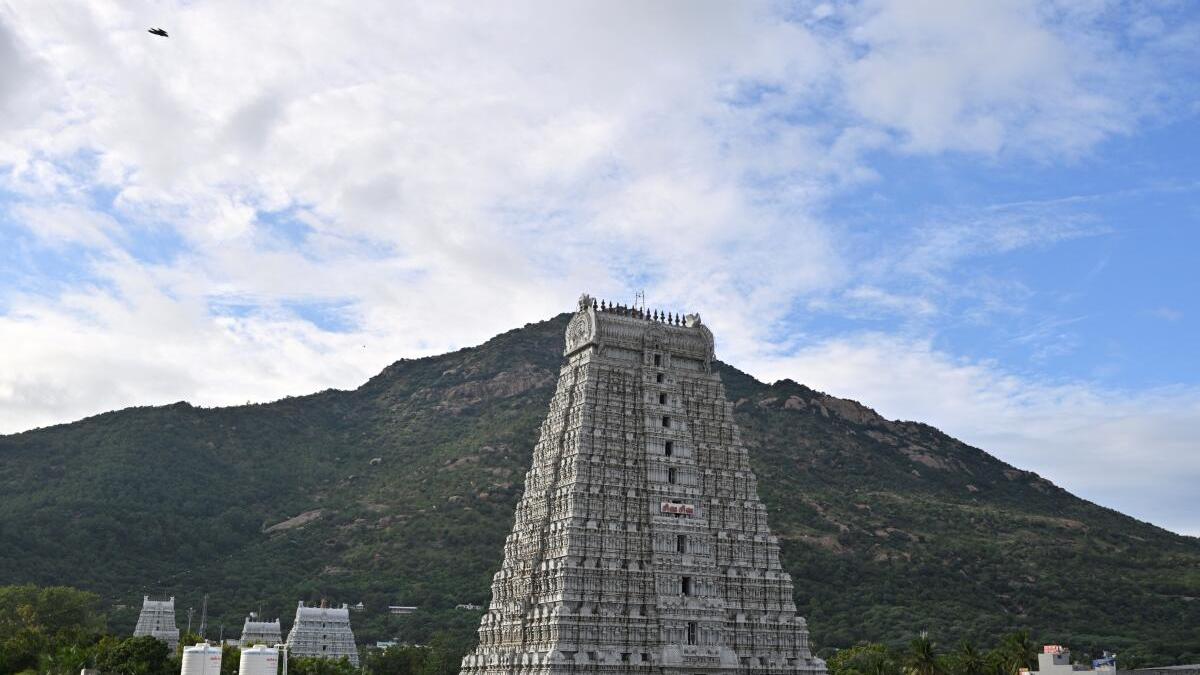
Situated at the foothills of a 2,668-foot-high hill, the Arunachaleshwara temple, spanning over a campus of 24.35 acres, is a fine illustration of Dravidian (South Indian) architecture and sculpture. According to inscriptions found there, the temple was built during the early Chola period (9th Century CE) and expanded during the periods of the later Chola, Hoysala, and Nayak kings. The temple has about 300 shrines that cover the Amman shrine; nine towers with four rajagopurams in four directions; many mandapams, including a 1,000-pillared one; and two huge tanks, the Sivaganga Punniya Theertham and the Brahma Theertham. Maintained by the Hindu Religious and Charitable Endowments Department of the State government, the temple had its last kumbabishekam in February 2017.
It all began in April 2002 when then Union Minister for Tourism and Culture Jagmohan visited the temple town. Though impressed by the beauty of several features of the temple – the architecture, sculpture, structural engineering, and art – he was disturbed by the sight of umpteen shops and encroachments in the vicinity of the temple.


A.P. DGP pays tribute to Potti Sriramulu on his 125th birth anniversary, honouring his sacrifice for a separate Andhra Pradesh.

Discover the cultural and health significance of neem and jaggery during Ugadi, explained by author Ratna Rajaiah.

A minor fire at Thiruvananthapuram government hospital led to patient evacuations; no casualties reported, situation now under control.

BJP reveals 144 candidates for Bengal Assembly polls, featuring Suvendu Adhikari contesting against Mamata Banerjee in Bhabanipur.

A look at Puducherry Assembly elections in 2021, highlighting the current CM N. Rangasamy and key ministers from AINRC and BJP.

Parliament Budget Session LIVE: Follow The Hindu's latest updates on the Parliament Budget Session on March 17, 2026.

Assembly Elections 2026 LIVE: Follow the latest updates on elections from across West Bengal, Tamil Nadu, Kerala, Assam and Puducherry.

Nvidia chief Jensen Huang on Monday said he expects the artificial intelligence chip powerhouse to bring in at least a trillion dollars in revenue through next year.

Political crossovers intensify in Kerala ahead of the 2026 Assembly elections, challenging traditional party loyalties and alliances.

Ten Lee Pharma employees were injured when their mini-bus overturned in Miyapur; all are in stable condition.

Discover how to turn creative passion into a sustainable business by mastering finance, IP, and strategic growth.

Arjun Krish and Ria Dinesh win Best Telefilm at Kerala State Television Awards for their impactful short film, F for Freedom.

redBus data reveals a significant 76% rise in solo women travelers from Karnataka since 2019, highlighting increasing independence in travel.