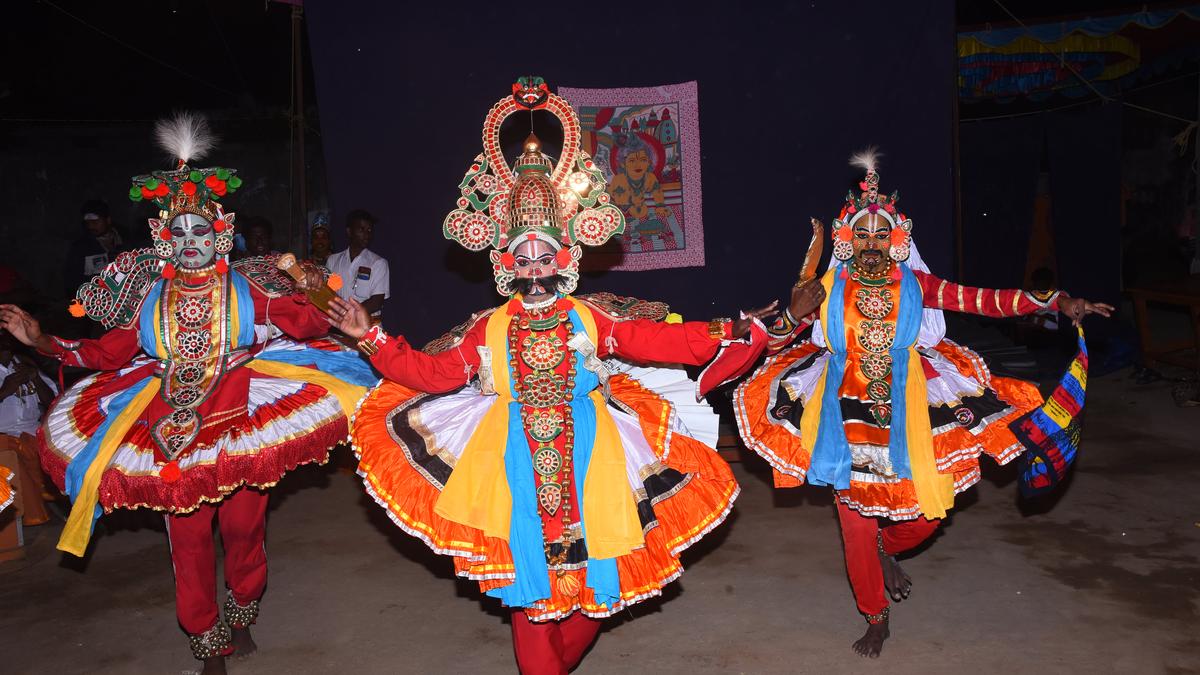
How a koothu performance proved to be a social leveller
The Hindu
Munnetram, a night-long koothu event and its social-cultural outcome
K. Velur village, Arcot taluk, Ranipet district, recently bustled with youthful energy, kindred spirits and pride. The stage near the Uthiragiri Amman temple in the village, with two statues dedicated to Kalavai Ponnusami and Tamil scholar Prof. M. Varadarasan, speaks of the village’s long-term involvement in their heritage of Koothu and Tamil.
The village hosted the Munnetram (Progress) project of Kattaikkuttu training programme in three villages in the surrounding area, sharing the shortened versions of their new koothu along with Carnatic music (Ashwath and team), Bharatanatyam (Sangeeta Isvaran and Mookambikai trained girls of Katradi Centre in Kalavai village) and multiple folk forms (Nanbarkal team from Chennai). The overnight event began at 9 p.m. and lasted till 6.30 a.m. The project was led by Thilagavathi Palani.
Overnight Koothu performances are not new in Northern Tamil Nadu. But the presence of a young audience through the night, the performances of urban and rural groups, the mixing of classical and folk forms and the inclusive caste and gender dynamics were certainly refreshing.
Though we think that breaking the fault lines of the urban-rural divide in the performing arts in Tamil Nadu is a recent phenomenon, it actually has its own unique history.
When culture in India is becoming homogenised, the home-grown artistes’ growing desire to critically engage with their art forms is heartening. This engagement has been crucial in bringing about change in the contemporary context — of being rooted yet accessible.
Village leader Nandakumar was happy that a Carnatic music concert was staged for the first time there. While the mangalavadhyam (nagaswaram and thavil, three of each) featured a female artiste, the North Chennai-based Nanbarkal group led by Deepan included school and college students and employed people; they performed Parai, Silambam, Karagam, Poikkaalkuthirai and Mayilattam.
Deepan shared how these art forms were livelihood options and skills to entertain and create awareness for members of the group.


In Surendranagar, Gujarat, where only a handful of families continue to practise tangaliya weaving, we visit artisanal communities working with brands like Jaypore to revive the intricate craft for contemporary wardrobes

Madras High Court allows police to arrest YouTuber 'Savukku' Shankar if needed, dismissing claims of solitary confinement.

Lula leads Brazil's largest-ever business delegation to India, aiming for trade deals and global governance reforms amidst geopolitical challenges.

AIADMK reveals its first candidate list for Tamil Nadu Assembly election, featuring familiar names and few surprises.

A study reveals antibiotic resistance causes 87% of India's typhoid economic burden, significantly impacting children and families.

How Dikshitar was inspired by Vaduvur Rama to come up with a composition in a raganga raga

Lok Sabha passes Finance Bill 2026 with amendments, completing its budgetary approval before Rajya Sabha's consideration.

Karnataka government to consult legal experts on pursuing action against Adani Group's ACC Ltd. over ₹850 crore in disputed dues.

The FCRA amendment bill aims to create an authority for managing NGO assets after license loss, addressing misuse of foreign funds.

Telangana Minister assures adequate petroleum stocks for three months, warns against illegal fuel carrying amid panic buying rumors.

TMC calls for the removal of Bhabanipur returning officer, citing alleged ties to BJP and concerns over neutrality.

Kerala CM Pinarayi Vijayan condemns UDF's misogynistic attacks on CPI(M) legislator U. Prathibha, highlighting political degeneration.

Selected from 9,400 submissions across 37 countries, the 100 photographs on display traverse intimate and political terrains. In MRC Nagar, photographer Swastik Pal captures life in the Sundarbans, where severe climate change has brought humans and wildlife into closer contact. Shane Hynan’s Beneath Beofhod reflects on Ireland’s boglands as sites of memory and restoration, while Mateo Trevisan’s More than the Sun examines the impact of coal-driven industrialisation in the Western Balkans.