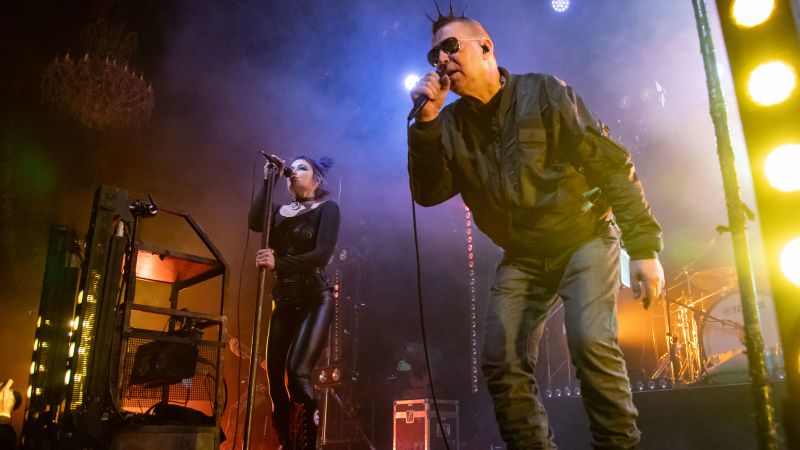
How a European industrial rock band opposed to violence got tied to school shootings in America
CNN
Searing guitar riffs, primal live drums, and pulsing electronic textures collide with impassioned vocals in a raw, unrelenting fusion to create a chaotic yet precise sonic storm that blurs the lines between human aggression and mechanical force.
Searing guitar riffs, primal drums, and electronic textures collide with impassioned vocals to create a chaotic yet precise sonic storm that blurs the lines between human aggression and mechanical force. That’s industrial rock, and for fans of German band KMFDM, it is the sweet spot between the freedom to express individuality and rebelling against a system of political corruption and injustice. But in 1999, when the band’s lyrics were cited by the perpetrators of the Columbine High School massacre in Colorado, which resulted in 13 deaths, their message of resistance was suddenly eclipsed by the violence they had long condemned. In January, a song by the band was featured in a TikTok video posted moments before a 17-year-old unleashed gunfire at Iowa’s Perry High School, killing two and wounding others. And now, the band has once again been thrust into the spotlight by photos of 15-year-old freshman Natalie Rupnow, who on Monday killed a teacher and student at her private school in Madison, Wisconsin. The images show her wearing a black KMFDM band shirt while at a shooting range. KMFDM issued a statement condemning the Columbine massacre, expressing sympathy for the victims and explaining its music was intended to stand against violence.


More than two weeks after the stunning US raid on Caracas that led to the capture of Nicolás Maduro, the political confrontation over the future of Venezuela is rapidly coalescing around two leaders, both women, who represent different visions for their country: the acting president, Delcy Rodríguez, who stands for continuity, and opposition leader María Corina Machado, who seeks the restoration of democracy.

President Donald Trump is one day away from the one-year mark of his second term. Over the past week, CNN has rolled out a series of poll findings on where Americans stand on his performance so far.

Democrats are kicking off the process of setting their 2028 presidential primary calendar this month, after 12 states submitted applications to lead the process.

Would Zohran Mamdani compromise?

Few Americans are satisfied with the amount of evidence released in the Jeffrey Epstein case, a CNN poll conducted by SSRS finds, with most saying they believe the government is intentionally holding back information.

Trump has been back in the White House for a year now, and his standing — more than anything else — will define the mood and the direction of the midterm campaign. Ebersole scores his performance at a 3 out of 5. The economy feels a little better to her, and illegal border crossings are down.

Demonstrators are continuing to brave frigid temperatures in Minneapolis to protest the Trump administration’s immigration crackdown. Follow for live updates.

Speaker Mike Johnson is actively working to unite his conference behind another Republican-only policy bill ahead of the midterms, with members clamoring for more wins and eager not waste what they fear could be the waning days of their majority.

Last year, the court said the Fed is shielded from political manipulation because it is “uniquely structured” with a “distinct historical tradition.”

President Trump says he can pull funding for sanctuary cities. Judges have repeatedly said otherwise
Trump’s threat is a broader version of one his administration has made many times already, attempting to cut funding to local governments it declared as “sanctuary jurisdictions,” but those efforts have been stopped repeatedly by judges.

The US Department of Justice said Sunday it is investigating a group of protesters in Minnesota who disrupted services at a church where a local official with US Immigration and Customs Enforcement apparently serves as a pastor.

A number of forces on the left questioned Josh Shapiro’s ties to Israel during Kamala Harris’ rushed running mate selection process in 2024. In his new memoir out next week, the Pennsylvania governor says the former vice president and her vetting team were among them.

Dr. Martin Luther King Jr.’s “I Have a Dream” address at 1963’s March on Washington is perhaps the most famous speech in American history. But fewer people remember the man behind King’s dream metaphor: a White banker named James Truslow Adams.