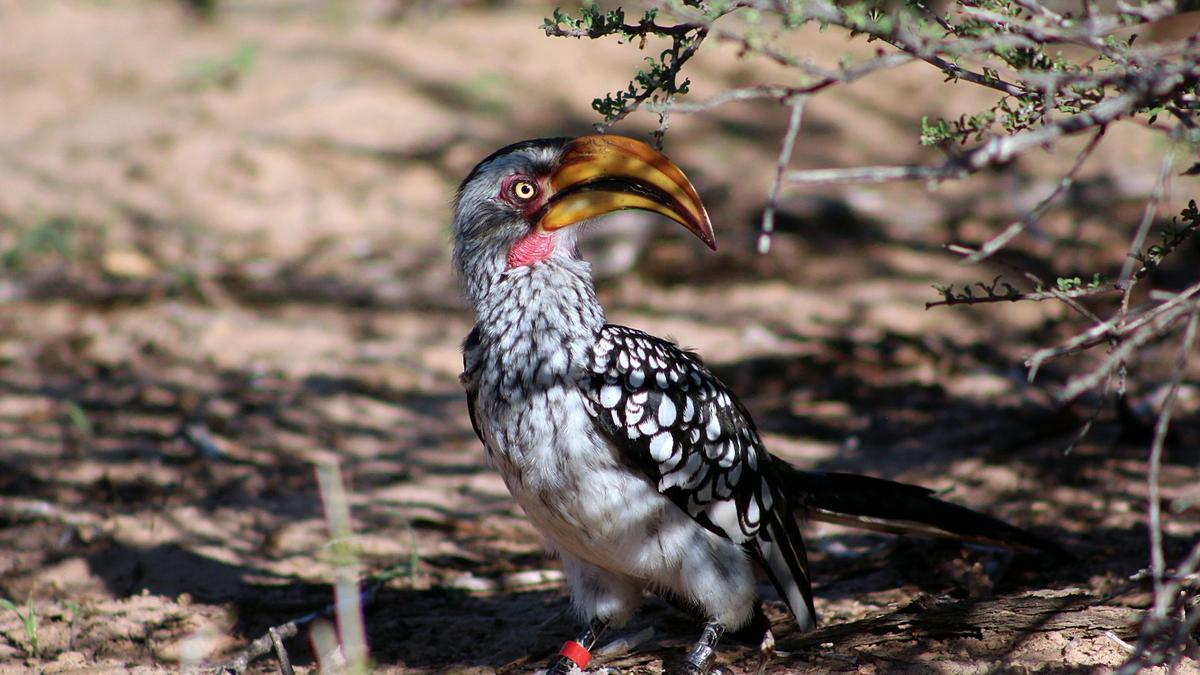
Hotter Kalahari desert may stop hornbills breeding by 2027
The Hindu
Rapid climate change negatively impacts hornbills’ breeding success in the Kalahari desert, highlighting the urgent need for mitigation.
Rapid climate change has the potential to strongly influence the physiology, behaviour and breeding success of animals. Research is showing that increasing temperatures, for instance, are having negative effects on animals. These range from mass die-off events during heat waves to less obvious problems like difficulty finding food.
For birds in arid zones, rising temperatures pose a significant problem. Birds in these dry zones usually breed in response to rainfall, which often occurs during the hottest time of the year. And birds are mostly active during the day, when they are exposed to the sun’s heat. This is when their vital processes for reproduction take place – such as territorial defence, courtship, finding food for their young and attending the nest.
Research suggests that high temperatures over a few days or weeks can have negative effects on foraging and body mass. At the scale of one or two breeding seasons, these effects have a negative impact on breeding performance. This can be through reducing the condition of offspring or the probability that young birds will survive to adulthood and breed.
The longer-term effects of responses to high temperatures – over decades – are less well-known.
Our recent research aimed to help bridge this gap in knowledge. We assessed the effects of air temperature and drought on the breeding output of southern yellow-billed hornbills (Tockus leucomelas) in southern Africa’s Kalahari Desert over a decade period, from 2008 to 2019.
We found that the breeding output of our study population collapsed during the monitoring period and was strongly correlated with temperature and rainfall. In the Kalahari, air temperatures have already risen more than 2°C in a few decades. At this rate, by 2027, these birds will not breed at all at this site.
First we examined air temperature and rainfall data from the South African Weather Service for the Kalahari region between 1960 and 2020. The frequency and severity of drought have not changed but spring and summer average daily maximum air temperatures have been increasing. They have risen from about 34°C to well over 36°C from the mid 1990s to the present day. This equates to a warming rate of about 1°C per decade, a rate five times faster than the worldwide average of about 0.2°C per decade.


Discover the Minor Planet Centre, the key hub for tracking and verifying observations of small solar system bodies.

Discover the Minor Planet Centre, the key hub for tracking and verifying observations of small solar system bodies.

In this week's Science for All newsletter, XX explains

Test your knowledge with the quiz on Science films at the Oscars through history

Set between the Siwalik hills and the plains, Butwal offers travellers a mix of regional cuisine, pilgrimage trails to Lumbini and the comfort of Hyatt’s new hospitality landmark

Explore 2026's wallpaper trends in India, highlighting botanicals and handmade designs that enhance modern homes with nature-inspired aesthetics.

Mercedes-Benz CLA 250+ with EQ Technology review: design, performance, range and features explained. Discover how the new electric CLA combines advanced AI, long range, fast charging and futuristic styling for the next generation of luxury EVs.

AI tool for sparrow conservation

BTS’s comeback with ‘Arirang’ marks a major global music event. When does the album release, and where can you watch their concert live stream? We have all the details

The 2026 U.S. cholesterol guidelines urge starting screening and treatment at 30 to prevent cardiovascular disease effectively.

Olam Festival 2026 in Thiruvananthapuram returns March 27-29 with 120+ vendors, music, art, and cultural zones.

A few storytellers in Thiruvananthapuram share their journeys, challenges, and evolving methods on World Storytelling Day, inspiring young minds.

76-year-old Kurian Jacob from Kerala triumphs with seven medals, including five golds, at the Open Masters Games in Abu Dhabi.