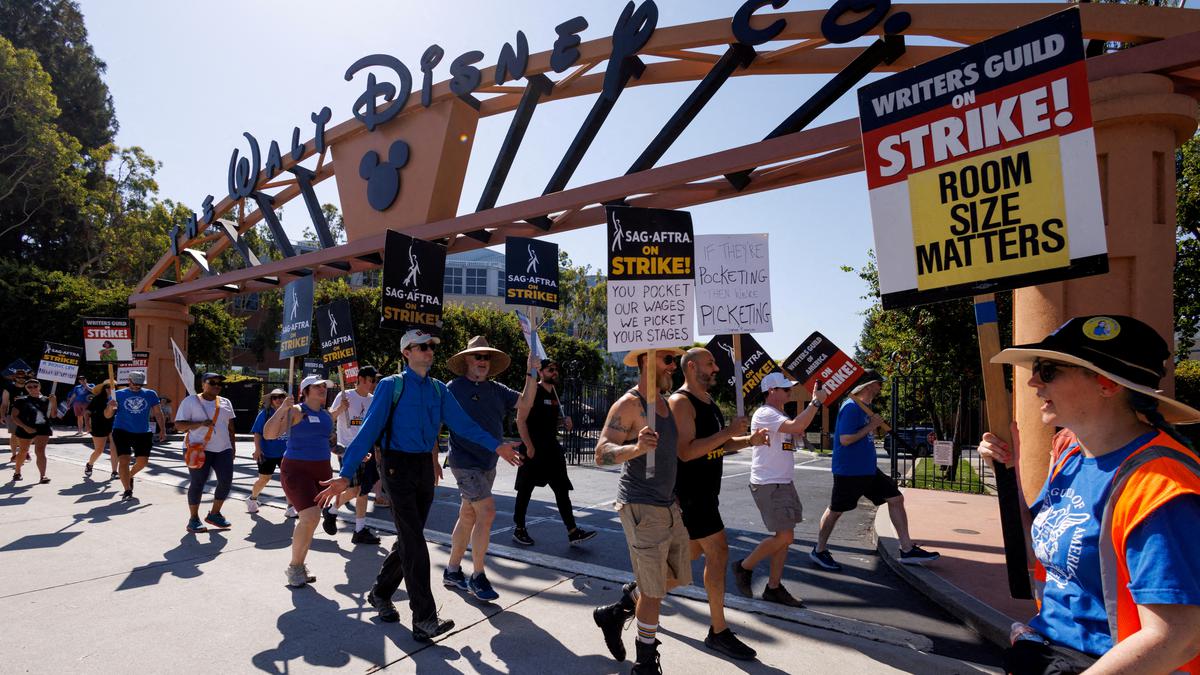
Hollywood Strike | Writers' deal may set a template for talks with striking actors
The Hindu
The Writers Guild of America (WGA), which went on strike May 2, reached a tentative deal with studios Sunday
The tentative deal Hollywood writers reached with the major studios and streaming services could serve as a template for actors, who have been on strike since mid-July. Writers and actors share common concerns, including the desire for higher pay and for curbs on the use of artificial intelligence (AI) in entertainment.
The Writers Guild of America (WGA), which went on strike May 2, reached a tentative deal with studios Sunday. It calls for improved minimum pay, increased streaming residuals and assurances that AI cannot be used to undermine a writer's credit. That agreement generated optimism among striking actors that they may soon settle their differences with the studios.
"I hear it's an exceptional deal and historically, whatever deal they give to one union, the next union uses as a template for their own deal," writer and actor Mel Shimkovitz said on Tuesday while picketing outside Netflix.
The WGA said writers could return to work on Wednesday ahead of their final vote to ratify the contract. That means talk shows can return to air and writing can resume, but filming cannot re-start until the actors reach a labor deal.
Negotiators for the SAG-AFTRA actors' union have not held talks with the Alliance of Motion Picture and Television Producers (AMPTP), which represents Walt Disney, Netflix and other studios, since this summer. Entertainment industry executives expressed the hope that negotiations would resume as soon as next week.
"SAG should not take long, I'll tell you that," said one studio executive after the writers' agreement. They requested anonymity because of the sensitivity of labor negotiations.
Performers want to protect their images and work from being replaced by "digital replicas" generated with AI. As with writers, actors are looking for compensation that reflects the value they bring to streaming, specifically, in the form of revenue sharing.


In ‘Jack Ryan: Ghost War’, John Krasinski is back as the savvy CIA analyst, diving headfirst into a high-stakes mission that unravels a deadly conspiracy and pits him against a rogue black-ops unit

Shriram Bharatiya Kala Kendra’s Shankarlal festival showcased rare ragas, radiant artistry, and inclusive performances, from Pt Madhup Mudgal’s serene morning ragas to Ramana Balachandran’s Saraswati veena.

Explore "Threads that Bind: The Kantha Project," an exhibition in Delhi reimagining kantha as a medium of repair and renewal.

Sean Penn skips the Oscars to meet Ukraine's Zelenskyy, who praises him as a "true friend" amid the war.

The teaser of Tamil star Suriya’s much-awaited film with director Venky Atluri, titled Vishwanath and Sons, was unveiled by the makers on Monday

A 'Golden' moment for a K-pop track at the Oscars.

Parvathi Nayar’s new exhibition, The Primordial, in Mumbai, traces oceans, pepper and climate change
Opened on March 12, the exhibition marks the artist’s first solo show in Mumbai in nearly two decades. Known for her intricate graphite drawings and multidisciplinary practice spanning installation, photography, video, and climate change, her artistic journey has long engaged with the themes of ecology, climate change and the natural world. In this ongoing exhibition, these strands converge through a series of works centred on water, salt, and pepper — materials that carry natural and historic weight across centuries.

Explore the highlights and key winners of the 98th Academy Awards, featuring memorable moments and historic achievements from Oscars 2026.

Spring season celebrated at Ramakrishna Mission Institute, Kolkata, with ‘Evening of Basant’

The Spirit of the Land, a solo show by artist Shivakumar Sunagar, is a vista of Nature-inspired emotions

Tal Fry is all set for an exciting new performance season

Netflix is making a bold move by snagging InterPositive, the AI filmmaking company founded by Ben Affleck, in a deal that could hit $600 million

Watch the eerie trailer for 'Hokum,' where Adam Scott faces a witch haunting in a mysterious Irish inn.