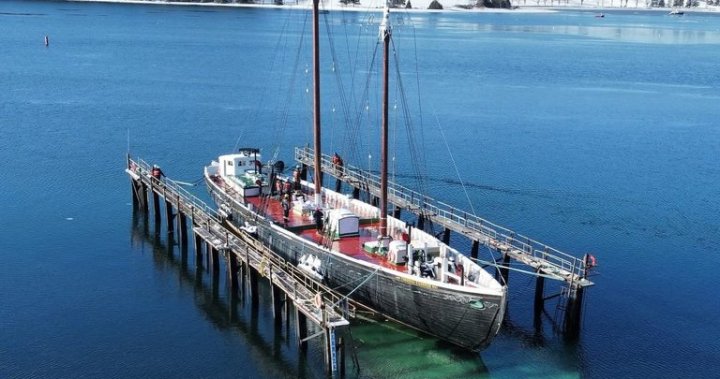
Historic Grand Banks schooner’s future being assessed at Lunenburg, N.S., shipyard
Global News
An assessment has been ordered to determine the options for a historic schooner that's been berthed at the site of the Fisheries Museum of the Atlantic in Lunenburg, N.S.
An assessment has been ordered to determine the options for a historic schooner that’s been berthed at the site of the Fisheries Museum of the Atlantic in Lunenburg, N.S.
The 85-year-old Theresa E. Connor is being described by the province’s Department of Communities, Culture, Tourism and Heritage as “showing signs of wear,” and having “some structural concerns.”
Department spokesman Rob Maguire said Monday the vessel was moved from its spot by the waterfront museum and taken to the Lunenburg Shipyard and hoisted onto a dry dock in February.
The vessel — which has been part of the museum since 1967 — has undergone regular repairs every three to four years, but the spokesman says on this occasion it will “be undergoing a full assessment” to help determine its options.
“This will help us better understand the vessel’s condition and what work may be required,” he wrote in an email.
“We know how important the Theresa E. Connor is to the Lunenburg community and to the many Nova Scotians and visitors who’ve experienced the vessel as part of the Fisheries Museum of the Atlantic. That’s why we’re working closely with our colleagues at the museum and with the Department of Public Works to ensure the schooner is preserved in a way that honours its cultural and historical significance,” he said.
According to museum records, Theresa E. Connor is one of Canada’s oldest schooners, and the last to dory fish the Grand Banks out of the port of Lunenburg.
Built in 1938 at Smith and Rhuland Shipyard, it is one of only two remaining fishing schooners constructed by the shipbuilding firm, which constructed Bluenose and the majority of Lunenburg’s early 20th century fishing fleet.


Two days after the first day of spring, parts of Atlantic Canada and Quebec will see another blast of winter with Environment Canada forecasting several centimetres of snow.

UNESCO recognized several Maritime historical groups including the executive director of the Black Loyalist Heritage Centre for their work on the Black Loyalist archive.

Aid shipments are beginning to arrive in Cuba and a Russian oil delivery is expected this month, but fuel shortages remain critical.

Tensions flared as CAQ leadership rivals clashed over Quebec’s “third link” project in the first debate to replace Premier François Legault.

Toronto police have charged a 60-year-old man with second-degree murder in connection with the death of Xian Wei Shao, whose remains were discovered in a north end home last week.

Finance Minister François-Philippe Champagne says the government has found ways to cut spending by $60 billion but cautions that published spending cuts require important context.

Three Canadians from Quebec who were stranded in the Persian Gulf since Feb. 28 have returned home following a coordinated repatriation effort.

Federal departments announced that they plan to cut more than 12,000 jobs over three years as part of the Carney government’s spending review plan.

Canada’s Integrated Threat Assessment Centre says the U.S.-Israeli war against Iran has heightened an already present threat against Jewish Canadians and public officials.

Edward Warner, his wife Tania and his seven-year-old step-daughter Ayla were coming back from a friend's baby shower on Saturday when they went through an ICE checkpoint in Sarita.

A fire chief from a village that battled flames during Saskatchewan's destructive wildfire season last year says the province's latest budget does not provide enough funding.

Manitoba’s upcoming budget will include more child care funding and a smaller deficit, as the NDP government aims to balance finances by 2027.

A member of the Royal Canadian Air Force in Winnipeg has just been crowned the World's Strongest Firefighter, outlifting athletes from around the world.