High fish mortality rates possible after record-breaking B.C. floods
Global News
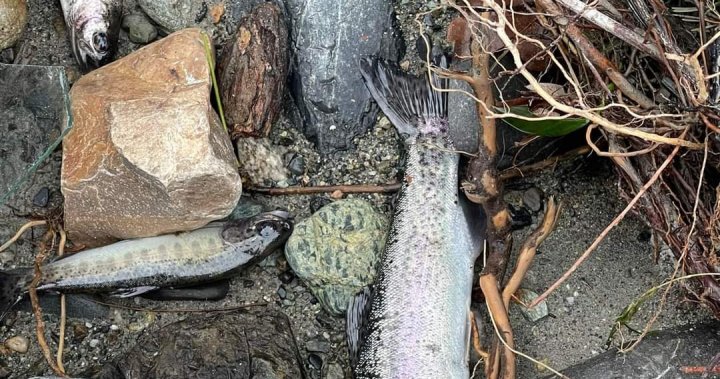
Pacific salmon are at particular risk as fast-moving flood water can displace eggs laid in the fall and expose them to hungry predators.
Several species of fish could suffer high mortality rates as a result of catastrophic flooding in southern B.C. last week, warn some experts and observers.
Pink salmon are at particular risk, said biologist Marvin Roseneau, as they spawn at the main stems of the now-swollen Fraser and Vedder/Chilliwack rivers.
Most of their eggs were laid in the fall and hidden in the gravel to incubate until spring hatching.
“The floods would have scoured the gravel out almost certainly,” he explained.
“Once the embryos are washed out of the gravel, predators eat them, they get smothered — it’s over for them.”
Roseneau, who teaches fish ecology and management at the BCIT, said Chinook, coho and steelhead salmon may be impacted to a lesser extent as well.
“We will quantify it a year and a half from now when the adults come back. We’ll see whether or not those runs have absolutely collapsed as a function of this event.”
He estimated salmon mortality rates in the low millions for juveniles and the billions for embryos, while clarifying that not all fish and eggs would have survived anyway, due to other natural causes.


It was both a big win and hopefully not too big of a loss for the Edmonton Oilers on Sunday.

Some experts say that a cyberwar through 'proxies' may be the next stage of the Iran war, with civilian infrastructure also coming under threat.

The study is being billed by the university as "the first to study a wide range of factors which link ADHD symptoms and mental ill health symptoms over time."

The group says MAGA Energy hasn't paid its lease for three years, and therefore the company is no longer allowed on their land in Edmonton.

The analysis by the Canadian Climate Institute says oilsands producers will pay an average of about 50 cents per oil barrel, if the minimum carbon price rises to $130 per tonne.

Between November 29 and February 27, authorities recorded 406 outbreaks of bird flu in domestic birds in 32 European countries and 2,108 outbreaks in wild birds, they said.

Dr. Michael Domeier, director of the Marine Conservation Science Institute, told Global News that they tag the adult females as they are the most interesting.

Regina’s recycling contamination is currently triple the limit and city is urging resident to change sorting habits now to avoid citywide fines and higher resident fees.

The study found that higher ultra-processed food intake at age three years was associated with adverse behavioural and emotional symptoms at age five years.

Edmonton's single-use waste rules were controversial and unpopular when introduced in 2023 — but new data shows the changes are having the intended effect of reducing garbage.

Carney's speech to Australia's parliament highlighted a soon-to-launch Canadian low earth orbit satellite network that experts say could soon compete with Elon Musk's Starlink.

The Pentagon said in a statement Thursday that it has “officially informed Anthropic leadership the company and its products are deemed a supply chain risk, effective immediately.”

Opioid overdose deaths in Canada are falling, but there's growing concerns on a certain veterinary tranquilizer being cut into fentanyl and other opioids.