Hey Bridgerton, why upper-caste Hindu Kate Sharma and not a Dalit woman as lead in 2022?
India Today
No, not that we expected Bridgerton S2 to now be our white saviour, as if Brahmin saviours were not enough. But Bridgerton could have been inclusive in the true sense, not just for the sake of it. Why not a Dalit or tribal woman in place of a Hindu upper-caste woman, Bridgerton? Why not Sapui instead of Sharma?
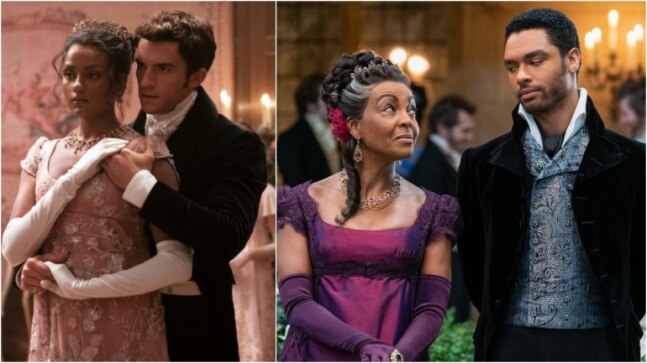
The regency drama Bridgerton challenged race stereotypes in its first season. And what a statement it was! In-your-face, bold and warmly inclusive. The Netflix-backed series gave us a Black Duke, the Duke of Hastings (Regé-Jean Page), as the lead, and more importantly, put a Black Queen, Queen Charlotte (Golda Rosheuvel), in charge of London society. It gave us an alternate historical universe in a story that's set in an era of white supremacy. And it was lauded for it. In the second season, Bridgerton gives us Kate Sharma, a female lead of Indian descent. Another statement, right on the lines of Season 1, no? No. Not quite.
Netflix released eight stills of the upcoming season on Twitter recently and had fans gushing on the micro-blogging site. You could picture Jonah Hill's now-memed OMG-OMG-OMG expression with every retweet and share on that. Yes, fans are excited. Indian fans, much more. For this time, we have Desi Girl Kate Sharma at the centre. Sex Education star Simone Ashley will be seen as Kate Sharma, Anthony Bridgerton's (Jonathan Bailey) new love interest. Kate Sharma, of course, has been re-imagined and is based on Kate Sheffield from Julia Quinn's second Bridgerton novel, The Viscount Who Loved Me. So, yeah, it ticks all the boxes on the surface - Indian representation: Check. Challenge race once again: Check. Be woke: Check. But what about caste? That's a concept still alien in this alternate historical universe.
Welcome back to Bridgerton — here is your first look at Season 2 pic.twitter.com/Fx44Cf5NSs
Bridgerton Season 2 premieres March 25 pic.twitter.com/pb8VEcjtSK
Sharma is a Brahmin Hindu surname, Google will tell you. A slightly closer look will show it is prevalent only in northern India. Some more research would reveal that that itself is non-inclusive. Because India isn't one colour or caste, it is a bouquet, where roses already get most of the attention, leaving little for the lilies. Brahmin supremacy, anyone?
Wavering a little from Bridgerton here, isn't Pushpa's success and the collective 'haww' around it proof of that? Behind every Pushpa-breaks-box-office-records is a sly how? How did a Telugu film beat masala Hindi films in, well, masala? To date, we fight phrases like 'he is a South Indian' as if, somewhere deep down, everything outside of the Hindi heartland is one mashed up pulp without individual identities.


Short kurtas paired with loose pants and dupattas were a big trend in the 2000s Bollywood, and now, they seem to be catching on in the West too.

Pinterest CEO Bill Ready wants governments to ban social media for teenagers under 16, saying current platforms are harming young people's mental health and development.

Delhi is strengthening its push for UPSC success by recognising top achievers and improving support for aspirants. In a first-of-its-kind initiative, the government engaged directly with successful candidates to understand their preparation journey.

Paul McCartney's last solo album, McCartney III (2020), recorded during the pandemic, topped UK charts, marking his first solo number one since 1989, showcasing his creative freedom and personal musical expression.

ICAI CA Final January 2026 results have been declared today, March 1. Candidates who appeared for Group 1 and Group 2 exams can now check their scorecards, merit list and All India Rank holders on the official website, icai.nic.in. Direct result link is now active.

Pinterest CEO Bill Ready wants governments to ban social media for teenagers under 16, saying current platforms are harming young people's mental health and development.

Reddit is exploring biometric verification methods such as Face ID and Touch ID to ensure users are real humans, not bots, while pledging to maintain the platform's tradition of anonymity. CEO Steve Huffman said the company is planning to address the rising influence of AI-generated content and protect authentic user engagement.

Delhi is strengthening its push for UPSC success by recognising top achievers and improving support for aspirants. In a first-of-its-kind initiative, the government engaged directly with successful candidates to understand their preparation journey.

WhatsApp is reportedly working on a new privacy feature that will allow messages to automatically disappear shortly after being read. The upcoming feature, called "After reading," is expected to give users more control over their conversations, especially when sharing sensitive information.

RBSE Class 10 Result 2026 is expected to be declared soon, with students eagerly awaiting the official announcement date and time. The Rajasthan Board 10th result will be available online, making it important for students to stay updated on where and how to check their scores quickly.

In a push towards more inclusive school environments, the Central Board of Secondary Education has rolled out fresh directives on menstrual hygiene across its affiliated institutions. The move comes after a landmark ruling by the Supreme Court of India that places menstrual health within the framework of fundamental rights.

Tata Motors has introduced a more affordable dual-motor QWD variant of the Tata Harrier.ev, bringing all-wheel drive capability and strong performance to a wider audience at a lower entry price.