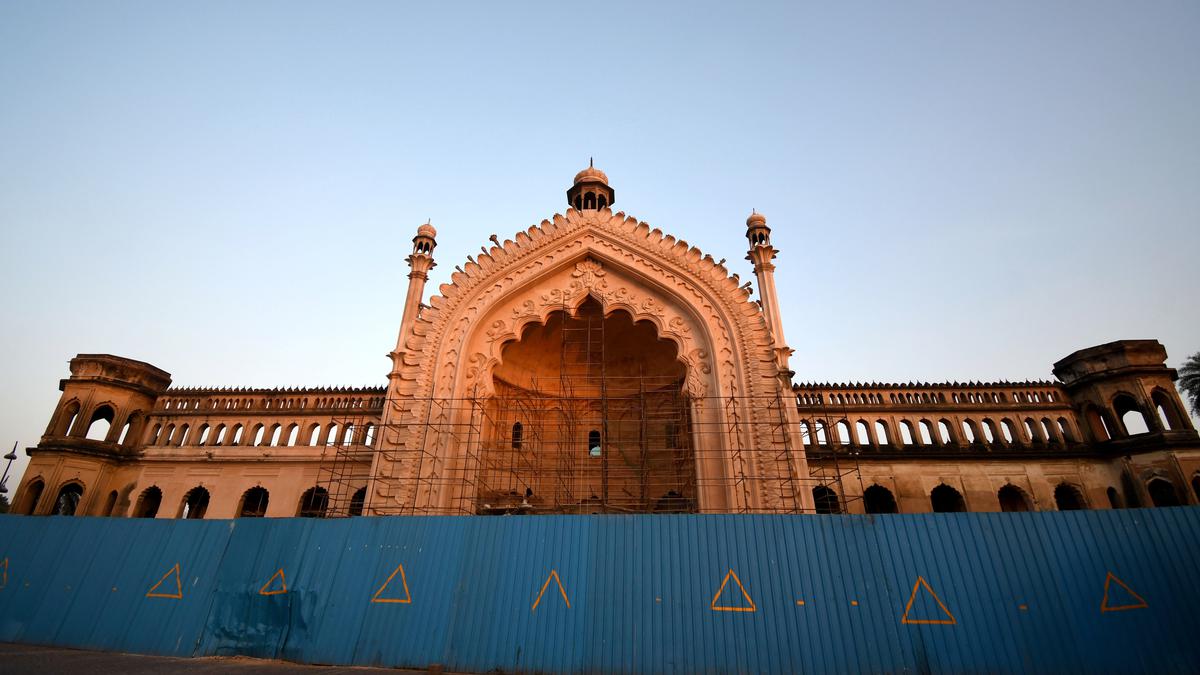
Heritage in crisis: Lucknow’s monuments cry for attention
The Hindu
Lucknow lawyer and heritage enthusiast, Syed Mohammad Haider Rizvi, fights against encroachments on heritage sites in Lucknow.
Syed Mohammad Haider Rizvi, 50, believes heritage sites are a collective legacy. A lawyer and heritage enthusiast, Mr. Rizvi was momentarily jubilant when the Lucknow Bench of the Uttar Pradesh High Court on February 7 once again directed authorities to convene a meeting of the committee constituted in 2013 by the High Court, to identify and take action against encroachments in monuments in Lucknow.
“The Court had asked the authorities to remove encroachments from centrally protected heritage sites, but the administration did little,” said Mr. Rizvi. The committee has met only 13 times over the past decade.
Up to 60 protected monuments in Lucknow have been declared to be of national importance under the Ancient Monuments and Archaeological Sites and Remains Act, 1958, by the Archaeological Survey of India (ASI). Mr. Rizvi said that most of these structures, built during the Nawab era (17th to 19th centuries), have been encroached upon in the last few decades.
Authorities, both at the Centre and in the State, had failed to take any concrete step to remove intrusions, he alleged. “Despite numerous petitions and public interest litigations (PILs), encroachment still exists at Chattar Manzil, the Kazmain buildings, Rumi Darwaza, Bada Imambara, Chota Imambara, among other heritage sites,” said Mr. Rizvi.
However, ASI’s Superintending Archaeologist in Lucknow, Aftab Hussain, said: “We issue notice to encroachers and approach the local administration for taking legal action wherever information of encroachment is found correct. We have issued notices to more than 1,100 people in Lucknow alone, and many encroachments have been removed.”
The ground reality is different. Lucknow’s iconic Bada Imambara, constructed in the late 18th century, has people living within the complex. Declared a protected monument by the ASI in 1920, it also houses a large Asfi mosque and a bhul-bhulaiya (labyrinth). It was built during a devastating famine by Awadh Nawab Asaf-ud-Daula, who aimed at providing employment to people reeling under poverty and hunger at the time.
The Ministry of Culture did a recent assessment of the Kazmain buildings, built mirroring a similar structure in Iraq, considered sacred to Shia Muslims. “The monument shows signs of rising dampness in the external façade on all sides along the plinth level,” reads the report published in October 2023. It goes to on to note “structural cracks at the lintel level”, “water seepage…at the ceiling which further led to deterioration of wooden roof structural members”, and “missing copper panels [from the dome]”.


The government plans to amend the FCRA, introducing new regulations for NGO asset management and accountability for key functionaries.

The draft policy for “Responsible Digital Use Among Students”, released on Monday by the Department of Health and Family Welfare, has recommended that parents set structured routines with clear screen-time rules and prioritise privacy, safety, and open conversation with children on digital well-being.

Police Observer Sushant Kumar Saxena conducts surprise inspection at Shencottai police station, reviewing warrants and security arrangements ahead of elections.

Andhra Pradesh government to launch key projects in April, focusing on industrial growth and infrastructure development, says Nara Lokesh.

Lok Sabha refers the Corporate Laws (Amendment) Bill to a JPC amid opposition concerns over CSR provisions dilution.

SHG members in Kanniyakumari use snakes and ladders to raise election awareness and boost voter turnout.

Government accelerates consultations for early implementation of the Women’s Reservation Act to ensure women’s representation in 2029 elections.

CM A. Revanth Reddy distributes ₹1 crore insurance cheques to families of deceased Electricity department employees, enhancing financial security for workers.

The Bengaluru Traffic Police (BTP) registered 634 cases of drunk driving during a week-long special enforcement drive conducted across the city between March 16 and March 22.

GHMC intensifies action against property tax defaulters, seizing properties and offering a One Time Settlement scheme for payments.

CCB arrests three drug peddlers in Mangaluru, seizing ₹2.5 lakh worth of MDMA and other valuables.

TVK's 28 candidates in Puducherry include former BJP MLAs, a sitting Independent, and a retired police IG.

BRS submits notice on private member bill to Speaker