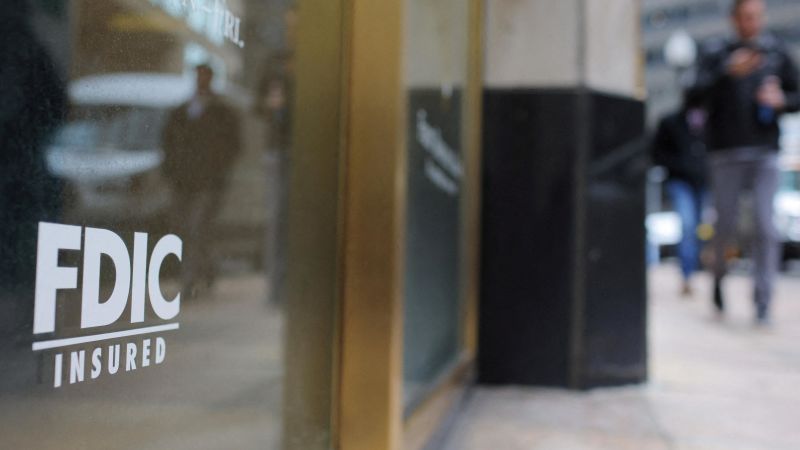
Here’s why some people keep uninsured money in their bank
CNN
Recent troubles at mid-sized banks across the US have boiled down to one core issue: Uninsured depositors, afraid of losing everything, take their money and run at the first sign of trouble.
Wall Street is still getting over the trauma of last year’s regional banking crisis. Somehow, the same issue plaguing last year’s failed banks is back in focus at the latest bank in crisis: massive loads of uninsured deposits. Shares of New York Community Bancorp have dropped about 57% over the past two weeks as losses on commercial real estate loans rattle the industry. Investors are concerned that a plunge in value of empty office space loans issued by NYCB could send depositors with more than the federally protected $250,000 in accounts running for the hills: a classic bank run. That hasn’t happened yet, and there’s no evidence that it will. But the fact that 40% of NYCB’s deposits are uninsured remains a risk for the bank and the sector as a whole. To be sure, the risk isn’t anywhere close to that of the banks that failed last year: About 94% of domestic deposits at Silicon Valley Bank were uninsured and 90% of Signature Bank’s deposits were uninsured, according to the Federal Reserve. Still, after numerous regional bank failures over the past year, the question must be asked: Why would anyone keep uninsured deposits at a bank and why would banks allow them to do so?


A California jury has largely sided with Twitter shareholders who accused billionaire Elon Musk of defrauding them by intentionally driving down the social media company’s stock ahead of his $44 billion acquisition in 2022.

The war with Iran is disrupting global oil flows, damaging energy infrastructure and raising fears of prolonged conflict. But gold, usually considered a safe haven during periods of economic uncertainty, has slumped.

US stocks and bonds fell, oil prices rose and gold had its worst week in four decades as the Iran war continues to ripple through financial markets.

The White House on Friday released its long-awaited national artificial intelligence legislative framework, a move to prevent states from enacting their own laws and enforce the Trump administration’s light-touch approach to AI regulation.

“Today is a difficult day,” CBS executives wrote to staff, explaining the cuts as a tough but necessary reallocation of newsroom resources.

President Donald Trump has repeatedly promised that Americans will get larger tax refunds this year thanks to his “big, beautiful bill.”

President Donald Trump has repeatedly promised that Americans will get larger tax refunds this year thanks to his “big, beautiful bill.”

Oil prices edged lower on Friday after a tumultuous day that saw the international benchmark surge above $119 a barrel as the Middle East conflict deepened energy supply fears.

The war in Iran has delivered what economists call a “black swan” event — an unforeseen shock so destructive, no one is immune to it.

The war in Iran is driving up the cost of buying a home in America.

Eight state attorneys general have filed an antitrust lawsuit to block Nexstar’s pending acquisition of Tegna, which would strengthen the right-leaning Nexstar and shrink the number of station owners in the US.

The Iran war has driven oil prices to their highest levels in years. Now, a wave of attacks in the past 24 hours on energy production sites across the Middle East have turned the spotlight on another crucial fossil fuel: liquefied natural gas, or LNG.

Oil and natural gas prices spiked Thursday, as Iran ramped up strikes on energy infrastructure across the Middle East and attacked one of the world’s most important liquefied natural gas (LNG) facilities in Qatar.