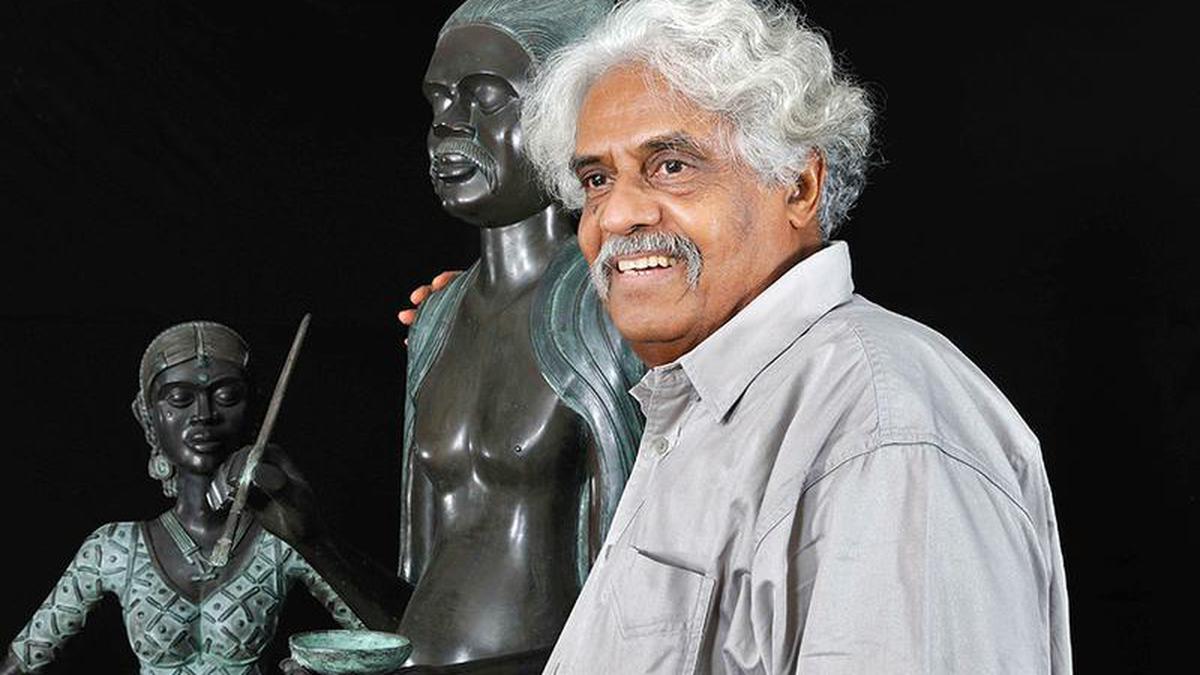
He wore his craft with grace and humility
The Hindu
Renowned Indian artist Achuthan Ramachandran Nair, known for his realistic and versatile art, passed away at 89.
Known for translating the poetics of nature into a distinct language of realism rooted in Indian ethos, Achuthan Ramachandran Nair, 89, passed away on Saturday morning in New Delhi. He is survived by his artist wife Chameli Ramachandran. For the connoisseurs of art, Ramachandran was a total artist for his sheer versatility, and his thought transcended genres. From a master painter and sculptor to a dedicated pedagogue and art historian of repute, the Padma Bhushan awardee wore his craft with grace and humility.
Hailing from Attingal, Kerala, the art of the postgraduate in Malayalam literature was etched by two traditions. His thought was shaped by his conversations with the progressive writers of Kerala and his artistic sensibility was moulded by his mentors in Santiniketan, where he learnt under the tutelage of master artist Ram Kinkar Baij and celebrated gurus like Nandalal Bose and Benode Behari Mukherjee.
Refusing to be swayed by European traditions, Ramachandran’s lotus pond meditations were mythically bound and metaphorically timeless. An avid traveller who loved little Bhil hamlets of Rajasthan, he discovered the quaint pond at Obeshwar and created female figures from his album of fantasia.
In his last lotus pond exhibition at Vadehra Art Gallery, it seemed as if time had dried up and lent its erosive contexts into the shadows of the lotus leaves.
A close encounter with anti-Sikh violence made a deep impact on his psyche and he started questioning realism. His art turned more lyrical. He faced criticism but over some time his lotus started to speak as much to the discerning as his acclaimed Kali Puja (1972). The artist had a great sense of humour and relished satire. Open to take criticism, he would say he did suffer from an occasional bout of a disease called male gaze.
Remembered as a revered guru in Jamia Millia Islamia, where he anchored the Fine Arts Faculty, drawing was an integral part of his daily ritual.
“Just like a musician has to string his taanpura every day to do his riyaz. I need to draw. It is my elixir,” he would say.


The government plans to amend the FCRA, introducing new regulations for NGO asset management and accountability for key functionaries.

The draft policy for “Responsible Digital Use Among Students”, released on Monday by the Department of Health and Family Welfare, has recommended that parents set structured routines with clear screen-time rules and prioritise privacy, safety, and open conversation with children on digital well-being.

Police Observer Sushant Kumar Saxena conducts surprise inspection at Shencottai police station, reviewing warrants and security arrangements ahead of elections.

Andhra Pradesh government to launch key projects in April, focusing on industrial growth and infrastructure development, says Nara Lokesh.

Lok Sabha refers the Corporate Laws (Amendment) Bill to a JPC amid opposition concerns over CSR provisions dilution.

SHG members in Kanniyakumari use snakes and ladders to raise election awareness and boost voter turnout.

Government accelerates consultations for early implementation of the Women’s Reservation Act to ensure women’s representation in 2029 elections.

CM A. Revanth Reddy distributes ₹1 crore insurance cheques to families of deceased Electricity department employees, enhancing financial security for workers.

The Bengaluru Traffic Police (BTP) registered 634 cases of drunk driving during a week-long special enforcement drive conducted across the city between March 16 and March 22.

GHMC intensifies action against property tax defaulters, seizing properties and offering a One Time Settlement scheme for payments.

CCB arrests three drug peddlers in Mangaluru, seizing ₹2.5 lakh worth of MDMA and other valuables.

TVK's 28 candidates in Puducherry include former BJP MLAs, a sitting Independent, and a retired police IG.

BRS submits notice on private member bill to Speaker