Harbouring tenderness amid rough waters Premium
The Hindu
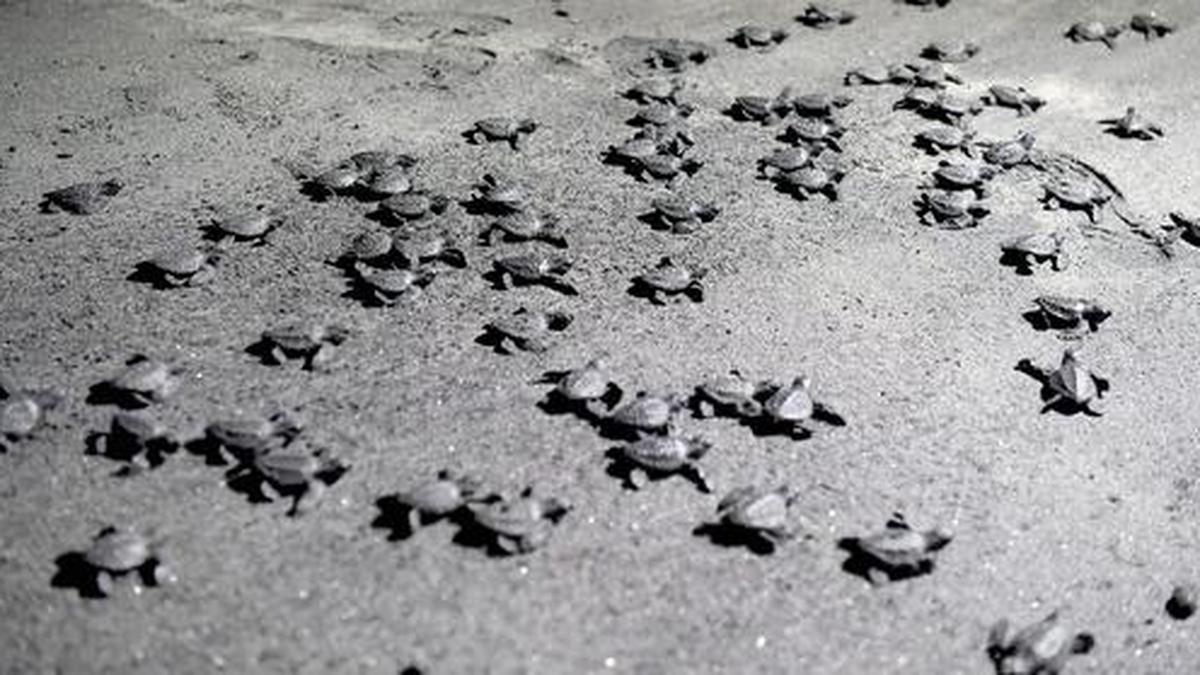
Many of the Olive Ridley turtles, tagged ‘vulnerable’ by the IUCN, utilise the beaches of North Andhra coast for their sporadic nesting activity; five hatcheries set up by conservationists only between R.K. Beach and Bheemunipatnam coasts
One cannot look at an Olive Ridley turtle’s journey from the sea to a nesting site and the emergence of hatchlings from the eggs and not once think of the true strength that lies in the delicate.
A documentary on marine turtle conservation made by the Visakhapatnam Division of AP Forest Department, titled ‘Saviours of the Sea –Tryst with the City of Destiny’, captures the journey of Olive Ridley turtles from the vast sea to the shore as they proceed for nesting their eggs. The fine balance of nature that allows the turtles to survive is depicted in the video conceptualised by the District Forest Officer and curator of the Indira Zoological Park, Anant Shankar.
A female turtle is seen flapping its flippers and making the perilous journey towards the shore, where it was born, at the RK Beach in Visakhapatnam. Had it not been for the intervention from the conservationists, the fate of the turtle and the more than 100 eggs it is about to lay is uncertain.
Thanks to the conservationists’ safe nesting centres, the turtle moves across the sand, find a safe and secluded spot, and digs a pit where it gently drops its eggs in clutches, one after the other. Next, it uses its flippers to close the pit with sand.
The fate of the eggs and the hatchlings that would come out of them after three months is also not any less dangerous than their mother’s tryst with the land. This is because they are a favourite delicacy of most canines and predatory birds that anticipate their arrival during this time of the year.
But for those hatchlings that are hatched on the shores between the R.K. Beach and Bheeminupatnam, their chances of survival are good as they are in the good hands of the conservationists.
Of the seven species of sea turtles in the world, five species are reported to be found in Indian coastal waters. Leatherback (Dermochelys Coiracea); Loggerhead (Caretta caretta); Green turtle (Chelonia mydas); Hawk’s bill (Eretmochelys imbricata), and Olive Ridley (Lepidochelys olivacea) are the five species and all are included in the Schedule I of the Indian wildlife (Protection) Act (1972) and in Appendix I of the Convention on International Trade in Endangered Species (CITES).


Deputy Director Udayakumar D. advocates skill development and self-employment for students to navigate today's competitive job market.

Freebies are necessary but there should be a monitoring mechanism, say activists

The New Mangalore Port Authority (NMPA) marked a milestone with the arrival of MT Apollo Ocean, an LPG tanker, at Berth No. 13 on Thursday, at 4 p.m., which is recognised as the 40,000th vessel to call at the Port since its inception.

Traffic curbs announced for Sri Rama Navami Yatra in Hyderabad

A Tamil Nadu State Planning Commission study reveals the ground reality of gig workers across platforms like Uber, Swiggy, and Zomato. Long hours, mounting debt, and lack of basic facilities expose the gap between “flexibility” and survival. Is the gig economy truly empowering workers—or trapping them?

Posing as Border Security Force (BSF) officials, conmen duped a Bengaluru-based firm of over ₹26 lakh by issuing a fake purchase order.

Sniffer dog wing welcomes puppy ‘Brownie’

The High Court of Karnataka on Thursday ordered the issue of notice to Chief Minister Siddaramaiah, his wife Parvathi B.M. and others on a petition challenging a special court’s order of accepting a clean chit given to them by the Lokayukta police on the allegation of illegalities and corruption in the allotment of 14 alternative sites worth ₹56 crore to Ms. Parvathi by the Mysuru Urban Development Authority (MUDA).

Parliamentary panel proposes a National Highway Safety Patrol to enhance accident response, enforce traffic discipline, and protect infrastructure.

Nara Bhuvaneswari announces a comprehensive development plan for Kuppam, focusing on industrial growth, welfare, and infrastructure.

Political tensions rise in Vattiyurkavu as UDF candidate alleges secret CPI(M)-BJP deals ahead of Kerala Assembly polls 2026.

Cashier in Hassan accused of refusing service and making derogatory religious remarks; police investigate after viral video.

Mangaluru City Corporation (MCC) in its Budget for 2026-27 proposed three initiatives for women.