Han Kang’s imagery of pain | Review of ‘We Do Not Part’
The Hindu
Han Kang's witness literature explores human violence and redemption, reflecting on dark chapters in South Korean history.
In Han Kang’s Human Acts (2016), an 18-year-old who witnessed the violent put-down of a student protest, calls up the local administration’s offices every day to ask why the fountain in the square is operating so soon after the uprising. Kim Eun-sook cannot fathom how life can return to normal after so many have died, with loved ones still searching for the missing.
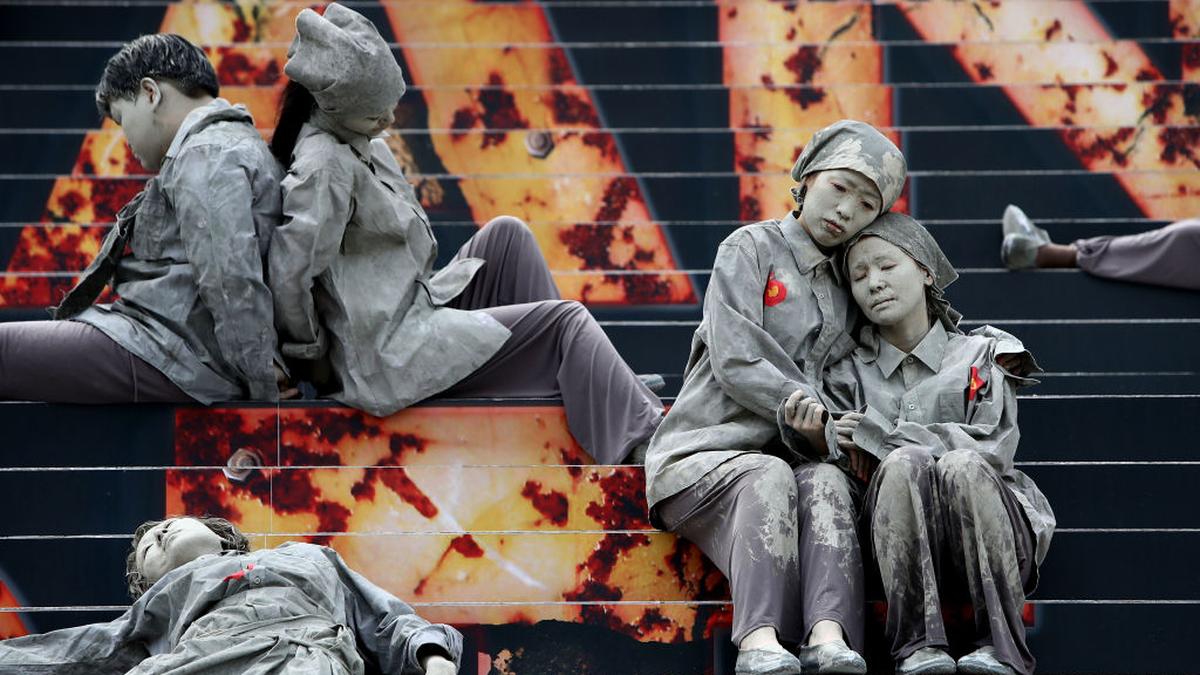
Han based her novel on a historical event that took place in 1980, a massacre carried out by the South Korean military on protesting students and civilians in the city of Gwangju, where she was born and grew up. Kim Eun-sook’s act was reflected in reality last year when the 54-year-old writer declined to celebrate her Nobel Prize for Literature amid ongoing wars in the world.
We Do Not Part, Han’s latest novel to be translated into English (by e. yaewon and Paige Aniyah Morris), looks further back at another dark chapter in South Korean history — the Jeju Island massacre of 1948 — told through the experiences of two friends and their burden of memory and grief.
Writers like Primo Levi (Auschwitz), Svetlana Alexievich (Chernobyl, World War I), Urvashi Butalia (Partition of India) and Nadine Gordimer (apartheid South Africa) have spoken truth to power by unravelling parts of history sought to be denied, downplayed or hidden. The theme of Han’s witness literature is focused on human violence. But though she writes about the cruelty human beings are capable of unleashing on one another, she also shines a light on the redeeming qualities, like kindness and dignity, that make us human amid the fragility of life.
Han shot into the limelight with her 2015 novel The Vegetarian which won the International Booker Prize. The contemporary relevance of her works in a world wanting to erase the past cannot be underscored enough, especially in novels such as Human Acts and We Do Not Part.
One of the protagonists of We Do Not Part is Kyungha, a writer who has recurring nightmares after finishing a book on the killing fields of a place simply initialled G. Even during the writing process, she suffered physically, unable to eat or sleep properly. “I’d thought, foolishly, that once it [the book] was out, the nightmares would cease. Having decided to write about mass killings and torture, how could I have so naively — brazenly — hoped to shirk off the agony of it, to so easily be bereft of its traces?” she reflects. One morning during a walk in winter, she notices the maple trees ablaze and glimmering in the sunlight. But the beauty around is dead to her.
At this dysfunctional moment in her life, she receives a text message from an old friend, Inseon, whom she had met after graduation and while working at a magazine. Inseon was a photographer and they had paired up for several assignments in Seoul, till she had to leave for Jeju Island to look after her ageing mother.


AP cadre IAS officer A. Vani Prasad is reallocated to Telangana cadre following a Telangana High Court order.

TMMK hosts special Eid prayers in Chennai, emphasizing peace amid ongoing West Asia conflicts and supporting those in need.

Telangana CM Revanth Reddy to inaugurate oil palm factory and release ₹3,590 crore for farmers on March 22.

Maharashtra aims to lead India's orange economy, positioning esports as a viable career for youth, says CM Fadnavis.

Civic group urges BMTC to tackle air and noise pollution from buses in Bengaluru, calling for immediate corrective measures.

Air India mistakenly deployed an unapproved aircraft for Vancouver, prompting a seven-hour return to Delhi.

Explore how murals in Kochi transform streets into vibrant canvases reflecting community, politics, and art beyond the Biennale.

Mamata Banerjee alleges unofficial President's rule in West Bengal, claiming a plot to strip citizenship and divide the state.

Man arrested for allegedly molesting a Malayalam actor in Kochi after repeatedly sending unwanted messages on social media.

Delhi experiences a temperature drop to 13°C with returning fog, while air quality remains satisfactory at AQI 94.

PM Modi and President Murmu extend Eid-ul-Fitr greetings, promoting unity, harmony, and compassion for a progressive nation.

Security forces in Manipur seized 29 firearms and 50 IEDs during operations amid ongoing ethnic violence.

A data jam on March 28 by OpenCity will have participants studying how the Assembly constituencies in and around Chennai are faring on a set of parameters