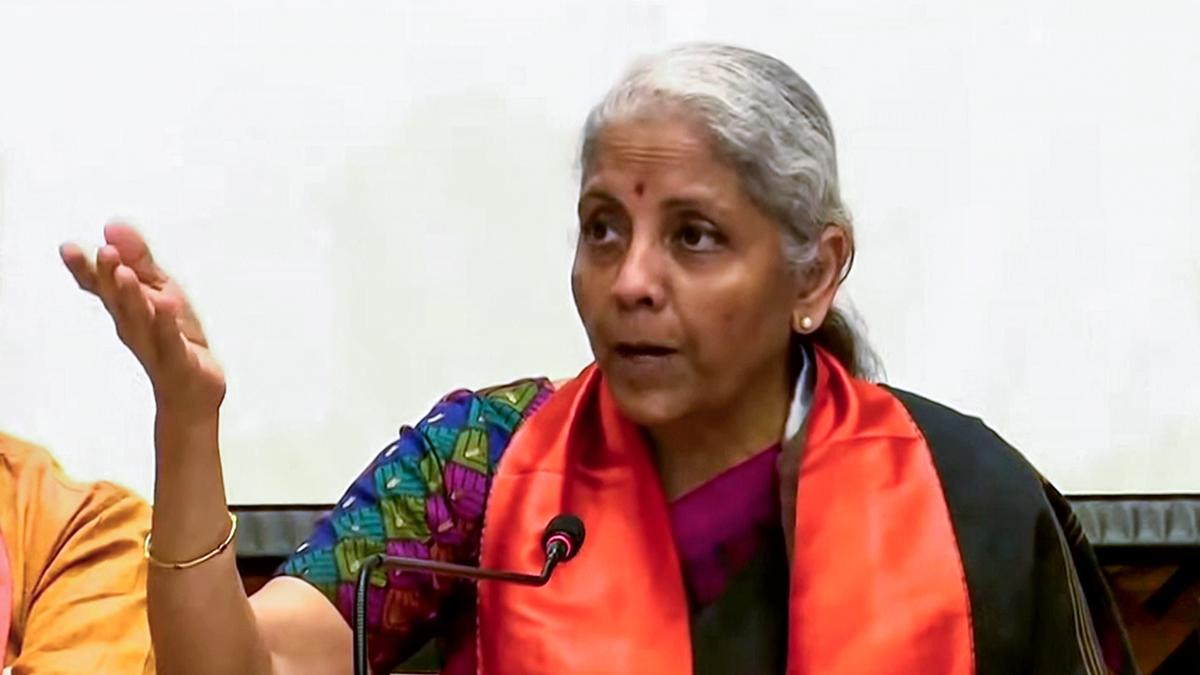
GST has helped people with a pro-poor approach, says Nirmala Sitharaman
The Hindu
Union Finance Minister Nirmala Sitharaman highlights the pro-poor benefits and economic impact of the GST regime in India.
The Goods and Services Tax (GST) regime has benefitted people through a pro-poor approach, Union Finance Minister Nirmala Sitharaman asserted on May 6, while underlining that the recent landmark of GST collections crossing ₹2 lakh crore was driven by heightened economic activity.
Under the GST framework, taxes on many essential items were lower compared to pre-GST rates, the Minister said, citing the examples of hair oil and soaps (down to 18% from 28%), and electrical appliances (reduced from 31.5% to 12%) and movie tickets.
“Reflecting a pro-poor approach, the effective weighted average GST rate has consistently fallen since 2017. The Revenue Neutral Rate was suggested to be 15.3% but was lower at 14.4% in 2017, and it has come down to 11.6% in 2019,” Ms. Sitharaman postulated.
“Further tax rate rationalization has been done since 2017. National Anti-profiteering Authority ensured that companies passed the benefits to the consumers. GST has exempted many essential items and services, such as unbranded food items, certain life-saving drugs, healthcare, education, public transport, sanitary napkins, hearing aid parts, agricultural services, etc,” she pointed out.
Noting that the idea of GST was first mooted under the Atal Behari Vajpayee-led NDA government, Ms. Sitharaman said that the UPA government was unable to achieve political consensus on its implementation, while the necessary compact was “carefully built” under Prime Minister Narendra Modi’s leadership.
“Before GST, India’s indirect tax system was fragmented and complicated, and every state was practically a distinct market in itself with different rules and tax rates. Inputs for central excise duty, etc, could not be availed, leading to an increased tax burden for the common people,” Ms. Sitharaman said in a statement. The GST streamlined 17 taxes and 13 cesses into a 5-tier structure, and reduced 495 submissions and filings across States to just 12, simplifying the tax regime, she said.
Stressing that GST simplified compliances through uniform processes, simple registration, single returns, and a fully IT-driven system with minimal physical interface, Ms. Sitharaman cited a survey that found 88% of micro, small and medium enterprises (MSMEs) credited the tax for reducing costs and optimising supply chains.


Petroleum Ministry directs reforms to enhance natural gas infrastructure, streamline approvals, and ease transition from LPG to PNG.

The Sora decision means the end of a blockbuster $1 billion deal between Disney and the ChatGPT maker that was announced a little more than three months ago.

Regulator mandates city gas distributors to provide piped gas to educational institutions within five days, supporting India's transition from LPG to PNG.

NHAI's Raajmarga InvIT listed on BSE, enhancing investor participation in highway infrastructure with strong demand and oversubscription.

HDFC Life Insurance faces ₹172 crore Income Tax order for alleged violations, plans to appeal the decision.

Air-conditioner makers in India are looking forward to FY27 with hope as the war in West Asia threatens to impact plastic component availability and consumer sentiment, adding to the challenges around raw material price and new energy label, a senior executive of a leading company has said.

Rupee falls 23 paise to an all-time low of 93.76 against the U.S. dollar amid foreign fund outflows and global uncertainties.

Stock markets surged nearly 2% as Trump paused strikes on Iran, boosting investor confidence amid easing geopolitical tensions.

Coal Minister urges State leaders to maintain stable coal prices amid rising global costs, assuring ample domestic supply.

Mahanagar Gas ensures reliable PNG and CNG supply in Maharashtra and Karnataka, offering customer benefits to encourage adoption.

OpenAI Chief Executive Sam Altman said on Monday he has stepped down from the board of directors of Helion Energy, the fusion startup he has backed since 2015

Nikhil Kamath and Quant MF back Swan Defence's oversubscribed ₹500 crore Offer for Sale, reflecting strong investor interest in defence stocks.

HDFC Bank appoints law firms to investigate allegations by former Chairman Atanu Chakraborty following his resignation.