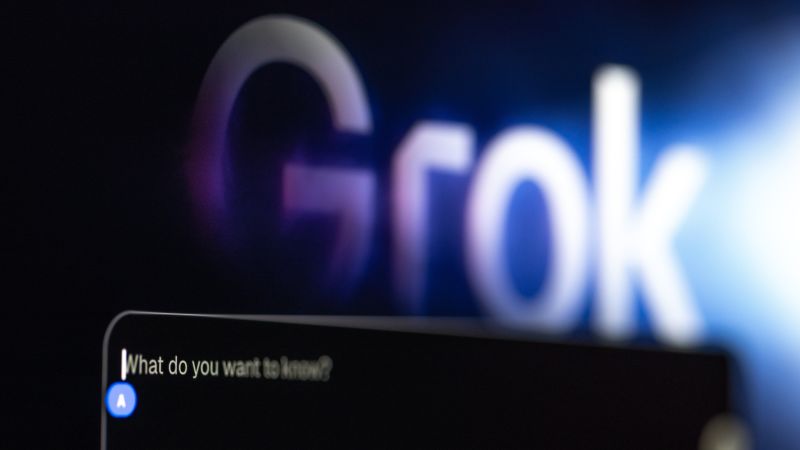
Grok’s antisemitic outbursts reflect a problem with AI chatbots
CNN
Grok, the chatbot created by Elon Musk’s xAI, began responding with violent posts this week after the company tweaked its system to allow it to offer users more “politically incorrect” answers.
Grok, the chatbot created by Elon Musk’s xAI, began responding with violent posts this week after the company tweaked its system to allow it to offer users more “politically incorrect” answers. The chatbot didn’t just spew antisemitic hate posts, though. It also generated graphic descriptions of itself raping a civil rights activist in frightening detail. X eventually deleted many of the obscene posts. Hours later, on Wednesday, X CEO Linda Yaccarino resigned from the company after just two years at the helm, though it wasn’t immediately clear whether her departure was related to the Grok issue. The episode came just before a key moment for Musk and xAI: the unveiling of Grok 4, a more powerful version of the AI assistant that he claims is the “smartest AI in the world.” Musk also announced a more advanced variant that costs $300 per month in a bid to more closely compete with AI giants OpenAI and Google. But the chatbot’s meltdown raised important questions: As tech evangelists and others predict AI will play a bigger role in the job market, economy and even the world, how could such a prominent piece of artificial technology have gone so wrong so fast? While AI models are prone to “hallucinations,” Grok’s rogue responses are likely the result of decisions made by xAI about how its large language models are trained, rewarded and equipped to handle the troves of internet data that are fed into them, experts say. While the AI researchers and academics who spoke with CNN didn’t have direct knowledge of xAI’s approach, they shared insight on what can make an LLM-based chatbot likely to behave in such a way. CNN has reached out to xAI.


Oil prices edged lower on Friday after a tumultuous day that saw the international benchmark surge above $119 a barrel as the Middle East conflict deepened energy supply fears.

The war in Iran has delivered what economists call a “black swan” event — an unforeseen shock so destructive, no one is immune to it.

The war in Iran is driving up the cost of buying a home in America.

Eight state attorneys general have filed an antitrust lawsuit to block Nexstar’s pending acquisition of Tegna, which would strengthen the right-leaning Nexstar and shrink the number of station owners in the US.

The Iran war has driven oil prices to their highest levels in years. Now, a wave of attacks in the past 24 hours on energy production sites across the Middle East have turned the spotlight on another crucial fossil fuel: liquefied natural gas, or LNG.

Oil and natural gas prices spiked Thursday, as Iran ramped up strikes on energy infrastructure across the Middle East and attacked one of the world’s most important liquefied natural gas (LNG) facilities in Qatar.

In normal times, the Federal Reserve would more or less ignore an oil price shock like the one we’re in now.

Property brokerage Compass on Wednesday dropped its lawsuit against Zillow, ending a legal clash over how home listings can be marketed online.

Fed officials didn’t make any rate moves at their March meeting and released an updated forecast for the path of the American economy as the war in Iran stretches on.

Fed officials are set to announce their latest rate decision Wednesday afternoon, along with a new forecast for the path of the American economy as the war in Iran stretches on.

“The speed with which American democracy is currently dismantled is unprecedented in modern history,” one of the world’s top democracy researchers says in a new report.

Oil prices held steady Wednesday after Iraq clinched a deal to resume some crude exports via Turkey. It’s not a ton of oil, but it’s what amounts for good news these days as the Strait of Hormuz remains largely blocked.

The US-Israeli war with Iran, now stretching into its third week, is dashing hopes that the Federal Reserve will lower interest rates at all this year.