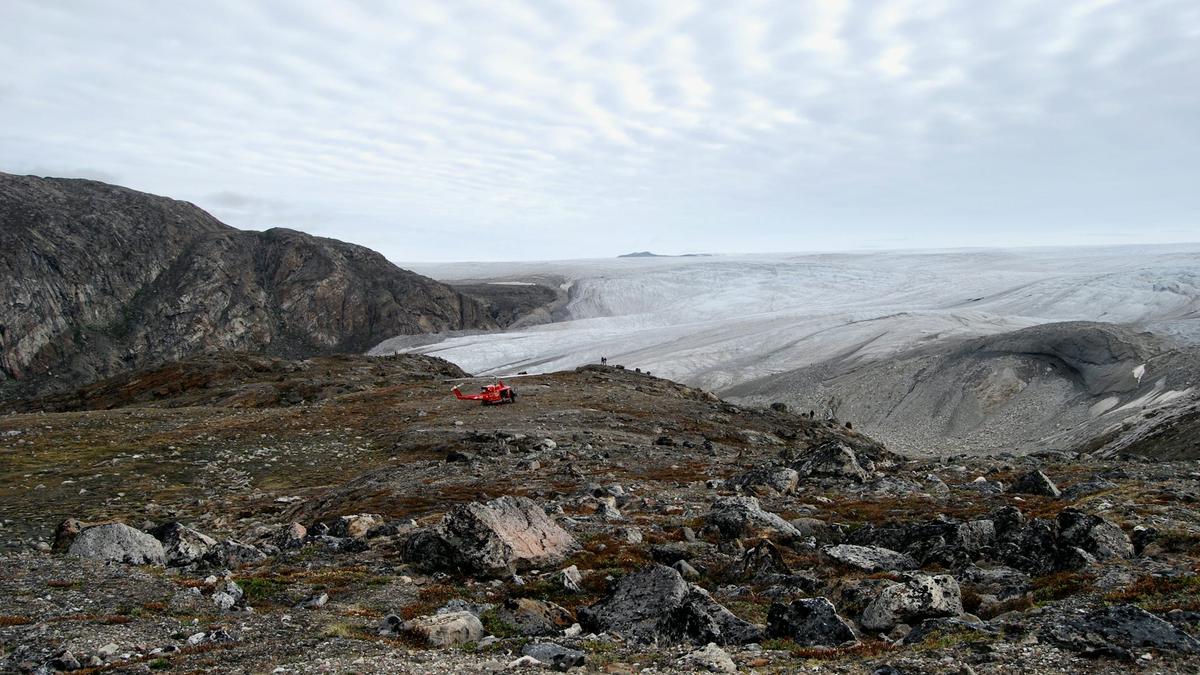
Greenland ice found at risk of melting at CO2 levels lower than today’s
The Hindu
Greenland's ice sheet history reveals vulnerability to melting, impacting sea levels and global climate change.
As we focused our microscope on the soil sample for the first time, bits of organic material came into view: a tiny poppy seed, the compound eye of an insect, broken willow twigs and spikemoss spores. Dark-coloured spheres produced by soil fungi dominated our view.
These were unmistakably the remains of an arctic tundra ecosystem – and proof that Greenland’s entire ice sheet disappeared more recently than people realise.
These tiny hints of past life came from a most unlikely place – a handful of soil that had been buried under 2 miles of ice below the summit of the Greenland ice sheet. Projections of future melting of the ice sheet are unambiguous: When the ice is gone at the summit, at least 90% of Greenland’s ice will have melted.
In 1993, drillers at the summit completed the Greenland Ice Sheet Project 2 ice core, or GISP2, nicknamed the two-mile time machine. The seeds, twigs and spores we found came from a few inches of soil at the bottom of that core — soil that had been tucked away dry, untouched for three decades in a windowless Colorado storage facility.
Our new analysis builds on the work of others who, over the past decade, have chipped away at the belief that Greenland’s ice sheet was present continuously since at least 2.6 million years ago when the Pleistocene ice ages began. In 2016, scientists measuring rare isotopes in rock from above and below the GISP2 soil sample used models to suggest that the ice had vanished at least once within the past 1.1 million years.
Now, by finding well-preserved tundra remains, we have confirmed that Greenland’s ice sheet had indeed melted before and exposed the land below the summit long enough for soil to form and for tundra to grow there. That tells us that the ice sheet is fragile and could melt again.
To the naked eye, the tiny bits of past life are unremarkable – dark flecks, floating between shiny grains of silt and sand. But, under the microscope, the story they tell is astounding. Together, the seeds, megaspores and insect parts paint a picture of a cold, dry and rocky environment that existed sometime in the past million years.


CERN's Large Hadron Collider discovers the Xi-cc-plus particle, enhancing understanding of quantum mechanics and baryon behavior.

Vibha Batra’s latest book, Spotless (Hachette India) is a novel in verse for young adults

In its first edition, the Madras Art Salon spotlights the works of journalist and artist Narayan Lakshman at The Botanical Club, a social space in the British Deputy High Commission, Chennai

Cholesterol enhances melanoma cell invasion by making nuclei squishier, revealing a potential treatment target in cancer progression.

The designers reinterpret the Swedish artist’s symbolic forms and colour energy through contemporary resortwear silhouettes

Discover the inspiring legacy of Bibha Chowdhuri, a pioneering woman in physics and a trailblazer in STEM history.

Discover the inspiring legacy of Bibha Chowdhuri, a pioneering woman in physics and a trailblazer in STEM history.

Ashdeen’s Spring 2026 collection features saris inspired by the designer’s Parsi gara archive

Red ochre burials, ritual markings and myths across cultures show that red repeatedly marks liminal thresholds such as puberty, sacrifice and death; anthropologists argue that the colour functions as a technology of collective ritual and value, binding communities through shared symbolic acts

India approves 23 institutions for quantum labs under the National Quantum Mission, aiming to advance quantum technology and research.

India approves 23 institutions for quantum labs under the National Quantum Mission, aiming to advance quantum technology and research.

The Gaza conflict exacerbates environmental damage, emitting millions of tonnes of CO2 and threatening climate stability in West Asia.

Chefs and cookery experts share smart kitchen hacks, hybrid cooking methods and appliance tips to help households reduce LPG use without compromising on food