Green future for whom?: Revisiting the marginalised lives of Challakere and Pavagada Premium
The Hindu
The once thriving industry is, today, a mere shadow of its past. The government took over 13,000 acres of the grasslands of Challakere to build Science City, cutting off the villagers’ access to water and land to graze sheep and cattle. Buying fodder was too expensive for most villagers resulting in distress sale of the sheep and the decline of a local industry.
In Challakere, weaving used to be not just a major form of livelihood but an integral part of the socio-cultural life of the community. Challakere kamblis, a type of water-resistant blankets made from wool, is significant to the locals for every occasion from cradle to grave. Newborn babies are placed on a Challakere kambli, brides are gifted kamblis and sheep, the dear departed are sent off with a piece of the kambli. One of the biggest customers of the water-resistant blankets, used in both monsoons and winters, was the Indian Army.
The once thriving industry is, today, a mere shadow of its past. The government took over 13,000 acres of the grasslands of Challakere to build Science City, cutting off the villagers’ access to water and land to graze sheep and cattle. Buying fodder was too expensive for most villagers resulting in distress sale of the sheep and the decline of a local industry.
With a goal of becoming a net-zero nation by 2070 and achieving 500GW of non-fossil fuel-based energy capacity by 2030, India’s climate objectives are tall. The country witnessed a 2x increase in solar installations in 2024 compared to the previous year. There has been an increased push towards renewable energy making India one of the fastest growing renewable energy markets.
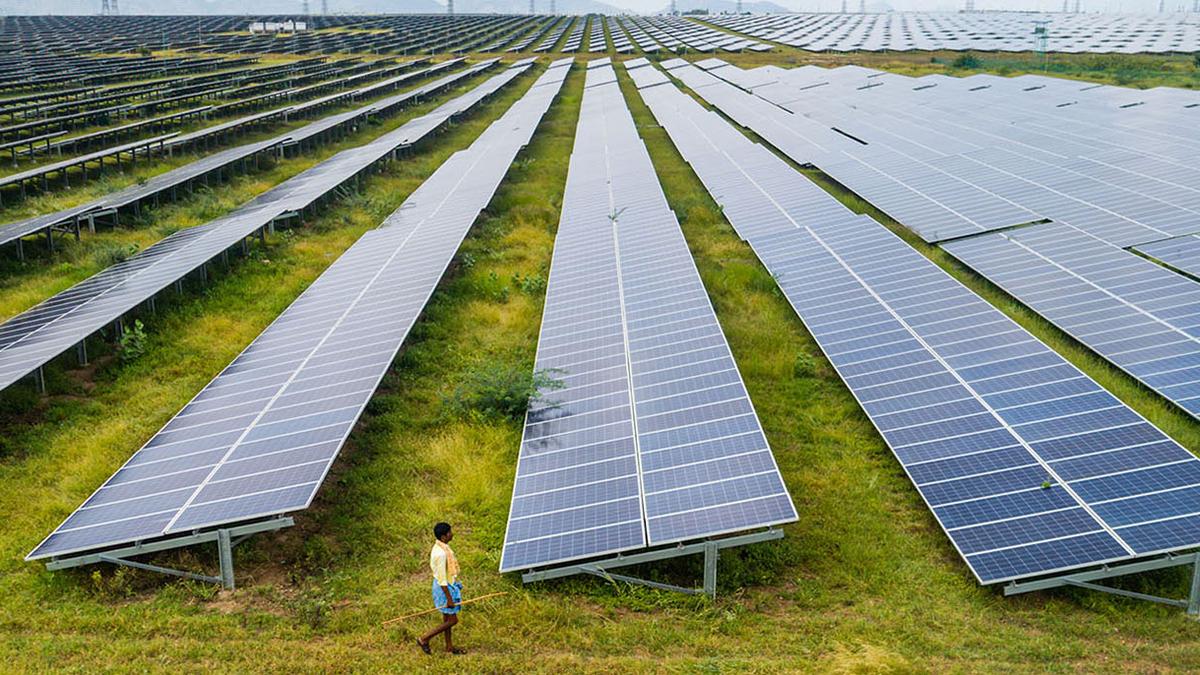
While clean energy is inevitable for a clean future, what shouldn’t be ignored is the unequal distribution of burdens of climate action on the poor and marginalised of rural India, argues Bhargavi S. Rao, educator, researcher and former trustee at Environment Support Group (ESG). Speaking recently at Ashoka Trust for Research in Ecology and the Environment, she highlighted the land diversions or ‘green grabbing’ in Pavagada, Challakere and Chamrajnagar in Karnataka, where farming communities have been displaced and dispossessed in the name of development.
“Renewable energy projects are very land intensive. Today renewable energy policies seem to be determining how land will be diverted to create these new forms of energy production,” Rao said.
It was in 2009 that the government started taking over around 10,000 acres of contiguous grassland in Challakere for building science city. Part of the commons, the grasslands or kavals were ecologically, historically, culturally and economically significant. These vast lands were set aside by Hyder Ali and Tipu Sultan in the 18th century for the strong, fast and highly drought-tolerant Amrit Mahal cattle rendering it the name Amrit Mahal kavals.
A document by ESG notes how the Kavalgara (Kaval protector) of these lands ensured that the Amrit Mahal breeds got the first right of grazing in the post-monsoon period, a tradition that continued in the post-independence period as well. The pastures were then opened for other cattle breeds, goat and sheep owned by local communities.


AIADMK reveals its first candidate list for Tamil Nadu Assembly election, featuring familiar names and few surprises.

A study reveals antibiotic resistance causes 87% of India's typhoid economic burden, significantly impacting children and families.

How Dikshitar was inspired by Vaduvur Rama to come up with a composition in a raganga raga

Lok Sabha passes Finance Bill 2026 with amendments, completing its budgetary approval before Rajya Sabha's consideration.

Karnataka government to consult legal experts on pursuing action against Adani Group's ACC Ltd. over ₹850 crore in disputed dues.

The FCRA amendment bill aims to create an authority for managing NGO assets after license loss, addressing misuse of foreign funds.

Telangana Minister assures adequate petroleum stocks for three months, warns against illegal fuel carrying amid panic buying rumors.

TMC calls for the removal of Bhabanipur returning officer, citing alleged ties to BJP and concerns over neutrality.

Kerala CM Pinarayi Vijayan condemns UDF's misogynistic attacks on CPI(M) legislator U. Prathibha, highlighting political degeneration.

Selected from 9,400 submissions across 37 countries, the 100 photographs on display traverse intimate and political terrains. In MRC Nagar, photographer Swastik Pal captures life in the Sundarbans, where severe climate change has brought humans and wildlife into closer contact. Shane Hynan’s Beneath Beofhod reflects on Ireland’s boglands as sites of memory and restoration, while Mateo Trevisan’s More than the Sun examines the impact of coal-driven industrialisation in the Western Balkans.

Hyderabad officials assure sufficient fuel supply for 60 days, warn against misinformation and illegal sales amid panic buying.

Telangana MP urges Centre to expedite ₹1,270 crore dues transfer from Andhra Pradesh for financial fairness and development.

A Karnataka man was detained with ₹62.5 lakh in cash during election checks on NH 544, claiming it was from a property sale.