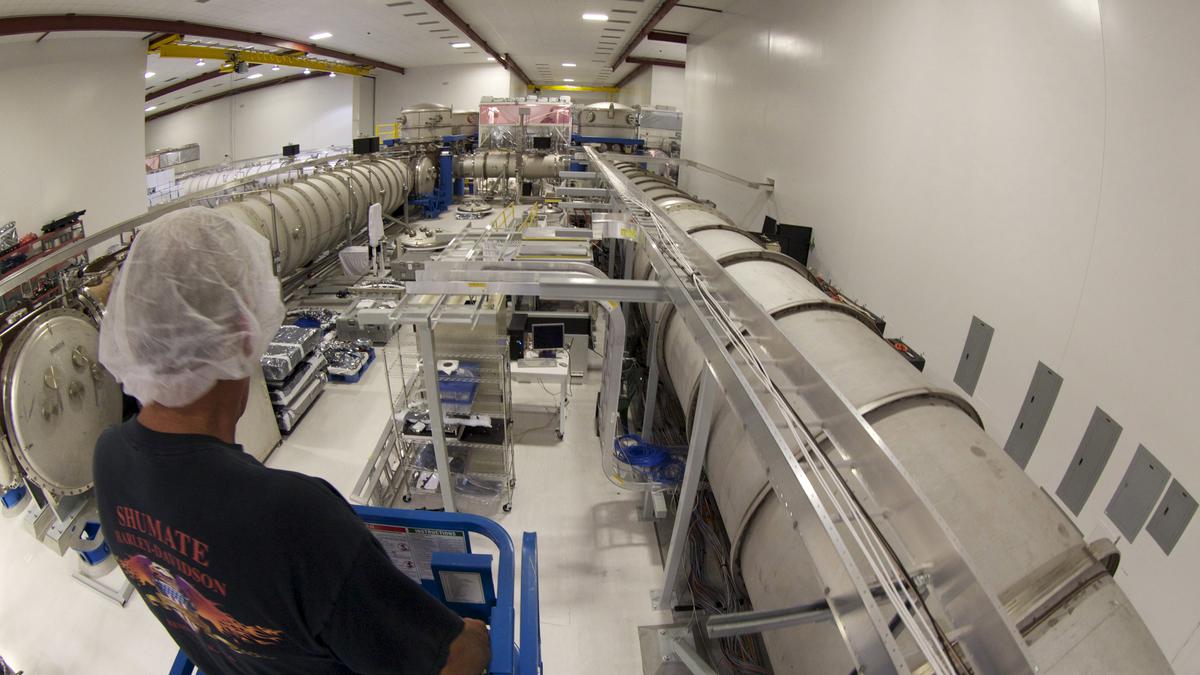
Gravitational wave detector LIGO is back online after 3 years of upgrades
The Hindu
After a three-year hiatus, scientists in the U.S. have just turned on detectors capable of measuring gravitational waves
After a three-year hiatus, scientists in the U.S. have just turned on detectors capable of measuring gravitational waves – tiny ripples in space itself that travel through the universe.
Unlike light waves, gravitational waves are nearly unimpeded by the galaxies, stars, gas and dust that fill the universe. This means that by measuring gravitational waves, astrophysicists like me can peek directly into the heart of some of these most spectacular phenomena in the universe.
Since 2020, the Laser Interferometric Gravitational-Wave Observatory – commonly known as LIGO – has been sitting dormant while it underwent some exciting upgrades. These improvements will significantly boost the sensitivity of LIGO and should allow the facility to observe more-distant objects that produce smaller ripples in spacetime.
Also Read | Gravitational waves detected for first time from newly born black hole
By detecting more events that create gravitational waves, there will be more opportunities for astronomers to also observe the light produced by those same events. Seeing an event through multiple channels of information, an approach called multi-messenger astronomy, provides astronomers rare and coveted opportunities to learn about physics far beyond the realm of any laboratory testing.
According to Einstein’s theory of general relativity, mass and energy warp the shape of space and time. The bending of spacetime determines how objects move in relation to one another – what people experience as gravity.
Gravitational waves are created when massive objects like black holes or neutron stars merge with one another, producing sudden, large changes in space. The process of space warping and flexing sends ripples across the universe like a wave across a still pond. These waves travel out in all directions from a disturbance, minutely bending space as they do so and ever so slightly changing the distance between objects in their way.


Discover the Minor Planet Centre, the key hub for tracking and verifying observations of small solar system bodies.

Discover the Minor Planet Centre, the key hub for tracking and verifying observations of small solar system bodies.

In this week's Science for All newsletter, XX explains

Test your knowledge with the quiz on Science films at the Oscars through history

Set between the Siwalik hills and the plains, Butwal offers travellers a mix of regional cuisine, pilgrimage trails to Lumbini and the comfort of Hyatt’s new hospitality landmark

Explore 2026's wallpaper trends in India, highlighting botanicals and handmade designs that enhance modern homes with nature-inspired aesthetics.

Mercedes-Benz CLA 250+ with EQ Technology review: design, performance, range and features explained. Discover how the new electric CLA combines advanced AI, long range, fast charging and futuristic styling for the next generation of luxury EVs.

AI tool for sparrow conservation

BTS’s comeback with ‘Arirang’ marks a major global music event. When does the album release, and where can you watch their concert live stream? We have all the details

The 2026 U.S. cholesterol guidelines urge starting screening and treatment at 30 to prevent cardiovascular disease effectively.

Olam Festival 2026 in Thiruvananthapuram returns March 27-29 with 120+ vendors, music, art, and cultural zones.

A few storytellers in Thiruvananthapuram share their journeys, challenges, and evolving methods on World Storytelling Day, inspiring young minds.

76-year-old Kurian Jacob from Kerala triumphs with seven medals, including five golds, at the Open Masters Games in Abu Dhabi.