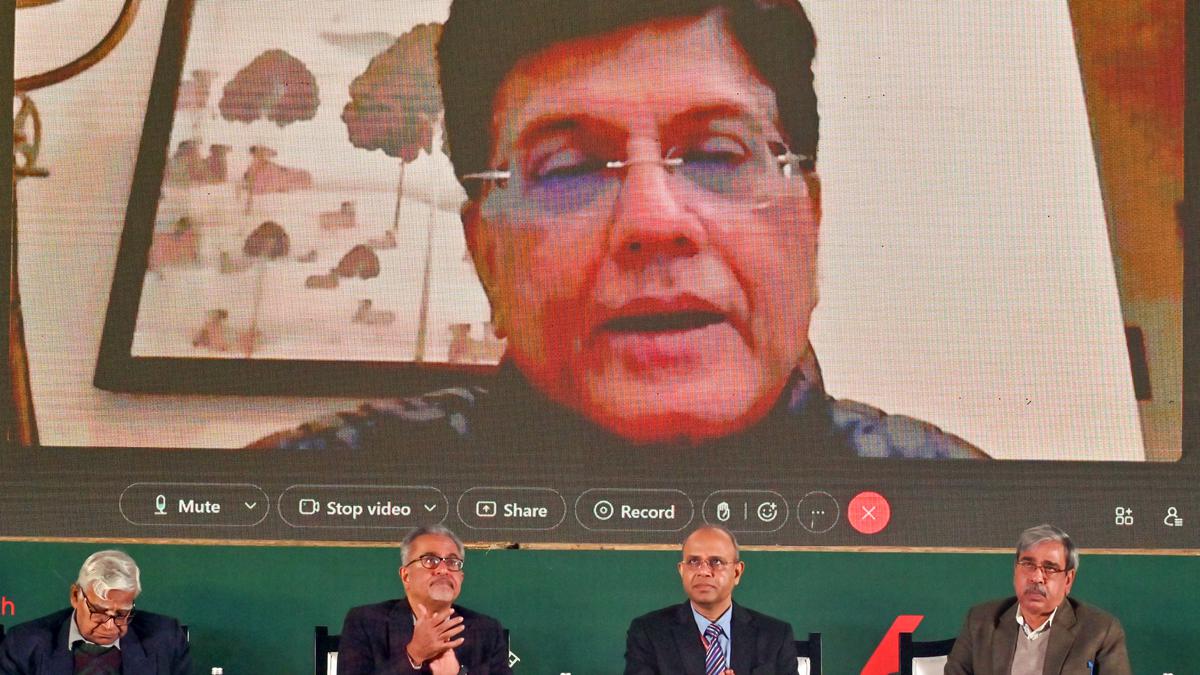
Goyal asks FCI officers to turn whistleblowers to curb corruption
The Hindu
The role of the FCI is not only to deliver ration, but also to instill confidence in farmers and beneficiaries by bringing in transparency, efficiency and accountability, said Piyush Goyal
The role of the Food Corporation of India (FCI) is not only to deliver ration, but also to instill confidence in farmers and beneficiaries by bringing in transparency, efficiency and accountability, said Union Food Minister Piyush Goyal here on Sunday in his address on the 60th foundation day of the FCI. Mr. Goyal urged the youth and officers in the FCI to turn as whistleblowers to ensure transparency in running the organisation.
He said the FCI should emerge as a trusted partner of farmers and people of the country. “The FCI plays a crucial role in facilitating flagship schemes such as Pradhan Mantri Garib Kalyan Anna Yojana [PMGKAY] by providing ration to beneficiaries in every corner of the country,” the Minister said, reminding the officers that the role of the FCI was not only to deliver the ration. He added that Prime Minister Narendra Modi had promised to make India free of corruption and asked the youth and staff of the FCI to bring in transparency and become whistleblowers.
Mr. Goyal said the FCI needed to embrace digitalisation and technology by ensuring quality. “Quality can be achieved in areas such as inspection, procurement, transportation, distribution and storage,” he said, and suggested the FCI to reduce operational costs through route optimisation, mechanised loading/unloading, innovative storage solutions and others.
The Minister said the open market sale scheme (domestic) operations had also proved to be an effective tool in moderating the prices of wheat and rice. “Bharat Atta, Bharat Dal, interventions regarding onion and tomato have assisted the Government of India in price stabilisation,” Mr. Goyal said.


Coal Minister urges State leaders to maintain stable coal prices amid rising global costs, assuring ample domestic supply.

Mahanagar Gas ensures reliable PNG and CNG supply in Maharashtra and Karnataka, offering customer benefits to encourage adoption.

OpenAI Chief Executive Sam Altman said on Monday he has stepped down from the board of directors of Helion Energy, the fusion startup he has backed since 2015

Nikhil Kamath and Quant MF back Swan Defence's oversubscribed ₹500 crore Offer for Sale, reflecting strong investor interest in defence stocks.

HDFC Bank appoints law firms to investigate allegations by former Chairman Atanu Chakraborty following his resignation.

Airlines are cancelling numerous flights amid escalating West Asia conflicts, leaving tens of thousands of passengers stranded worldwide.

The rupee declines 20 paise to 93.73 against the dollar as global oil prices rise and investor uncertainty persists.

Siemens said on Monday that the Iran war has led to customers holding back on new investments as prices increase for raw materials and energy.

OpenAI said its close ties with Microsoft could be a potential risk to its business, telling investors that the software company is responsible for “a substantial portion of our financing and compute,” CNBC reported

LPG crisis: Alternative solutions are being considered, with ammonia cylinders being increasingly used for industrial applications amid delays in commercial LPG deliveries.

India monitors U.S. military pause on Iran as oil prices dip; External Affairs Minister engages with GCC nations for support.

India monitors U.S.-Iran tensions as Trump pauses attacks, leading to a significant drop in oil prices.

Union Minister Ashwini Vaishnaw launches three initiatives to enhance India's creative economy through AI training, citizen platforms, and advanced tech access.