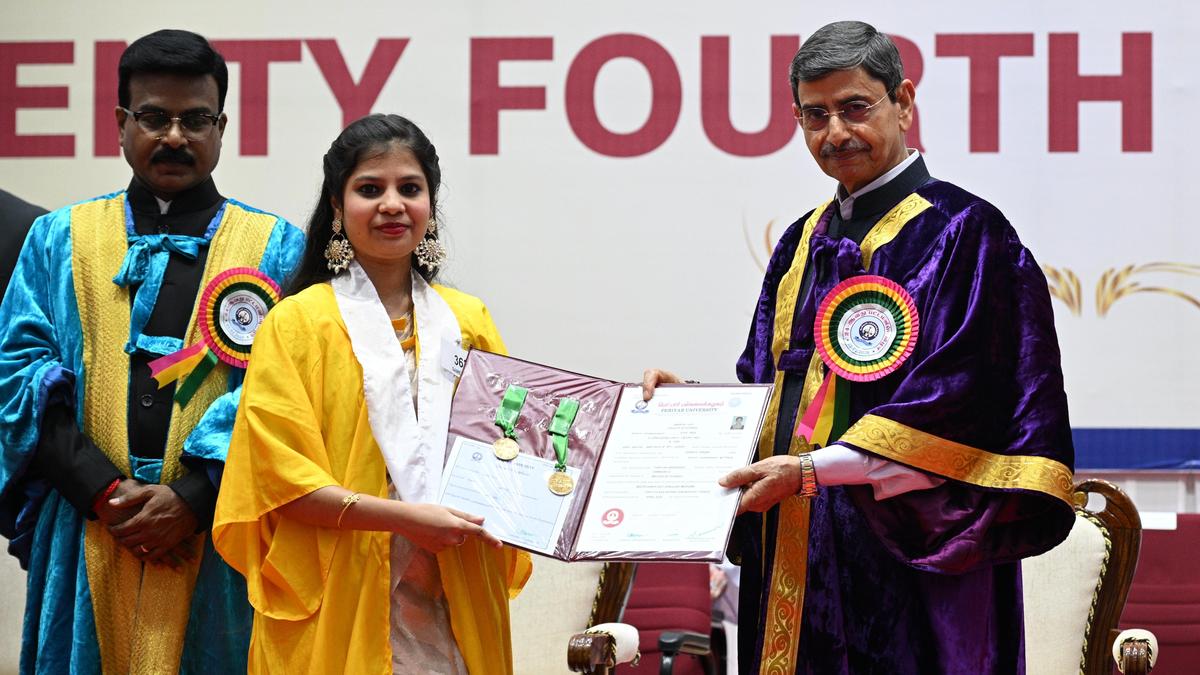
Governor confers degrees to candidates at Periyar University; Higher Education Minister boycotts convocation
The Hindu
Governor R.N. Ravi conferred degrees at Periyar University's convocation, while Higher Education Minister Govi. Chezhiaan boycotted the event.
Tamil Nadu Governor and Chancellor of University R.N. Ravi on Thursday (February 5, 2026) conferred degrees to candidates during the 24th convocation ceremony at Periyar University. Minister for Higher Education Govi. Chezhiaan, who is pro-chancellor of the university, boycotted the convocation.
A total of 110 candidates received gold medals in person, including 33 postgraduate students from university departments, 30 from affiliated colleges, 45 undergraduates from affiliated colleges and two undergraduates from university departments. As many as 356 candidates received degrees in doctor of philosophy and two received in doctor of science. Likewise, 49,429 received degrees in absentia, including 33,089 male and 16,340 female candidates.
E. Sundaravalli, commissioner of collegiate education and convenor of the vice-chancellor committee, presented the annual report of the university and delivered a welcome address. She said that Periyar University is placed within the top 100 of the Ministry of Education’s National Institutional Ranking Framework (NIRF) for the last 10 years. The number of participating institutes has almost doubled from 2,781 in 2024 to 4,045 in 2025. She added that the university also secured a four-star rating for the past three consecutive years for its innovative activities under the Institution’s Innovation Council.
Ms. Sundaravalli stated that the university faculties have been granted 31 copyrights, 26 patents, and FSSAI licenses for a variety of food products in order to promote start-ups. Under the Chief Minister’s Research Grant, 16 faculty members have been awarded cumulative research grants to the tune of ₹4.77 crore and to date, faculty members have submitted 80 research proposals worth ₹21.45 crore to various funding agencies, she added.
Speaking at the function, chief guest C. Anandharamakrishnan, director of CSIR-NIIST Thiruvananthapuram, said that with a GDP of about $4.19 trillion in 2025, India is the world’s fourth-largest economy and on track to become the third-largest by 2027-28. India boasts the world’s third-largest start-up ecosystem, with about 1.59 lakh start-ups and 125 unicorns, trailing only the U.S. and China. “Our country is the world’s second-largest producer of good grains, with about 332 million tonnes produced annually and approximately 49% of India’s power generation now comes from non-fossil fuel sources,” he said.
He also pointed out that India’s per capita water availability is declining, with estimates ranging from 1,341 to 1,401 cubic meters per person annually, making the country a water-stressed country. Ensuring food, energy, and water security in India is critical, given rapid population growth, urbanisation, and climate change, which threatens severe resource shortages. “Global average life expectancy has been steadily increasing, reaching 73.5 years in 2025. In India it is at 72 and is expected to exceed 80 in 2050, Mr. Anandharamakrishnan added


redBus data reveals a significant 76% rise in solo women travelers from Karnataka since 2019, highlighting increasing independence in travel.

Air India and AI Express will operate 44 flights to West Asia amid Dubai airport restrictions on foreign carriers.

Maharashtra Assembly passes the Freedom of Religion Bill, imposing strict penalties for unlawful conversions, ensuring protection for vulnerable individuals.

Trump claims he can do “anything” with Cuba amid U.S.-Cuba talks, escalating tensions over political intervention and economic crises.

Amrutanjan owes ₹9.74 crore in rental arrears for Mylapore Kapaleeswarar Temple land, despite lacking a landlord-tenant relationship.

BJP intensifies campaign in Palakkad for the 2026 Assembly elections, targeting UDF amid scandal surrounding MLA Mamkootathil.

Jeevan Reddy leads a rally for maize farmers in Jagtial amid speculation of leaving Congress for BRS.

BJP and AINRC likely to maintain 2021 seat-sharing formula for Puducherry's 2026 Assembly elections, confirms party president.

BJP reveals 144 candidates for Bengal Assembly polls, featuring Suvendu Adhikari contesting against Mamata Banerjee in Bhabanipur.

Anna University partners with Ramco Systems to create an advanced ERP lab for enhanced industrial engineering education.

NDA announces candidates for 12 Kozhikode seats in Kerala Assembly polls 2026 as UDF and LDF ramp up campaigning.

As India formulates its next steps in the Israel-U.S.-Iran war, it is necessary to consider not only what it will mean for the whole region but also its own ties with each neighbour

CITU criticizes the Centre's privatization efforts for VSP, alleging employee removal over production increase and financial mismanagement.