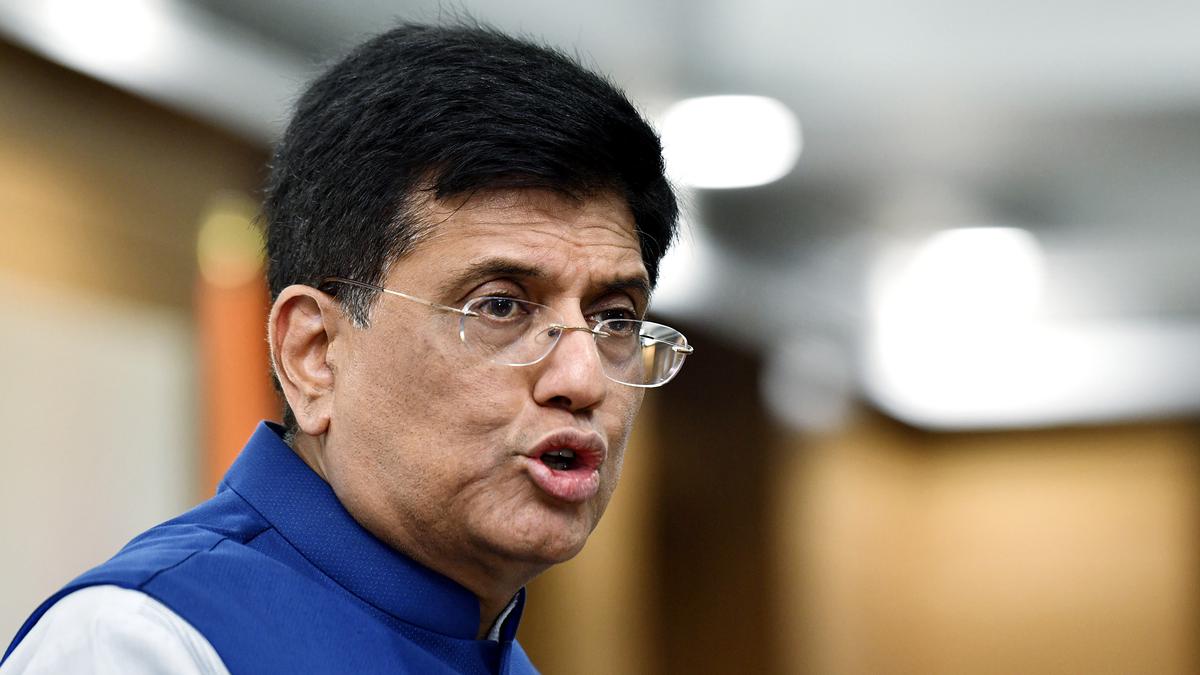
Government to bring more products under mandatory quality norm: Piyush Goyal
The Hindu
Consumer Affairs Minister Piyush Goyal on January 6 said the government will bring more products under the mandatory quality norm as India moves towards becoming a developed nation by 2047.
Consumer Affairs Minister Piyush Goyal on January 6 said the government will bring more products under the mandatory quality norm as India moves towards becoming a developed nation by 2047.
Addressing virtually the 77th foundation day of the Bureau of Indian Standards (BIS), Mr. Goyal said complying with high quality standards in products and services will help India achieve high goals and become a developed nation.
Towards this direction, the BIS should become an ambassador of quality standards. "It should not just become an adopter of standards, but should be a pioneer of standards," he said.
That apart, the BIS should frame quality standards comparable to international standards wherever possible. "For example in products such as lift, air filters and medical devices, I think India can be a front-runner and set international standards." He also urged for much greater stakeholder engagement for making quality standards and asked the industry to be more demanding to set labs for testing the quality.
Hailing the BIS efforts in creating a quality conscious nation, the Minister said bringing more products under the mandatory compliance of quality norms issued through the Quality Control Order (QCO) has ensured availability of quality products/services to the consumers.
“So far, 156 QCOs have been issued, covering 672 products. Before 2014, only 106 products were covered under 14 QCOs,” he said.


Iran war impacts pesticide prices, warning of a 20-25% rise and increased risk of counterfeit products during the kharif season.

India's forex reserves fell by $7 billion to $709.76 billion, according to RBI data for the week ending March 13.

Natco Pharma will launch its Semaglutide injection (multi dose vials) in the domestic market on Saturday.

Flipkart announces a 105% bonus payout for 2025, rewarding employees for strong growth and performance metrics.

Core sector growth in India plummeted to 2.3% in February, amid declining domestic production and impending West Asia crisis impacts.

Stock markets rebound with Sensex rising 325 points, driven by IT and PSU bank stocks amid fuel price concerns.

The Indian rupee plummets 82 paise to a record low of 93.71 against the dollar due to rising crude prices and geopolitical tensions.

Power Minister highlights energy security and renewable transition during Bharat Electricity Summit 2026 amid global tensions.

The rupee hits a record low of 93.08 against the dollar, pressured by rising oil prices and FII outflows.

OpenAI said on Thursday it will buy Python toolmaker Astral, as the ChatGPT maker seeks to strengthen its portfolio against rival Anthropic to gain more share in the artificial intelligence coding tools market.

Crude oil prices drop over 2% as Netanyahu reassures investors amid ongoing Iran conflict and rising energy market concerns.

PPAC designated as nodal agency to enhance data collection on domestic fuel and energy stocks for improved mandate enforcement.

Indian markets plunged over 3% amid soaring crude prices, rupee depreciation, and escalating West Asia geopolitical tensions in March 2026.