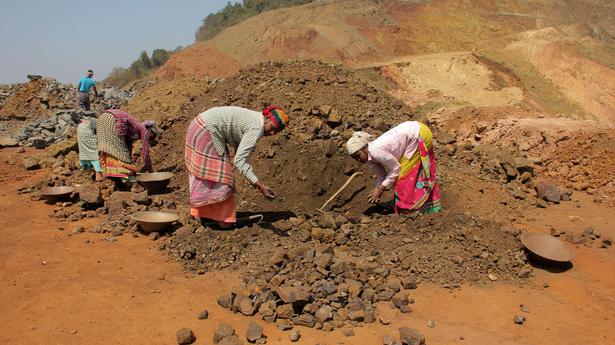
Gorumahisani, India’s first iron ore mine township is a picture of neglect despite 100 years of mining
The Hindu
Gorumahisani is located near the home town of Droupadi Murmu
Droupadi Murmu’s nomination as Presidential candidate may have propelled the little known Rairangpur in Odisha’s Mayubhanj district to claim a spot in country’s map now, but the region was not a ‘dull or ordinary’ place in the past. More than a century ago, the tribal heartland of Odisha had played a key role in laying the foundation for an incredible industrial journey.
About 20 km from Rairangpur lies Gorumahisani, which is India’s first iron ore mine, and widely dubbed as ‘mother mine’ for empire of Tata Steel that has grown to a global steel behemoth having crude steel capacity of 34 million tonnes per annum.
India’s legendary geologist P. N. Bose had written a letter to J.N. Tata (founder of Tata Steel) about the discovery of Gorumahisani Iron Ore Mine on February 24, 1904, which led to the establishment of Tata Iron and Steel Company at Sakchi (now in Jharkhand) on August 26, 1907. Bose was then State Geologist of Mayurbhanj princely state after his stint at the Geological Society of India.
The first iron ore rock, which was tested in London to ascertain the iron content in the first decade of 1900s, is still preserved in the mining area. The memorial is known as P. N. Bose Memorial.
Subsequently, then King of Mayurbhanj Sriram Chandra Bhanjdeo, who was considered to be ahead of his times, entered into an agreement with the Tata Iron and Steel Company Limited (TISCO Limited), (now Tata Steel) and granted lease of Gorumahisani iron ore mine.
“TISCO Limited was given prospecting licence for five years between 1905 and 1910 before being granted lease. The first 30 years of lease of Gorumahisani was granted to TISCO for a period of 30 years from July 1, 1910 to 30 June 1940. The lease was further extended by 30 years till 1969. This was perhaps the first mining lease formally executed in India,” said Rabindra Nath Patnaik, Rairangpur-based senior journalist
The TISCO surrendered the lease pre-maturely in 1969 before the expiry of the lease period, ostensibly due to some labour problem and high cost of production. Subsequently, the lease area over 1435.30 hectares was granted to Ghanshyam Misra on January 7, 1970 for 30 years.


First tranche of Rythu Bharosa released by CM Revanth

Collectors in Kanniyakumari and Thoothukudi inspect polling stations to ensure election preparedness ahead of Tamil Nadu's assembly elections.

The Vice-Chancellor of Rajiv Gandhi University of Health Sciences (RGUHS) B. C. Bhagavan said on Sunday that the university will soon open a research centre on Yoga and Naturopathy on 60-acre land in Bengaluru.

Parliamentary committee urges swift action to fully operationalise Lokpal's inquiry and prosecution wings amid rising corruption complaints.

Hyderabad paediatrician Dr. Sivaranjani Santosh faces legal action from pharma firms over her remarks on ORS labelling reforms.

Palla urges NDA leaders to unite for grassroots outreach, enhancing public trust through balanced welfare and development initiatives.

DRI seizes ₹8.3 crore in drugs and arrests three in Bengaluru, disrupting a major trafficking operation.

Jeevan Reddy announces his decision to part ways with Congress party

Yercaud's garbage to be processed through biomining, addressing waste management issues in the tourist town and surrounding panchayats.

India's gem and jewellery sector aims for a 15% boost in domestic sales by 2026 to counter export challenges amid war impacts.

Tamil Nadu's Fisheries Department will install 26,000 artificial reefs in Rameswaram to protect rare marine species and enhance fish breeding.

Deputy CM visits fire mishap site in Khammam district, vows proper compensation

Over 750 wheelchairs are prepared in Thoothukudi for accessible voting, ensuring convenience for differently abled and elderly voters.