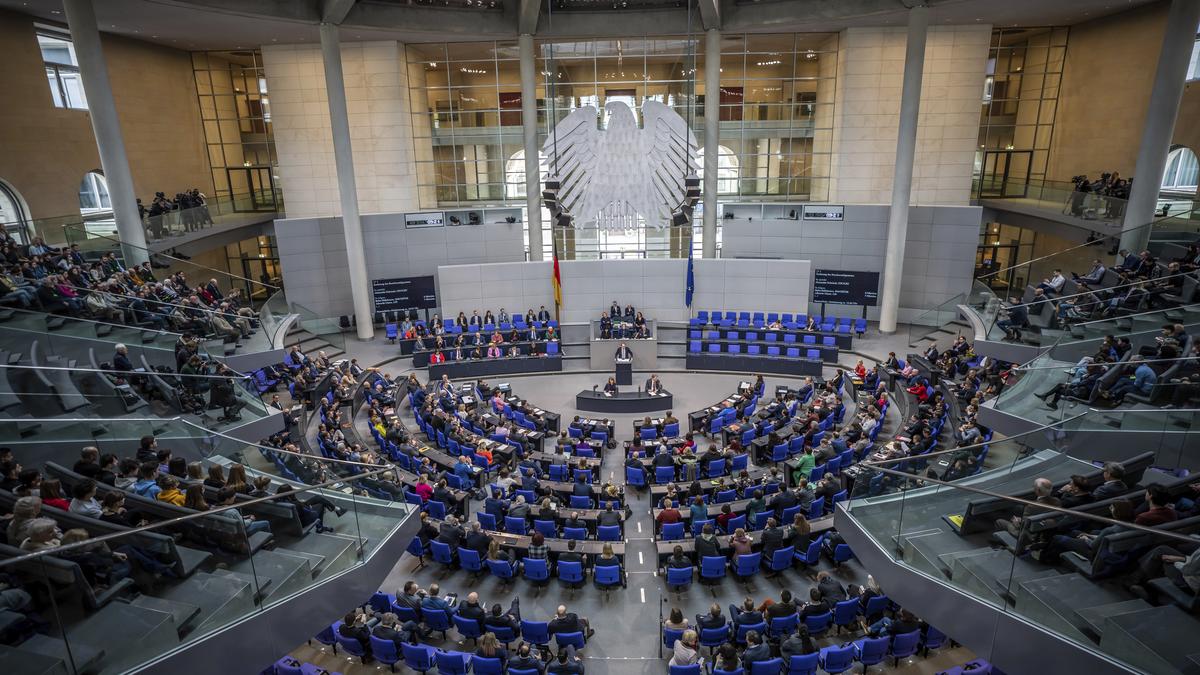
German lawmakers approve plan to shrink bloated parliament
The Hindu
Other proposals to reform the system have failed in recent years because of the difficulty of reconciling parties’ interests.
Lawmakers in Germany approved electoral reforms Friday that would educe the size of the country's increasingly bloated parliament, but two opposition parties were vehemently critical and the plan is expected to face a court challenge.
Parliament's lower house, or Bundestag, currently has a record 736 members. The changes approved on a 400-261 vote with 23 abstentions would reduce that number to 630.
Other proposals to reform the system have failed in recent years because of the difficulty of reconciling parties’ interests. Germany’s next national election is expected in the fall of 2025.
In German elections, every voter gets two votes: one for a directly elected candidate, the other for a party list.
Each of the country’s 299 constituencies elects its legislative representative directly by a simple majority vote. At least 299 further seats go to candidates elected on party lists. The list votes are critical because they determines the percentage of seats each party wins.
At present, if a party wins more seats via the direct vote than it would get under the party vote, it keeps the extra seats — but more seats are added for other parties to ensure the proportional vote is reflected accurately.
Because Germany’s traditional big parties have continued to dominate the direct vote even as their overall support has declined, that can result in the Bundestag having many more lawmakers than the minimum 598.


Russia claims control of Potapivka village in Ukraine's Sumy region amid ongoing military efforts to establish a buffer zone.

Iranian missile strikes on Israeli towns cause widespread damage and injuries, marking a significant escalation in the ongoing conflict.

As Gor makes first trip as U.S. Special envoy to South Asia, Delhi watches strategic signals closely
Sergio Gor's inaugural trip as U.S. Special Envoy to South Asia signals strategic U.S. engagement amid regional tensions.

Slovenians vote in a tight election between liberal and populist candidates, impacting the country's future domestic and foreign policies.

Netanyahu asserts U.S.-Israel alliance fights Iranian threats, emphasizing global security after missile strikes on Israeli and European targets.

Israeli settlers attack Palestinian villages in the West Bank, causing injuries and destruction amid ongoing settlement expansion.

Britain asserts no evidence of Iran planning missile strikes on Europe, despite Israeli claims of missile capabilities.

UNESCO reports over half of countries have banned phones in schools due to concerns about attention, cyberbullying, and social media impact.

Analysis reveals a U.S.-operated Patriot missile likely caused a pre-dawn explosion in Bahrain, injuring numerous civilians.

Sri Lanka raises fuel prices by 25% amid ongoing West Asia conflict, impacting petrol and diesel costs significantly.

Iran strikes near Israeli nuclear research center as Trump threatens attacks on Iranian power plants
Iran's missile strikes near Israel's nuclear site escalate tensions as Trump threatens retaliation against Iranian power plants.

Saudi Arabia intercepts one of three ballistic missiles targeting Riyadh amid ongoing regional tensions and threats from Iran.

Iran's death toll exceeds 1,500 amid escalating war, with heavy airstrikes and shifting U.S. and Israel strategies reported.