Gendered politics of Gaanewali’s ghazals
The Hindu
Mumbai-based O Gaanewali delves into the history of ghazals with their performances
By Gaurika Mehrotra
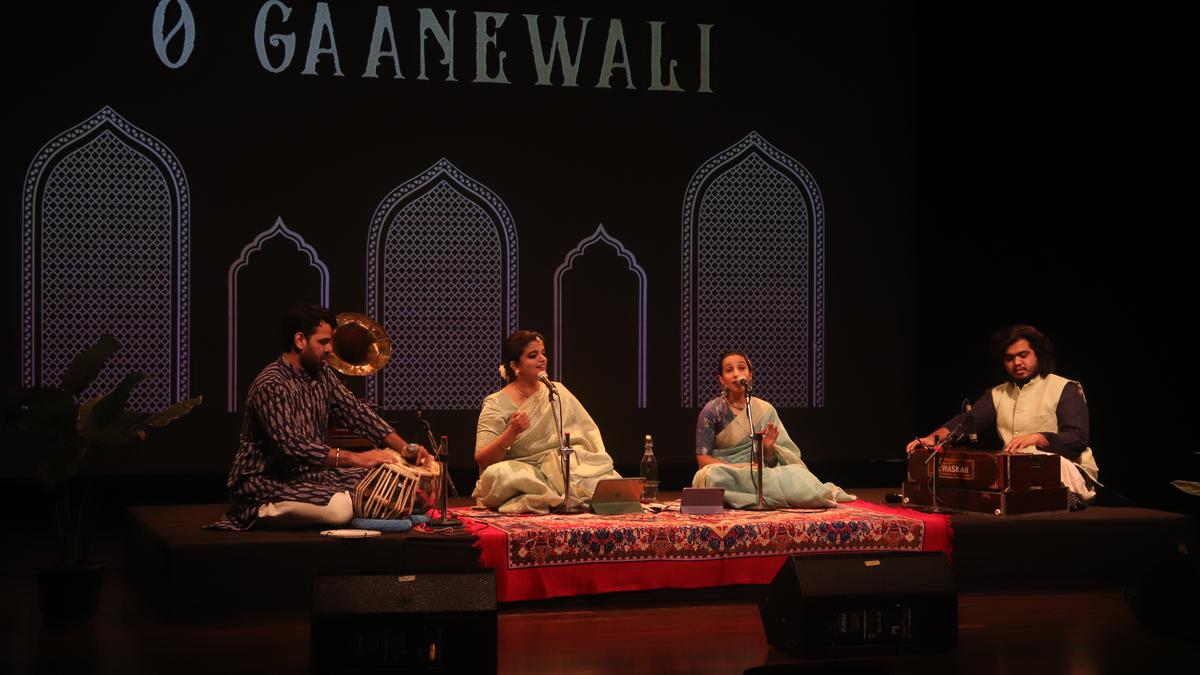
O Gaanewali, a music group from Mumbai, recently performed at the Bangalore International Centre. As producer and vocalist Avanti Patel’s voice rang through the air, delivering her very first line of the evening, Kale baadal gher hai, the audience was transported to the age of gaanewalis and nachnewaalis — the tawaifs of India.
As this intoxicating mehfil wove its charm around each seated member, the performers painted intricate tales of these magnificent women artistes. The baithak alternated between mellifluous ghazals and the stories of the women who composed and sang them.
“I am never not going to talk about women,” Avanti said in an interview prior to the performance. “To have the female gaze in a ghazal is very rare — when it was in fact the ustaads and the pandits who co-opted this genre from the tawaifs,” she said.
Vocalist Rujuta Lad shed light on the esoteric education that these courtesans received in comparison to the women of their era. “These were highly intellectual women, fluent in languages such as Farsi and Urdu, despite it being considered inappropriate for respectable women to perform on stage,” she shared.
Notwithstanding their creative genius, there were attempts to sanitise their music of sensual elements and people claimed that the only way to “save” these trendsetters of Indian music was to marry them off. In fact, these women needed no saving from men. Being among the highest tax payers to the British government, their coffers were overflowing!
The audience was witness to a strong rapport between the harmonium player Apoorv Petkar and the tabalchi Akshay Jadhav. His fingers rolled away on the tabla, against the backdrop of the complementary timbres of the female voices.


South African naturalist Steve Boyes speaks on ghost elephants, ancestral tracking, and Werner Herzog’s documentary exploring Angola’s elusive highland giants

Actor-director Amol Palekar will receive META's Lifetime Achievement award for 2026 on March 25 in New Delhi.

India's artists unite against rising censorship, advocating for creative freedom and support for marginalized voices in the arts.

Written and directed by Kunal, the film also stars Sparsh Shrivastava and Vanshika Dhir

This year, Bharatnatyam artistes will present the Tyagaraja Aradhane as a dance performance

This year, Bharatnatyam artistes will present the Tyagaraja Aradhane as a dance performance

The actor, along with director Sushant Shah, speak about their upcoming series ‘Chiraiya’, Divya’s process of working on the dialect, Sushant’s approach to telling a story about women, and more

An independent video, ‘Feel the Spark’ by Raleigh Rajan with vocals by Ciera Dumas that celebrates Tamil literary giants, garnered 1.4 million views in less than 36 hours.

In ‘Jack Ryan: Ghost War’, John Krasinski is back as the savvy CIA analyst, diving headfirst into a high-stakes mission that unravels a deadly conspiracy and pits him against a rogue black-ops unit

Shriram Bharatiya Kala Kendra’s Shankarlal festival showcased rare ragas, radiant artistry, and inclusive performances, from Pt Madhup Mudgal’s serene morning ragas to Ramana Balachandran’s Saraswati veena.

Explore "Threads that Bind: The Kantha Project," an exhibition in Delhi reimagining kantha as a medium of repair and renewal.

Sean Penn skips the Oscars to meet Ukraine's Zelenskyy, who praises him as a "true friend" amid the war.

The teaser of Tamil star Suriya’s much-awaited film with director Venky Atluri, titled Vishwanath and Sons, was unveiled by the makers on Monday