‘Gandhiji realised the making of India as a nation did not require erasure of linguistic diversities in the European way’ Premium
The Hindu
The roots of the "one nation, one language" debate in India can be traced back to colonial-era Europe.
The “one nation, one language” debate has been simmering for a while now, with leaders of the ruling party, from time to time, proposing Hindi as a medium to unify the country.
What few people may know is that the roots of the idea of a national identity based on a single language can be traced back to colonial-era Europe. And it was challenged during the Indian freedom struggle by none other than Mahatma Gandhi.
The idea of “one nation, one language” or that every language group will have its own nation took shape in the late 19th and early 20th century European political theory, said Ashutosh Varshney, political scientist, academic and Sol Goldman Professor of International Studies and the Social Sciences at Brown University.
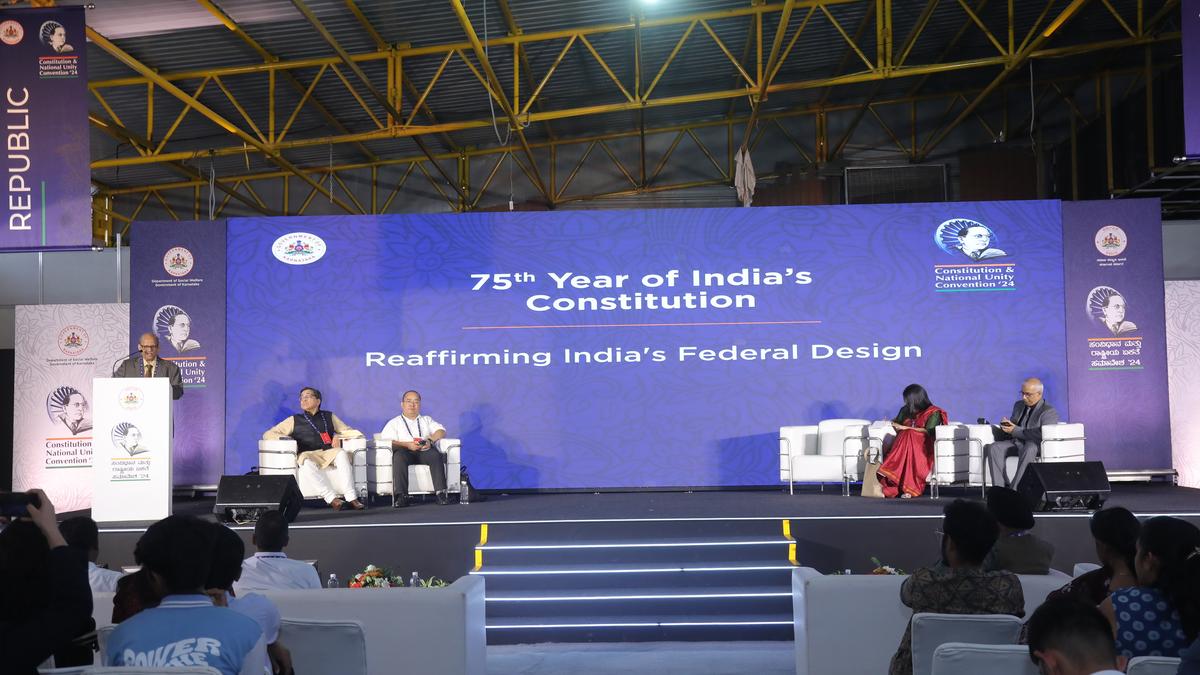
“Led by Mahatma Gandhi, the freedom movement fundamentally challenged the dominant concepts of nationhood in the late 19th and early 20th centuries,” he said, speaking at the Constitution and National Unity Convention held by the Karnataka government in Bengaluru.
“As with so many things in modern political theory, it begins with John Stuart Mill,” Varshney said.
John Stuart Mill, also known as the father of modern liberalism, was an English intellectual, philosopher and economist of the 19th century.
“In his great text Representative Government, 1869, John Stuart Mill wrote linguistic diversity was a ‘special, virtually insuperable hindrance to nation making’. This is about the improbability of Indian nationhood,” Varshney said.


Diya Chitale and Manav Thakkar reach semifinals, while Yashaswini Ghorpade upsets top seed Sreeja Akula at National TT Championships.

DYFI criticizes A.P.'s job calendar for failing unemployed youth, demanding a revision to include 1 lakh posts and higher age limits.

‘Lethargic’ officials who left Chambal sanctuary to the mercy of sand miners will be held liable: SC
Supreme Court holds negligent officials accountable for enabling illegal sand mining in Chambal Sanctuary, emphasizing habitat protection laws.

Work on the Srisailam Left Bank Canal tunnel resumes after 13 months, with completion targeted by 2027-end, says Minister Reddy.

Ancient ‘Vanni’ tree at Sri Meenakshi Sundareswarar Temple tilts; steps on to restore it

Bengaluru Metro penalises 14 passengers for disrupting services with loud singing, following a viral clip of their antics.

ASR district plans a 122 km world-class trekking network, enhancing tourism and local employment across Araku, Paderu, and Lambasingi.

Development without impact: Coastal residents of Kanniyakumari and Nagercoil constituencies voice discontent

Environmentalists in Kakinada celebrate World Sparrow Day, urging conservation efforts for sparrows and migratory birds.

T.K. Govindan secures full support from K. Sudhakaran for Kerala Assembly polls 2026 as a UDF-backed Independent candidate.

Karnataka implements weekly reviews and control rooms to combat rural drinking water shortages during the summer months.

BJP leads candidate selection for upcoming bypolls, while Congress faces internal challenges and community pressure in Bagalkot and Davangere.

A man died in a Kolkata hospital lift, prompting accusations of negligence against the West Bengal government and hospital authorities.