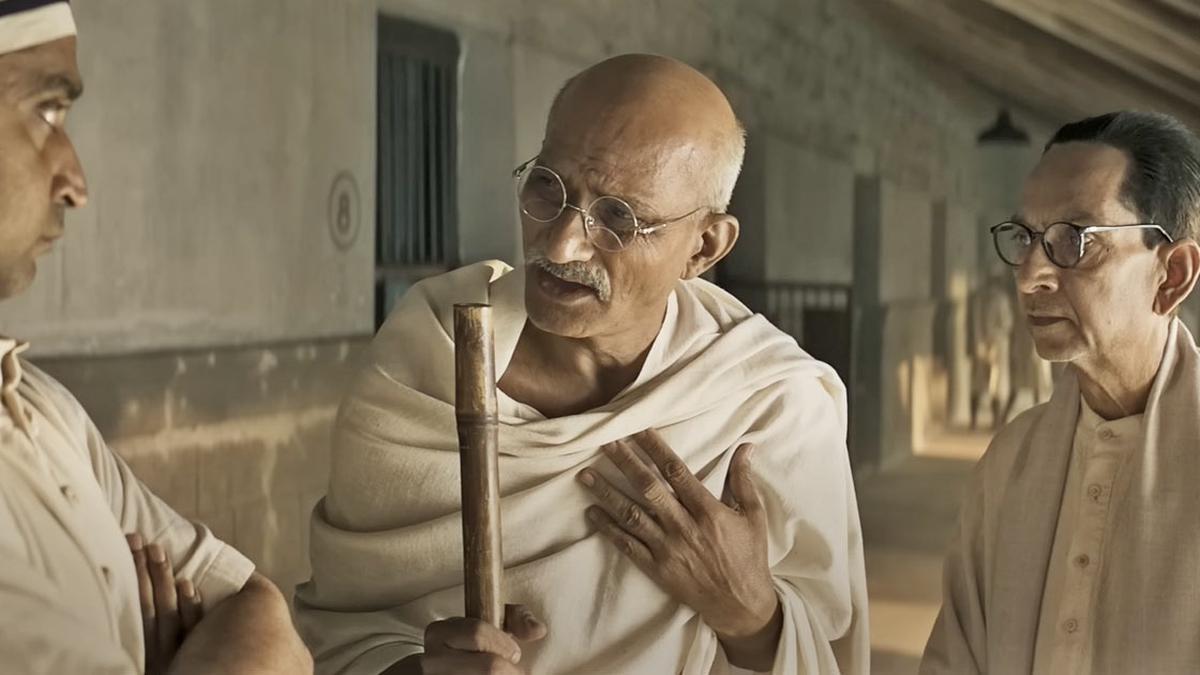
‘Gandhi Godse: Ek Yudh’ movie review: A timely dialogue on the idea of India
The Hindu
At a time when the Hindutva ideology has seen a spike, director Rajkumar Santoshi denies Godse the pleasure of martyrdom and allows him to evolve. At the same time, he attempts to humanise and critique Gandhi in his parallel universe
At a time when history is being fictionalised, director Rajkumar Santoshi uses creative licence to bust the canards that have been allowed to fester over the years to delegitimise Mahatma Gandhi in public conscience. From being called a pawn of the Empire to faking fasts, a notion has been created that Gandhi forced the first government of independent India to release Rs 55 crore to Pakistan.
The film suggests that it triggered Nathuram Godse to kill Gandhi on January 30, 1948. Santoshi revisits the events leading up to Gandhi’s assassination and then takes a leap into an imaginary space where Gandhi survives the three bullets that Godse pumped into his chest and seeks a dialogue with him.
Based on prominent Hindi scholar Asghar Wajahat’s play, one could question the need to provide a platform to Godse and create a false equivalence with Gandhi, but as the film progresses it becomes clear that Gandhi and Godse are just metaphors. The idea is to initiate a dialogue on the idea of India that got diminished at the time of the partition of the country. Instead of brushing the divide under the carpet of euphemisms, it experiments with the bitter truths and seeks to find a middle ground.
When Gandhi tells Godse his ideology has weakened both Hindustan and Hinduism and impaled the idea of inclusivity that defined India for centuries, he answers Godse’s supporters who keep selling the majoritarian fear for vested interests. When charged with appeasement of Muslims, he simply asks Godse to travel across the country to get a sense of the diverse culture he loves to protect. When a prisoner asks Godse whether he threw any stone at the British government before firing at Gandhi, the disciple of Savarkar doesn’t have any answer.
At a time when the Hindutva ideology has seen a spike, Santoshi, who once upon a time brought Bhagat Singh back into national imagination, denies Godse the pleasure of martyrdom and allows him to evolve. At the same time, he attempts to humanise and critique Gandhi in his parallel universe.
Unlike Richard Attenborough, the film probes Gandhi’s personal space and questions his idea of celibacy where physical love is seen as a disorder and how he inflicts psychological violence on those close to him. He also addresses how the Gandhian idea of gram swaraj would have come in the way of government functioning as he could see the poor and the marginalised were yet to be freed. Here is a who man doesn’t allow non-violence to become a cover for lack of courage.
It provides space to figures like Bhimrao Ambedkar who had ideological differences with him and questions Congress leaders on their decision to turn a movement into a political party. But the bottomline is in the battle of ideas; you don’t silence people with bullets. As Gandhi says, you can’t achieve goodness by evil means.


South African naturalist Steve Boyes speaks on ghost elephants, ancestral tracking, and Werner Herzog’s documentary exploring Angola’s elusive highland giants

Actor-director Amol Palekar will receive META's Lifetime Achievement award for 2026 on March 25 in New Delhi.

India's artists unite against rising censorship, advocating for creative freedom and support for marginalized voices in the arts.

Written and directed by Kunal, the film also stars Sparsh Shrivastava and Vanshika Dhir

This year, Bharatnatyam artistes will present the Tyagaraja Aradhane as a dance performance

This year, Bharatnatyam artistes will present the Tyagaraja Aradhane as a dance performance

The actor, along with director Sushant Shah, speak about their upcoming series ‘Chiraiya’, Divya’s process of working on the dialect, Sushant’s approach to telling a story about women, and more

An independent video, ‘Feel the Spark’ by Raleigh Rajan with vocals by Ciera Dumas that celebrates Tamil literary giants, garnered 1.4 million views in less than 36 hours.

In ‘Jack Ryan: Ghost War’, John Krasinski is back as the savvy CIA analyst, diving headfirst into a high-stakes mission that unravels a deadly conspiracy and pits him against a rogue black-ops unit

Shriram Bharatiya Kala Kendra’s Shankarlal festival showcased rare ragas, radiant artistry, and inclusive performances, from Pt Madhup Mudgal’s serene morning ragas to Ramana Balachandran’s Saraswati veena.

Explore "Threads that Bind: The Kantha Project," an exhibition in Delhi reimagining kantha as a medium of repair and renewal.

Sean Penn skips the Oscars to meet Ukraine's Zelenskyy, who praises him as a "true friend" amid the war.

The teaser of Tamil star Suriya’s much-awaited film with director Venky Atluri, titled Vishwanath and Sons, was unveiled by the makers on Monday