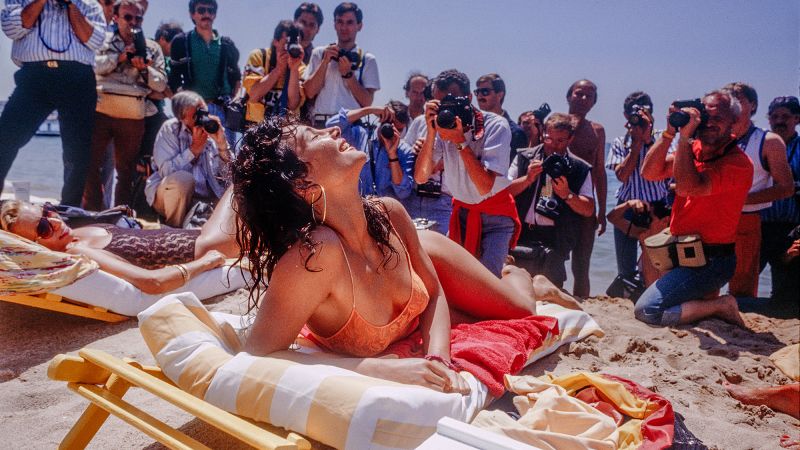
‘Fun, crazy and ludicrous’ images of Cannes before camera phones
CNN
This year’s festival will largely be experienced via social media, but photographer Derek Ridgers remembers capturing a different era of the event — in the 1980s and 1990s, without a single cell phone in sight.
Photographer Derek Ridgers’ introduction to the Cannes Film Festival arrived in 1984, when he was commissioned to shoot the DJ and rapper Afrika Bambaataa — in town to promote his cameo in Stan Lathan’s “Beat Street” — for the music magazine, NME. “I don’t think I’d ever really thought about Cannes, or the film festival, before I went,” Ridgers, widely celebrated for his distinctive portraits of British subcultures, told CNN via email. “Every year one sees items about it on TV, but it hadn’t impacted my life in any significant way.” Ridgers would return to the French resort town a further 11 times, during which he said he “only ever saw two films” — “Beat Street” and Thaddeus O’Sullivan’s “December Bride” (he’d been at art school with the director). “If you’re on the French Riviera and the sun’s out, why would you choose to go to the cinema if you didn’t have to?” he reasoned. Instead, Ridgers focused on the compelling and sometimes controversial scenes that unfolded around him, shooting celebrities, young models and upcoming actresses, as well as fellow photographers. Three decades on, some 80 images from Ridgers’ archive have been brought together in a new book, “Cannes,” published by IDEA. The festival it presents is in many ways a different kind of spectacle to its contemporary iteration. This year’s edition, which runs through May 24, will largely be experienced via social media (the official Festival de Cannes Instagram page has 1.3 million followers alone, while thousands of tagged videos populate TikTok). In Ridgers’ pictures, made in the 1980s and 1990s, there’s not a single cell phone and barely a point and shoot camera; star-making-moments, political statements and fashion history were all typically reported by TV and printed media. “My interest has always been people and, I suppose, a study of the human condition,” said Ridgers, who, alongside his professional assignments, spent much of the 1980s and the decade prior documenting London’s punks, skinheads and New Romantics. “The film festival was my first extended foray into reportage, but it’s still all people doing what people do,” he noted, reflecting on how his book “Cannes” was shaped by this same curiosity, in tandem with his rejection of the more traditional red carpet set-up. “There’s so much of life’s rich pageant on show during Cannes, there are great photographic opportunities almost everywhere,” he continued. Shooting both in color and black and white, Ridgers captured icons such as Clint Eastwood, Helmut Newton and John Waters, as well as then-up and coming models like Frankie Rayder, who appears on the book’s cover dressed in diamonds and fur (the surrounding crowd adopting casual jeans and T-shirts), and performers attending the Hot D’Or adult film industry awards too, including the late Lolo Ferrari. “During the years I was going, the film festival seemed to become a bigger and bigger deal,” shared Ridgers. “When the porn stars were having their awards show there as well (the Hot D’Or’s ran from 1992-2001), that added a layer of craziness and made for some interesting photographic juxtapositions. The main film festival seemed to take itself awfully serious, and having the porn stars there lightened the mood somewhat.”


With his maxi leopard print Chanel bag, the pop star issued a loud and proud proclamation that he got his hands on one of the most in-demand, status-bestowing styles of the moment.

Millions more adults should consider starting cholesterol-lowering medications earlier to reduce their risk of heart attack and stroke, according to new medical guidance.

At Paris Fashion Week, there were luxuriously plain black dresses and coats of the kind favored by Carolyn Bessette Kennedy, models strutting down runways with theatrical flourishes, and in some cases, no cellphones in sight.

Roughly one-third of respondents – equivalent to more than 82 million Americans – said they have had to cut back on at least one daily living expense to cover their health care bills, according to a new survey.

Before South African high school students complete their final exams, they first walk the red carpet, pulling out all the stops for their celebratory matriculation, or ‘matric,’ balls. The photographer Alice Mann documented the increasingly lavish dances for five years in her new book, “The Night is Young.”

The drug leucovorin was touted by the Trump administration in September as a potential treatment for thousands of children with autism. Now, some parents and guardians of children with autism say they feel abandoned by the US Food and Drug Administration’s new stance on leucovorin.

The prescription drug leucovorin is getting a label update, though it’s not what that the US Food and Drug Administration suggested might be coming during a White House briefing in September, when officials touted the drug as a potential treatment for thousands of children with autism.

With the release of “The Bride!” we asked scholars, film curators and experts in Mary Shelley’s work why so few women have tackled the Frankenstein story — and the impact that has on how we make sense of the 200-year-old tale.

In front of the Louvre Pyramid, Eileen Gu stepped out this week wearing a set of diaphanous wings — a fitting ensemble for an Olympic athlete whose sport sends her airborne.

Meagan Johnson recently spent four days calling dozens of pharmacies around Austin, Texas, trying to fill a prescription for her son, Jack.

Evidence is mounting that the wildly popular weight-loss medicines known as GLP-1s may also hold potential for treating addiction, and the field may be on the verge of obtaining desperately needed answers through more study.

Known for her blistering pace and powerful shots, the soccer player is having a Barbie made in her likeness as the toymaker names her as role model of the year.

The Screen Actors Guild Awards are back with a new name — and a thematic dress code.