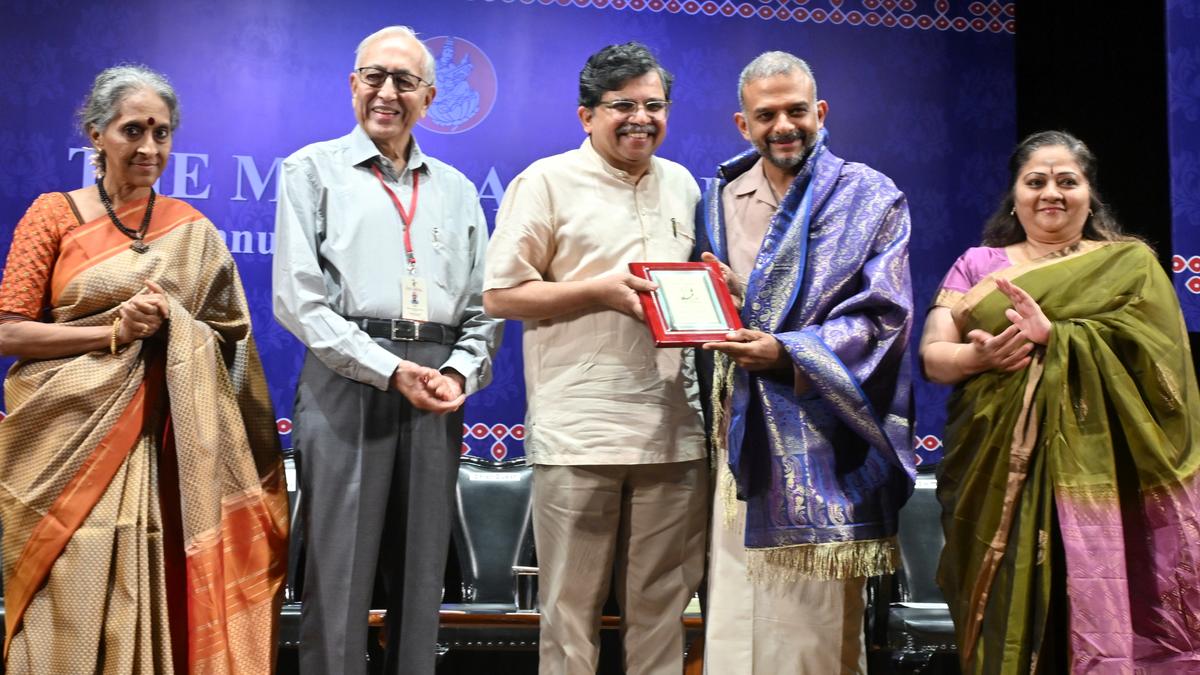
Full speech of T.M. Krishna while accepting Sangita Kalanidhi M.S. Subbulakshmi Award
The Hindu
Respected figures in the world of Karnatik music reflect on tradition, evolution, and the future of this art form.
Respected Justice S. Muralidhar, former Chief Justice of the Orissa High Court; President of The Music Academy Mr. N. Murali; Sangita Kalanidhi Dr. S Sowmya, Sangita Kalanidhi Bombay Jayashri Ramanth, vice- presidents, secretaries, committee members of The Music Academy, artists of song and instrumental, practitioners of dance, and its accompanying arts, friends and connoisseurs of music, my namaskarams to all of you. M S Subbulakshmi - the very name carries in it the mystique of the temple town Madurai and the extraordinary musical soarings of Sangita Kalanidhi M S Subbulakshmi. For a singer like me to receive an award instituted in her memory is not just a signal honour but a blessing. Even more, it carries with it a responsibility: that I sing not just with my trained voice , not just with a concentrating mind , but with my very being, my life, my all. I thank The Hindu for reposing that responsibility on me.
It is indeed an honour to be standing before you on this stage, a proscenium on which I have witnessed – ‘experienced’ would perhaps be the right word – memorable musical moments, some that have transformed my life forever.
I began learning Karnatik music as a young boy with no idea of why I was doing so. Little did I know then that I was entering an aural topography that would so infuse my imagination as to eventually become me. Even while we study, and practice this artform, we are not fully aware of what it has to offer. We learn music, with an almost mechanical fidelity , initially doing just as we are told. As time goes by, whatever we were instructed in becomes ingrained as habit and we are convinced that the repetitive act is creative and more – it is creative freedom! Honing our techniques, expanding our repertoire, replicating concert success and upskilling keeps us busy. Pleasing the audience is pleasing and applause becomes in itself a kind of music to the musicians’ ears. We are left with little time to pause and reflect on the music and ourselves. Our minds are so fixed on performance that the stage takes over the song. Questions such as ‘Why am I singing this musical form?’ and ‘What am I sharing with all of you every time I take the stage?’ seem too abstract and esoteric as to warrant contemplation. But asking them is essential if we want to truly immerse
in the splendour of this art form. Any cultural or intellectual initiative requires the canopy of an overarching philosophical framework. It is within the shelter of that structure that the details, even the nuts and bolts, have to be worked on. If we do not, all we will have is a rudderless ship.
As it has been said before by many great musicians, India’s gift to the world of music is the Raga, which is at the very core of Karnatik music. Every moment in a concert is drenched with the fragrances of the ragas that we delve into. Raga is both a singular melodic possibility and its own plural. A concert needs to be a Raga experience. In a non-musical sense, Raga is an evocative or evoked state.
We can neither dictate one emotion nor confine it to one feeling. Every individual draws what she, they or he seek from it. Musically, I would further enlarge the word and include within its meaning tala, laya, sahitya, sollukkattu and every rhythmic sound. Then, the question that we need to ask ourselves is, are we evoking Raga ?
When Vidvan Semmangudi Srinivasa Iyer opened the shloka Moulou Ganga, hovering on the Panchama; when Vidushi T. Brinda sang emanadiccevo, and the first syllables ‘emana’ stood tantalisingly on the rishabha; when Vidvan M.D. Ramanathan glided across an entire octave, eschewing commonly heard gamakas; when Vidushi M.S. Subbulakshmi’s every sangati in an alapana dazzled like the stars in the sky; when Palghat Mani Iyer executed a pharans at the speed of sound; when Pazhani Subramanya Pillai played his trademark korvais; when S. Balachandar tugged at the vina’s strings stumbling upon one gem after another, ignoring even the need for a ‘pluck’; and when Vidvan V. Nagarajan’s strokes thundered on the Kanjira, they were embracing raga and inviting us into its domain.


Explore the behind-the-scenes of political strategy with "Inside the War Room," a must-read for aspiring politicians and managers.

Villivakkam faces civic challenges despite infrastructure improvements, with residents demanding better healthcare, transport, and green spaces ahead of elections.

District Collector launches e-dip lottery for Settipalle land plots, benefiting 2,111 beneficiaries with planned infrastructure development.

Chengalpattu's horticulture farm launches herbal tea, Idhazh, made from sun-dried hibiscus and organic herbs.

Hyderabad is set to become a global film hub, says CM Revanth Reddy at TGFA 2025, highlighting its cinematic potential.

Sivananda Damodara Pai appointed head of RMC Chennai, known for advancing seasonal rainfall and temperature forecasting models.

Madurai Collector chairs meeting with Election Observers

CBI interrogates Anil Ambani in a ₹2,929-crore cheating case involving alleged loan fund irregularities from State Bank of India.

Tamil Nadu's 2026 election features intense competition among established parties and a new disruptor, promising unique voter choices.

Explore the contrasting management styles of England and India cricket teams, highlighting player support and development challenges faced by Liam Livingstone and Sanju Samson.

Modi and Jaishankar advocate for dialogue as India and France collaborate to de-escalate tensions amid escalating strikes on energy infrastructure.

The star-studded event was held in Mumbai and was attended by rithik Roshan, Alia Bhatt, Bobby Deol, Shahid Kapoor, Vijay Varma, Sonakshi Sinha, Jyotika, Ali Fazal, Sonali Bendre, Preity Zinta, Ravi Kishan and others

Shorts News:We are working on securing LPG, petroleum to meet our energy security needs: MEA