From the frontlines: what we see when we look at suffering Premium
The Hindu
The New York Times unveils a catalogue of images marking the aftermath of Israel's assault on Gaza.
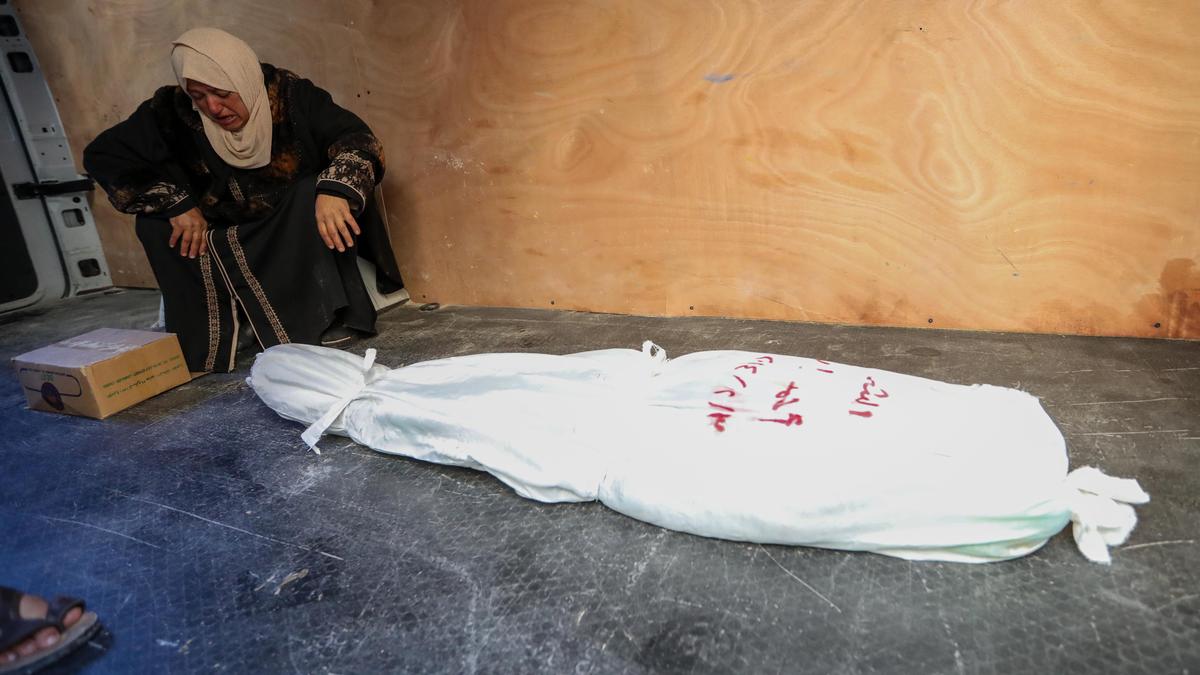
It has been a little over five months since Israel’s assault on Gaza. To mark this dismal occasion, The New York Times unveiled a catalogue of images in early March 2024. The online gallery opens with a stark portrayal: Palestinian women grieving for their loved ones lost in Israeli airstrikes at the al-Najjar hospital in Rafah. The photograph zooms in on three anonymous women, their faces etched with anguish. In the frame’s centre, a woman embraces two children, unaware of the camera’s intrusion. The photographer appeared to have interrupted a moment of private grief. By looking at it, we too turn into voyeurs.
The Times arranges the photographs chronologically so that as we scroll down, we are guided through the different stages of human suffering since its unfolding in October 2023. It labels Palestinians and Israelis distinctly on their website, suggesting universal suffering. Photography aspires towards objectivity despite war’s bias.
This was impossible, Susan Sontag argued. “War was and still is the most irresistible — and picturesque — news,” she emphasised. Her acerbic words are difficult to overlook. It is an idea she expanded in her works, On Photography (1977) and Regarding the Pain of Others (2003).
We live in an age of images. We are seen, and sometimes we see. We are both observers and the observed, caught in the perpetual exchange of scrutiny. We have come a long way from Talbot’s Pencil of Nature (1844) or Joseph Nicéphore Niépce’s “heliography.” We’ve taken a leap from Louis Daguerre’s once revolutionary metal plates to Open AI’s DALL-E. We make images just as they make us.
Indeed, in making such progress, we have had to confront our role concerning the technologies of image-making. What makes images human? Is a photograph different from other forms of visual images? John Berger, the renowned art critic and historian, seemed to think so.
In his discerning ode to photography, About Looking (1991), Berger asserted that, unlike other forms of visual images, a photograph was not an interpretation or an imitation of its subject but rather a trace of it. While the human eye and camera both “registered” an image, a camera did what the human eye could not. It “fixed” the appearance of the event. It froze time. Berger’s words are a discerning annotation to Susan Sontag’s celebrated On Photography (1977). Unlike Berger, Sontag is dramatic in her assessment. “Reality has always been interpreted through the reports given by images,” she asserted on an occasion.
A photograph had little power to summon the past, they insist. Marcel Proust, the author of the monumental In Search of Lost Time (1913-27), was distinctively unimpressed by its influence. The photographic process, its output, and the voluntary deliberateness of the past thus evoked seemed shallow to him. Berger reminds us that while Proust’s judgment may seem harsh, it is inevitable. Before the advent of the camera, humans had no means of capturing appearances. The faculty of memory came close. Despite this, Berger clarifies, “unlike memory, photographs do not in themselves preserve meaning. They offer appearances –”


Parliament Budget Session LIVE: Follow The Hindu's latest updates on the Parliament Budget Session on March 23, 2026.

T. Nagar faces severe infrastructure challenges amid commercial growth, impacting emergency services and resident quality of life.

Five individuals detained after a man's death due to a lift malfunction at R.G. Kar Hospital in Kolkata.

In 2014, Amazon introduced its first smartphone, hoping to take on Apple and Samsung. Instead, the Fire Phone, overseen directly by founder Jeff Bezos, was scrapped in barely over a year, one of Amazon’s highest-profile flops.

A data jam on March 28 by OpenCity will have participants studying how the Assembly constituencies in and around Chennai are faring on a set of parameters

IUML files police complaint over a fake Facebook post targeting its leader, warning against misinformation and potential legal action.

Experience global flavors at Vizag's 'World Flavours' food festival, celebrating cultural unity through authentic international cuisines.

Three men were killed in a road mishap after their mini truck crashed into a stationary truck near Medahalli in east Bengaluru on Saturday night, police said.

Kerala's critical sectors face LPG shortages despite a 20% relief allocation, impacting restaurants and hotels significantly.

Explore the Sattankulam custodial torture deaths of P. Jayaraj and his son J. Benicks, revealing a shocking tale of police brutality.

Explore the Sattankulam custodial torture deaths of P. Jayaraj and his son J. Benicks, revealing a shocking tale of police brutality.

The 2026 Assembly elections in India will involve Assam, West Bengal, Kerala, Tamil Nadu, and Puducherry across 824 constituencies.

Ernakulam initiates a drive to recycle old clothes into eco-friendly mobile holders for polling stations, promoting sustainability.