From a rules-based world to shambolic disorder Premium
The Hindu
Even prior to the Trump phase in the United States, there were enough signs that the world was witnessing uncertainty across many sectors and there is little hope of change for the better
Even prior to the Trump interlude in the United States, there were enough signs that the world was witnessing uncertainty across many sectors. This was a heralding of problematic conditions in many areas of the globe, and policymakers, strategists and business leaders had begun to prepare for more difficult times ahead. Some did, however, hew to the view that new analytical tools and strategic methodologies which were in use would help mitigate the levels of uncertainty in the course of time.
Notwithstanding this, the majority adhered to the view that the recent shifts in global hegemonies, the spate of disruptive technologies and also prevailing geopolitical tensions were certain to herald more disruption, accompanied by an increase in geopolitical tensions and economic tsunamis. The general consensus, hence, is that given the influence wielded by leaders such as Xi Jinping of China, Vladimir Putin of Russia, and Donald Trump in the U.S. — not excluding the role of leaders such as Ukraine’s Volodymyr Zelenskyy, intent on disrupting the existing order — there is little hope of change for the better.
Few parallels, perhaps, exist for this state of affairs, at least in the recent period. Many also hew to the view that this is the beginning of a new phenomenon in the history of the world — one which has the potential to not only disrupt but also overturn the existing order. Such a situation, many also believe, would be very different from what had existed since the early 21st century, which was marked by considerable turbulence.
The U.S., which since 1945, had trumpeted the view that it is the fountainhead of democracy, is itself beginning to witness disruption of a kind that it has not seen in recent centuries. One consequence of this has been an escalation in tensions between the U.S. and several other countries. Most important, however, is that the situation is leading to what some experts estimate to be a ‘cauldron of unexpected consequences’.
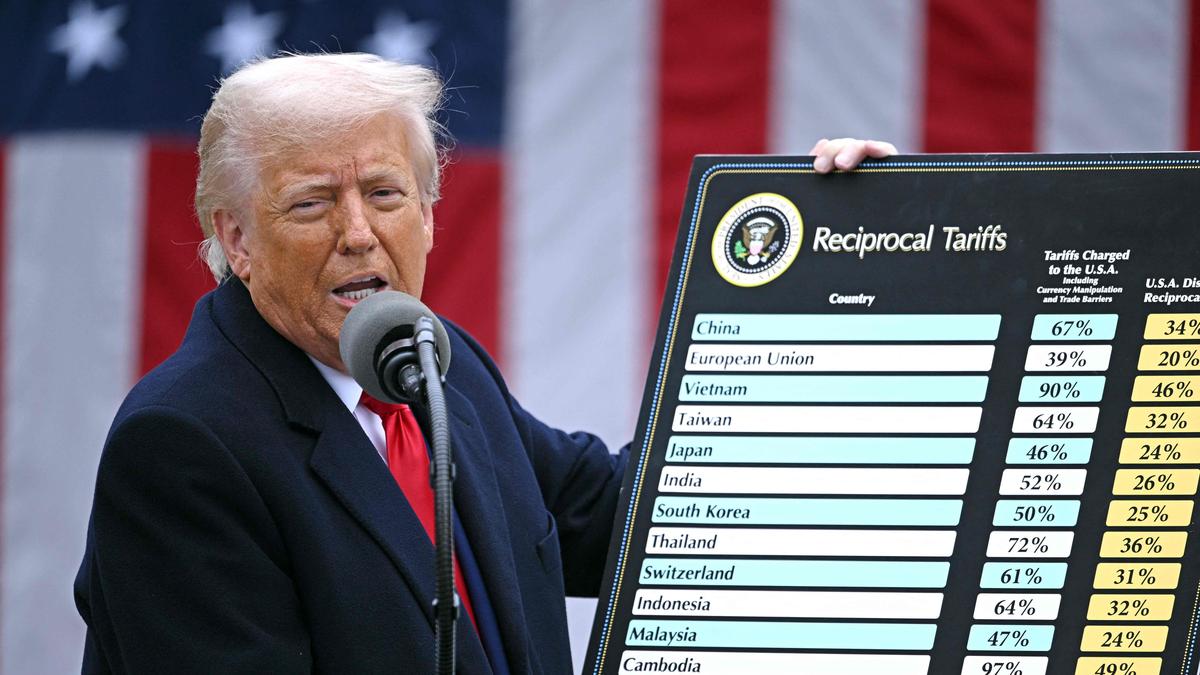
Today, the U.S. appears like a nation divided. Seen as a pillar of democratic stability, it is currently grappling with profound internal divisions. This. in turn, has had an adverse impact on its relations with countries across the globe. One reason for this is, no doubt, Mr. Trump’s new tariff war — which demonstrates a profoundly transactional approach — the impact of which has been to turn the world upside down. This is having a highly unsettling effect on global trade. Already leading economists assess that the impact of tariffs has led to sharp decline in the growth potential of the U.S., and brought down its GDP.
The U.S. President also seems not unwilling to shoot himself in the foot. Trumponomics now involves inflicting crippling wounds on world famous educational institutions such as Harvard and Columbia. It has targeted foreign students (who reportedly contribute over $40 billion to the U.S. economy, and sustain over 4,00,000 American jobs). This again is likely to adversely impact the future of the U.S., and, incidentally, its intrinsic capabilities.
In the meantime, with Mr. Trump’s ascendancy, Europe finds itself in a serious dilemma. Embroiled in a conflict with Russia over Ukraine for the past three years (which shows no signs of ending, despite recent peace efforts initiated by Mr. Trump), what Europe is now staring at is pronounced uncertainty about its future and that of the North Atlantic Treaty Organization. The European Union is today a pale shadow of what it appeared to be only a few months back — Mr. Trump’s recent diatribes about Europe’s inability to defend itself is further adding to concerns about its future.


Anuradha Jonnalagadda took over as in-charge Vice-Chancellor of the University of Hyderabad, focusing on continuity during the transition.

Telangana government awaits committee report on TGSRTC staff absorption, with decisions to be made at an appropriate time.

Telangana's revised pay scale implementation for employees will take timer. The tenure of Pay Revision Commission extended. Govt likely to take decision on reccomendation based on its report.

Vizianagaram's SP A.R. Damodar highlights 20 accident-prone areas and urges drivers to prioritize safety with helmets and seat belts.

Kerala HC stays disqualification of SNDP Yogam leaders, reversing a single judge's order regarding financial and regulatory compliance issues.

Karnataka announces daily supply of 10,000 LPG cylinders to hotels, easing the commercial shortage for the hospitality industry.

Malayalam superstar Mohanlal will be reuniting with filmmaker Priyadarshan, it was announced recently. It will mark the 100th film of Priyadarshan and is backed by Mohanlal’s longtime collaborator, Antony Perumbavoor

Gautham Vasudev Menon loses Madras High Court appeal, ordered to pay ₹4.25 crore to R.S. Infotainment with interest.

AIADMK faces its toughest challenge in 53 years as it prepares for the crucial 2026 T.N. Assembly elections.

Lakmé Fashion Week x FDCI 2026 in Mumbai: What worked and what didn’t

Telangana CM announces underpass beneath Begumpet Airport runway to alleviate traffic congestion in Hyderabad.

Congress leader Ramesh Chennithala claims an alliance between Pinarayi Vijayan, Modi, and Shah aims to undermine UDF in Kerala elections.

CCB arrests Bengaluru couple for running a fake government job scam, cheating over 100 victims out of crores.