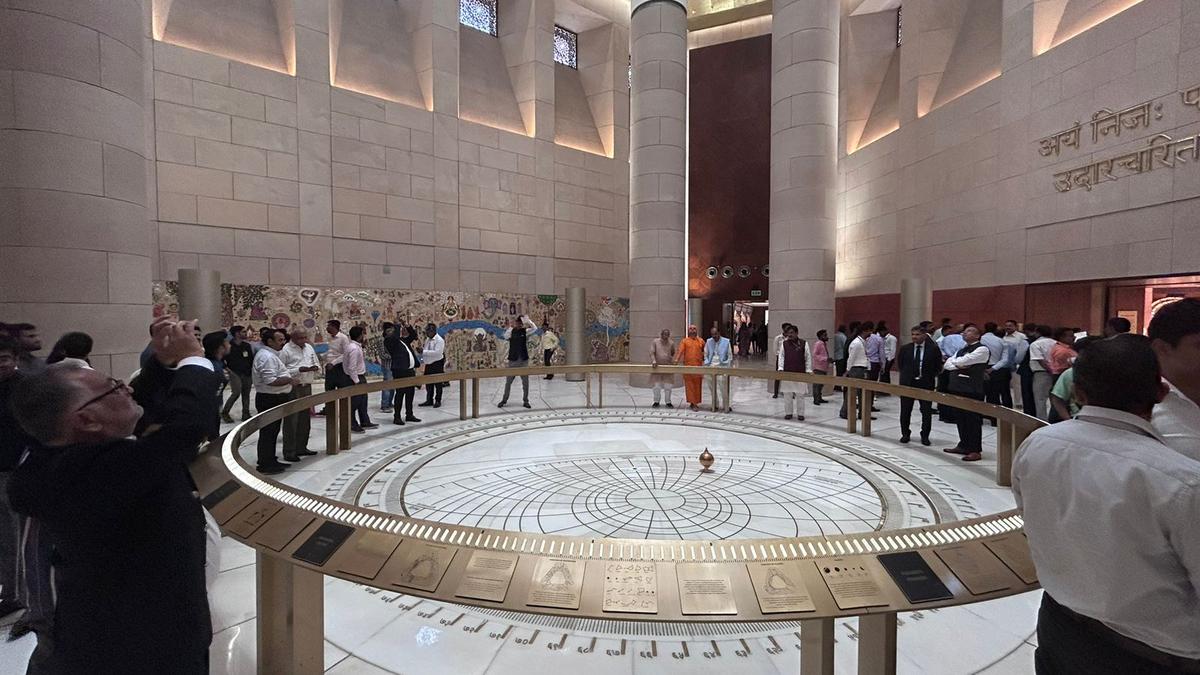
Foucault pendulum | Earth’s rotation on display Premium
The Hindu
The incident paved the way for the current version of Foucault pendulum.
Foucault pendulum, the 19th-century experiment that exemplified the earth’s rotation without complex calculations, has found a new home in the recently inaugurated Parliament building of India. The pendulum features in Parliament’s Constitutional Gallery area. It was designed and installed by the National Council of Science Museums (NCSM), Kolkata.
Invented by the 19th century French physicist Jean Bernard Léon Foucault, the pendulum provided simple physical proof that the earth rotated on its axis.
However, as E. Islam, a member of the NCSM team that has built Foucault pendulum models in India and abroad, pointed out in a research paper, the invention was actually an accident. According to Mr. Islam, Foucault was setting up a long and thin metal rod in a lathe when he accidentally plucked it, causing the end of the metal rod to vibrate in the same plane. Its other end rotated while being fixed on the headstock of the lathe.
The incident paved the way for the current version of Foucault pendulum. To test the theory, Foucault suspended a short pendulum from the chuck of a vertical drill press and set it to oscillation. He then started the drill press, and noticed that the pendulum swung in its original plane, irrespective of the fact that its mounted end was rotating. Foucault knew he was onto something. He set up an 11-metre-long wire in the Paris Observatory for analysis and found that it too rotated clockwise.
The physicist first set up the public display of the pendulum at the Pantheon in Paris in 1851. It consisted of a hollow brass sphere filled with lead to reach 28 kg in mass. It measured 17cm in diameter and was suspended from a 67-metre-long pendulum.
According to his findings, it is much easier to understand the phenomenon of the earth’s rotation using the pendulum at the Poles than it is at lower latitudes. At the Poles, the pendulum’s plane rotates once every 24 hours (which is the approximate period for one rotation of the earth), while at the Equator, it does not rotate at all. This is because the earth rotates faster at the Equator than it does at the Poles because it is wider in the centre and hence needs to cover more area in the same time period as compared to the North or South Pole.
The pendulum swings across a plane, which is the surface swiped by the motion of the sphere, also called the pendulum’s bob. As the earth rotates, the plane of the pendulum’s swing appears to rotate slowly. However, it’s not the pendulum, but the earth itself, that is rotating.


76-year-old Kurian Jacob from Kerala triumphs with seven medals, including five golds, at the Open Masters Games in Abu Dhabi.

Can nations unite to protect the endangered Hudsonian godwit and address the challenges of climate change and habitat loss?

Discover the Minor Planet Centre, the key hub for tracking and verifying observations of small solar system bodies.

Discover the Minor Planet Centre, the key hub for tracking and verifying observations of small solar system bodies.

In this week's Science for All newsletter, XX explains

Test your knowledge with the quiz on Science films at the Oscars through history

Set between the Siwalik hills and the plains, Butwal offers travellers a mix of regional cuisine, pilgrimage trails to Lumbini and the comfort of Hyatt’s new hospitality landmark

Explore 2026's wallpaper trends in India, highlighting botanicals and handmade designs that enhance modern homes with nature-inspired aesthetics.

Mercedes-Benz CLA 250+ with EQ Technology review: design, performance, range and features explained. Discover how the new electric CLA combines advanced AI, long range, fast charging and futuristic styling for the next generation of luxury EVs.

AI tool for sparrow conservation

BTS’s comeback with ‘Arirang’ marks a major global music event. When does the album release, and where can you watch their concert live stream? We have all the details

The 2026 U.S. cholesterol guidelines urge starting screening and treatment at 30 to prevent cardiovascular disease effectively.

Olam Festival 2026 in Thiruvananthapuram returns March 27-29 with 120+ vendors, music, art, and cultural zones.