Fostering the urban jungle of Bengaluru Premium
The Hindu
Renee M. Borges discusses the impact of urbanization on biodiversity, emphasizing the importance of preserving ecological connections in cities.
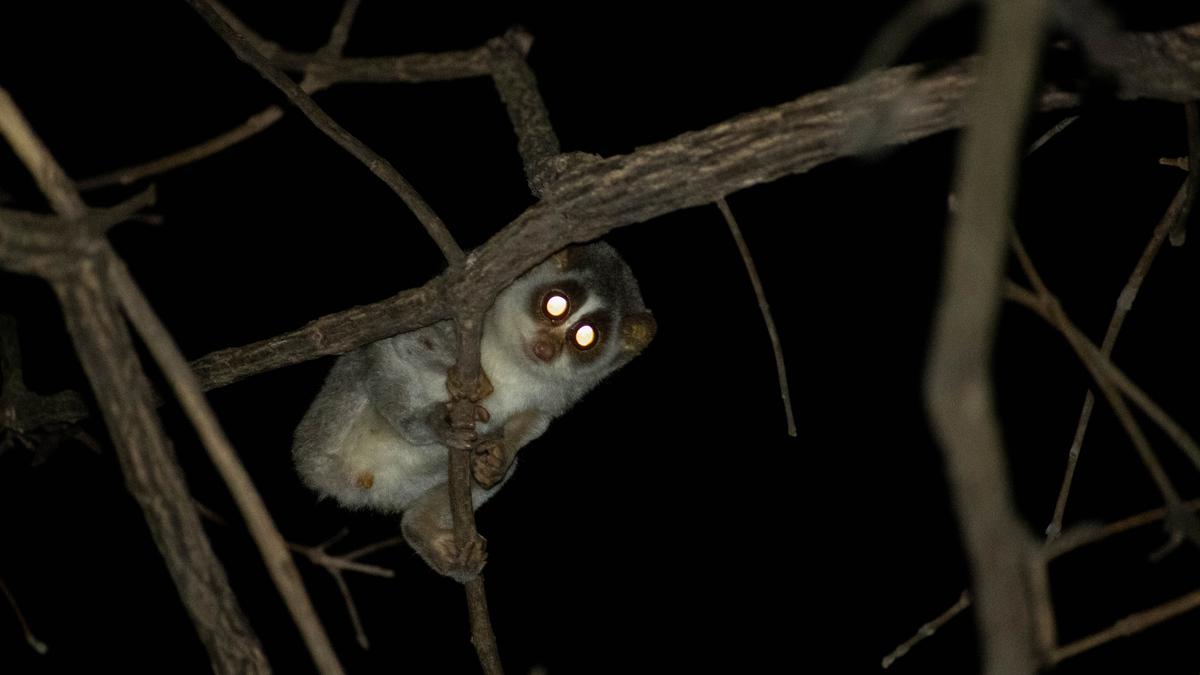
Renee M. Borges often hears the distinct high-pitched calls of slender lorises from the canopy above her while driving home from the Indian Institute of Science. “There is the Central Power Research Institute on one side of the road and the IISc campus on the other,” says the evolutionary ecologist from IISc’s Centre for Ecological Sciences. “I can hear a loris above the road, crossing (from one campus to the other) through the trees.”
If the trees were not connected, it would be devastating to these animals, she says, at a recent lecture titled “Fostering the Urban Jungle” held at Science Gallery Bengaluru. In that scenario, these beautiful, insectivorous animals, among the oldest living primates in the world, would be unable to survive in the city. “I want to emphasise that the slender loris will only survive if there are connections between trees,” she says about these shy, arboreal creatures, listed as ‘Endangered’ in the IUCN Red List.
There are good reasons for Borges’ concern for these animals. Slender lorises, as well as many other urban-dwelling animals, cannot survive if their populations — already small and limited to a few patches of trees in the city — become isolated because they will not be able to move from one place to another either to hunt prey or escape predators. She expands on the concept of landscape resistance, a measure of “how much a landscape resists movement of organisms from one patch to another” and its effect on small animals in cities. “They will find it very difficult, and their populations will be restricted based on the impervious, cemented landscapes that prevent them from moving from one area to another,” she warns.
There is yet another consequence of fragmented landscapes for animals like lorises: loss of genetic diversity, which is crucial for their survival. “If you are not able to mix easily, then your genetics becomes very localised or very specific to a locality because you are not able to share genes with individuals that are farther away,” says Borges. “These are very well-understood consequences of fragmentation that happens because of urbanisation.”
At the talk, Borges makes a broader point about urbanisation and its consequences on plant and animal life. She shares a map that offers a global perspective into the evolution of urban life and points to a scattering of organisms on the map that live in close proximity to humans, including pigeons, bedbugs, lice, fleas and rats. ”There has been a sort of two-way interaction,” she says. “Humans have also influenced these organisms, and these organisms, in turn, have influenced humans.”
While the co-evolution of humans and these animals has occurred over several millennia, the dramatic increase in urbanisation in the past few decades is affecting the evolution of plants and animals significantly. Take, for instance, herring gulls: large, rather noisy shorebirds found in the northern hemisphere.
“If you track the mutations in a rural population of herring gulls compared to an urban population or in a steel town, you can see that the rates of mutation increase because of pollution in urban populations,” she says, drawing from a recent study about genetic mutations, the raw material for evolutionary change, in these birds. She points out that this indicates “a clear kind of relationship that tells us how urbanisation is affecting the evolution of these animals. Because mutations are an index of evolution.” Similar findings have been reported in mice, lizards and plants.


PM Modi emphasizes India's pursuit of diverse gas and crude oil sources amid the global energy crisis due to West Asia conflict.

Kerala BJP chief Rajeev Chandrasekhar challenges Congress to prove undisclosed assets allegations in court, dismissing them as distractions.

As per information by Minister of State for Civil Aviation Murlidhar Mohol to a question in the Rajya Sabha, ₹146.89 crore has been utilised under the UDAN scheme till October 31, 2025.

Supreme Court rules women officers in Armed Forces deserve equal opportunities, upholding their right to permanent commission and pension benefits.

Telangana government assures no fuel shortage; Hyderabad police commissioner urges citizens to avoid panic buying

Telangana government employees will receive 10-20% discounts on electric vehicles to promote eco-friendly transportation, announces Transport Minister.

Discover the engaging teaser of 'Pallichattambi,' a period drama starring Tovino Thomas, releasing on April 10.

SP P. Jagadeesh reviews night patrols in Anantapur to enhance security and public safety during Operation Night Safety.

DMK announces candidates for 13 seats in Puducherry elections, reserving one seat for ally VCK amid strategic alliances.

Delhi HC safeguards Sonakshi Sinha's personality rights, prohibiting unauthorised use of her image and attributes across platforms.

Mohanlal's 'Drishyam 3', directed by Jeethu Joseph, has been postponed to May 21, coinciding with his birthday. The film marks the franchise's final installment.

Family of custodial death victims demands harsh punishment for nine convicted policemen to prevent future abuses of power.

United Democratic Front's candidate list for the 2026 Kerala Assembly elections, aiming for a significant political comeback.