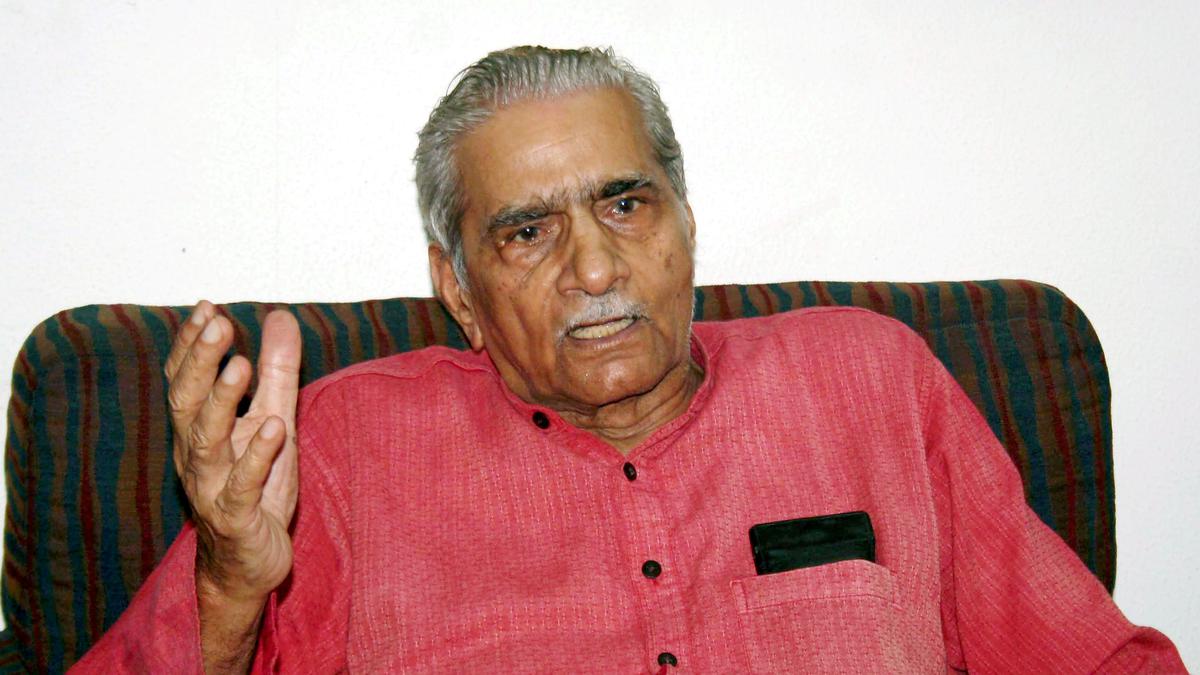
Former Law Minister Shanti Bhushan, who stood up for ‘basic structure’, passes away
The Hindu
Shanti Bhushan joined the BJP in 1980 but resigned from the party six years later. He was a founding member of the Aam Aadmi Party.
Former Law Minister and senior advocate Shanti Bhushan passed away on Tuesday. He was 97.
He always stood for truth both as a Law Minister in the Morarji Desai Cabinet between 1977 and 1979 and as a senior advocate who fought alongside his son and noted civil rights lawyer, Prashant Bhushan, for judicial accountability and transparency.
In his memoir ‘Courting Destiny’, Mr. Bhushan quotes the cricketing legend Don Bradman to say that one can successfully combine the values of dignity, integrity, courage and modesty with pride, ambition and competitiveness.
The fierce integrity of Mr. Bhushan came to the fore when he stood up to Prime Minister Indira Gandhi and successfully got her disbarred for election malpractices. An event which culminated into the Emergency. But Mr. Bhushan’s argument that “no political leader was above the law outlived those dark days in India’s history, and whenever a top leader had to relinquish office, the nation could always find a successor” has outlived those dark years.
Later, he defended the Basic Structure of the Constitution and the inviolability of fundamental rights against the 39th Constitutional Amendment before a Bench led by Chief Justice A.N. Ray, who had superseded three senior judges of the Supreme Court to become top judge. Mr. Bhushan was able to convince the Bench that “every Constitution has some basic features which make it unique and give it an identity”.
He later wrote that “if some amendment changed democratic Constitution into a dictatorial one, naming the dictator and giving the dictator power to name a successor, it cannot be perceived as an amended Constitution of India”.
In the Habeas Corpus case, when Opposition leaders were detained during the Emergency, he defended the rule of law. His main argument in the case was that rule of law always protected the liberty of citizens and they could be deprived of their liberties of free speech and right to life only in accordance with law.


CM announces Cabinet Sub-Committee on Musi rejuvenation; rehabilitation for all displaced

Ramanathapuram identifies 145 polling stations as sensitive, ensuring security with paramilitary forces ahead of assembly elections, says DEO.

BJP Puducherry president V. P Ramalingam files nomination for Raj Bhavan, joined by Union Minister Mandaviya and Khushbu Sundar.

History-sheeter 'Thoppai' Ganesh shot dead by police in Chennai after attacking officers during attempted escape.

The government plans to amend the FCRA, introducing new regulations for NGO asset management and accountability for key functionaries.

The draft policy for “Responsible Digital Use Among Students”, released on Monday by the Department of Health and Family Welfare, has recommended that parents set structured routines with clear screen-time rules and prioritise privacy, safety, and open conversation with children on digital well-being.

Police Observer Sushant Kumar Saxena conducts surprise inspection at Shencottai police station, reviewing warrants and security arrangements ahead of elections.

Andhra Pradesh government to launch key projects in April, focusing on industrial growth and infrastructure development, says Nara Lokesh.

Lok Sabha refers the Corporate Laws (Amendment) Bill to a JPC amid opposition concerns over CSR provisions dilution.

SHG members in Kanniyakumari use snakes and ladders to raise election awareness and boost voter turnout.

Government accelerates consultations for early implementation of the Women’s Reservation Act to ensure women’s representation in 2029 elections.

CM A. Revanth Reddy distributes ₹1 crore insurance cheques to families of deceased Electricity department employees, enhancing financial security for workers.

The Bengaluru Traffic Police (BTP) registered 634 cases of drunk driving during a week-long special enforcement drive conducted across the city between March 16 and March 22.