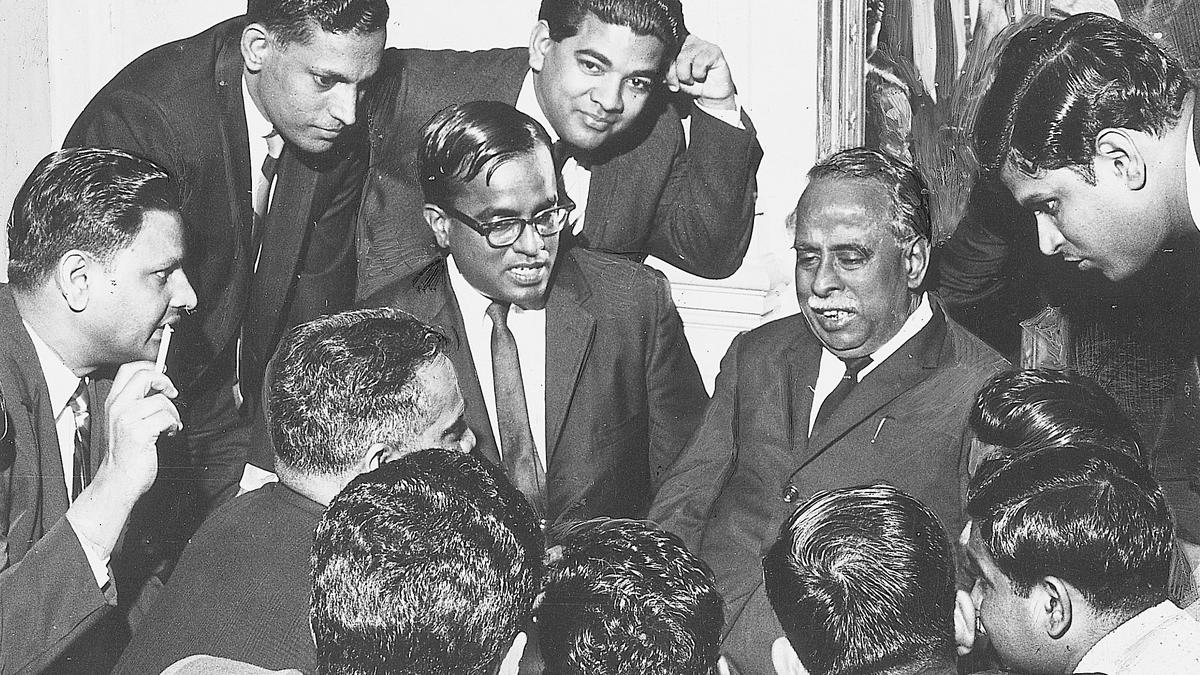
For Annadurai, patriotism was not about national anthem but work alone, as he witnessed in Japan
The Hindu
DMK founder and former Chief Minister C.N. Annadurai's interview reveals his intellectual calibre, economic understanding, and vision for Tamil Nadu's future.
DMK founder and former Chief Minister C.N. Annadurai, whose death anniversary was observed on February 3, was known for his intellectual calibre as much as for his oratorical and writing skills. In 1968, Annadurai, who had the previous year been elected as the first non-Congress Chief Minister of Tamil Nadu, had visited the United States and Japan.
On his return, he spoke in detail about his tour to the All India Radio (AIR). This interview offers glimpses into his intellectual calibre and sharp understanding of economics, agriculture, Five-Year Plans and labour-oriented industrial development, and making use of the manpower available in India. The interview also sparks a feeling of what would have been the course of Tamil Nadu’s history, had he lived long to give shape to his ideas. At a time when India is gripped with nationalistic fervour and frenzied sloganeering, the suggestion made by Anna, as he was fondly called, to emulate the Japanese has resonances for the country. The patriotism of the Japanese, he says in the interview, is not confined to singing the national anthem or parades or flag hoisting, but to work, work, and work alone.
He sounds modest when told that he should make use of “his good influence on people” to convey the message. “Fortunately or unfortunately, I happen to be a politician and a politician’s word will not be taken with full sense. They may note that there may be propaganda behind it. If the students, who have been in Japan for so many years, tell our people how Japanese people are progressing, it would have a good effect,” he says.
Driven by his experience and interaction with students, professors, and economists of various universities in the U.S. and Japan, Anna, a student of world history, points out that the industrial prosperity of most of the countries is based on the agricultural prosperity. “Unless the agriculture base is strong, unless our rural part becomes rich, there cannot be an industrial superimposition,” he argues. He was of the opinion that India’s Five-Year Plans did not give as much importance to agriculture as it deserved. “Most of the countries, including America, first developed their agriculture and through agriculture they raised the prosperity of rural parts and when there was prosperity in rural parts, they were able to contribute share amount and capital for various industries that were started. That was how the industrial progress of America was established. That is the lesson we should learn,” he says.
Even in the 1960s, he had fully understood that a country like India, endowed with huge manpower, could not afford to embrace capital-driven industrialisation. “In America, most of the industries are capital-oriented. Because there is a shortage of manpower, they want everything to be done on a massive scale through machines and they do not utilise more men there. But the manpower is so large in our country that our industries and projects ought to be more labour-oriented than capital-oriented,” he explains.
As for the development of agriculture, he cited Japan as a model for India since there was no large-scale farming. He travelled on a train between Tokyo and Kyoto, a distance of roughly 300 miles, and witnessed farming on three acres, four acres and five acres, but with the help of machines. “I saw Japanese farmers using power tillers. If we develop our agriculture on that line, we can make our educated young men take up agriculture, because if you ask our educated young men to go to the field and plough, they feel somewhat diffident to use the bullock-driven plough. But if they are offered power tiller and the agriculture is mechanised, young people will get interested in agriculture,” he reasons.
Annadurai’s argument is that India should give thrust to agriculture because the majority of the population is dependent on it. “When we have industrial potential and have got alternative employment for our people, we progressively reduce the number of people dependent on agriculture, then we can mechanise. It means that I am not against mechanisation or mass production. I am fully conscious of the manpower that is found to be in our country and therefore, we should progress keeping in mind the basic fact that many projects in our country for long years to come should be labour-oriented,” he reiterates.


GHMC intensifies action against property tax defaulters, seizing properties and offering a One Time Settlement scheme for payments.

CCB arrests three drug peddlers in Mangaluru, seizing ₹2.5 lakh worth of MDMA and other valuables.

TVK's 28 candidates in Puducherry include former BJP MLAs, a sitting Independent, and a retired police IG.

BRS submits notice on private member bill to Speaker

CPI-M accepts DMK's five-seat offer for Tamil Nadu Assembly elections, prioritizing INDIA bloc unity over seat demands.

Ricky Rai, son of former underworld operative Muthappa Rai, on Monday appeared before the Bengaluru Traffic Police for questioning in connection with a case involving a Lamborghini performing dangerous stunts at Anil Kumble Circle on March 21.

The Dispur election heats up as 'CongBJP' defections shape a high-stakes contest between veteran candidates from BJP and Congress.

Bengaluru's M. Chinnaswamy Stadium conducts readiness drill ahead of IPL 2026, ensuring upgrades and technical preparations are complete.

First-level randomisation of EVMs completed in Nagapattinam for upcoming elections, ensuring transparency and security.

A district-level committee in Krishnagiri has been formed to assess and verify seizure claims of goods and cash.

Minister Anam Ramanarayana Reddy pledges government support for local fishermen and farmers facing challenges in Andhra Pradesh.

MP M. Sribharat urges collective efforts to revive Visakhapatnam Steel Plant, highlighting key reforms for crucial recovery and growth.

141 candidates have filed nominations for Kozhikode's Assembly elections, with scrutiny on March 24 and campaigning intensifying.