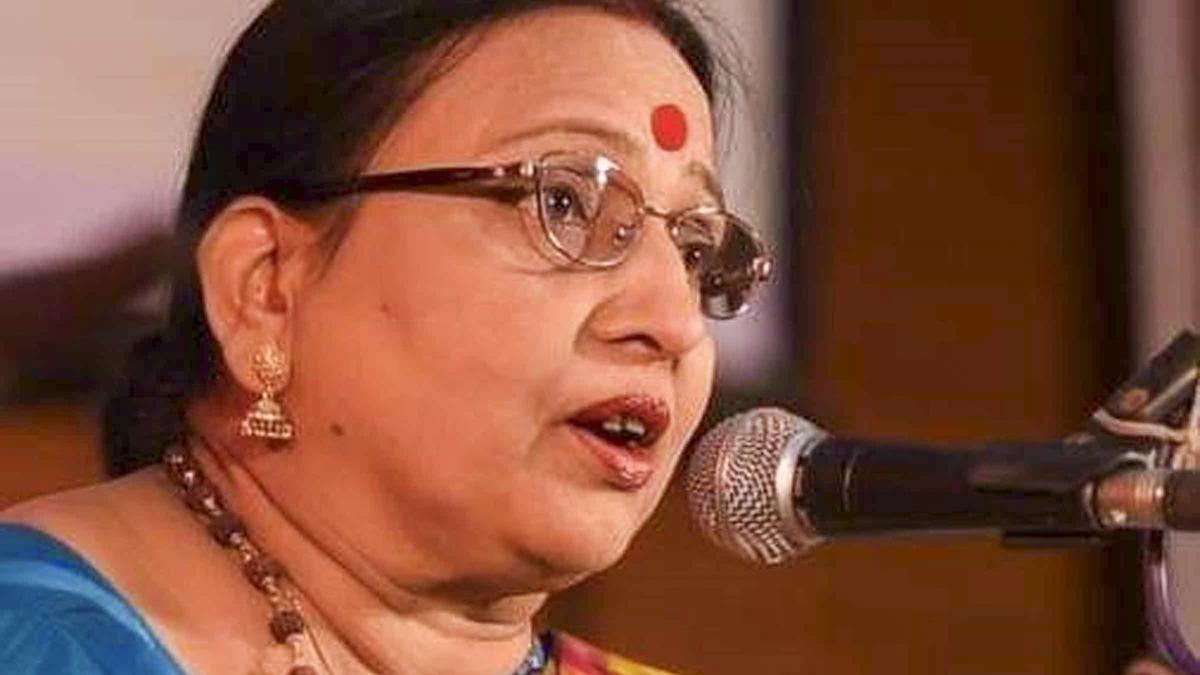
Folk singer Sharda Sinha, voice of Chhath, dies at 72
The Hindu
Popular folk singer Sharda Sinha, who was undergoing treatment at All India Institute of Medical Sciences-Delhi, has died
Popular folk singer Sharda Sinha, who was undergoing treatment at All India Institute of Medical Sciences (AIIMS)-Delhi, died on Tuesday night (November 5, 2024). She was 72.
“Sharda Sinha expired at 9.20 p.m. due to refractory shock as a result of septicemia,” an AIIMS official said.
Ms. Sinha was known among her fans for folk songs such as “Kartik Maas Ijoriya” and “Koyal Bin” as well as Bollywood numbers “Taar Bijli” from “Gangs of Wasseypur- II” and “Babul” from “Hum Aapke Hain Koun”.
Ms. Sinha, a Padma Bhushan recipient synonymous with folk songs in Bhojpuri, Maithili, and Maghahi languages, was on ventilator support following a health complication due to multiple myeloma, a form of blood cancer.
The singer was admitted to the intensive care unit of Institute Rotary Cancer Hospital (IRCH), the cancer institute of AIIMS, in October 2024.
“Noted folk singer, Smt. Sharda Sinha is admitted in AIIMS, New Delhi for treatment. Hon’ble Prime Minister Shri Narendra Modi ji is continuously monitoring her condition and is in direct contact with the treating doctors. He has conveyed his prayers for her good health and speedy recovery through the treating team,” AIIMS in a post on X said earlier.
Later in the day, Union Minister Giriraj Singh visited the ailing artist at AIIMS.


Khalid Rahman is reuniting with Malayalam superstar Mammootty after Unda (2019). The Thallumaala director has teamed up with the veteran for Mattancherry Mafia.

Bollywood actor Akshay Kumar paid tribute to the martial arts grandmaster and Hollywood’s action star, Chuck Norris, who passed away on Thursday, March 19, 2026.

Renowned Odissi dancer Madhumita Raut, aged 59, dies of cardiac arrest, leaving behind a legacy of artistic achievements.

Chuck Norris, iconic martial arts master and actor, dies at 86, leaving behind a legendary legacy and internet memes.

South African naturalist Steve Boyes speaks on ghost elephants, ancestral tracking, and Werner Herzog’s documentary exploring Angola’s elusive highland giants

Actor-director Amol Palekar will receive META's Lifetime Achievement award for 2026 on March 25 in New Delhi.

India's artists unite against rising censorship, advocating for creative freedom and support for marginalized voices in the arts.

Written and directed by Kunal, the film also stars Sparsh Shrivastava and Vanshika Dhir

This year, Bharatnatyam artistes will present the Tyagaraja Aradhane as a dance performance

This year, Bharatnatyam artistes will present the Tyagaraja Aradhane as a dance performance

The actor, along with director Sushant Shah, speak about their upcoming series ‘Chiraiya’, Divya’s process of working on the dialect, Sushant’s approach to telling a story about women, and more

An independent video, ‘Feel the Spark’ by Raleigh Rajan with vocals by Ciera Dumas that celebrates Tamil literary giants, garnered 1.4 million views in less than 36 hours.

In ‘Jack Ryan: Ghost War’, John Krasinski is back as the savvy CIA analyst, diving headfirst into a high-stakes mission that unravels a deadly conspiracy and pits him against a rogue black-ops unit