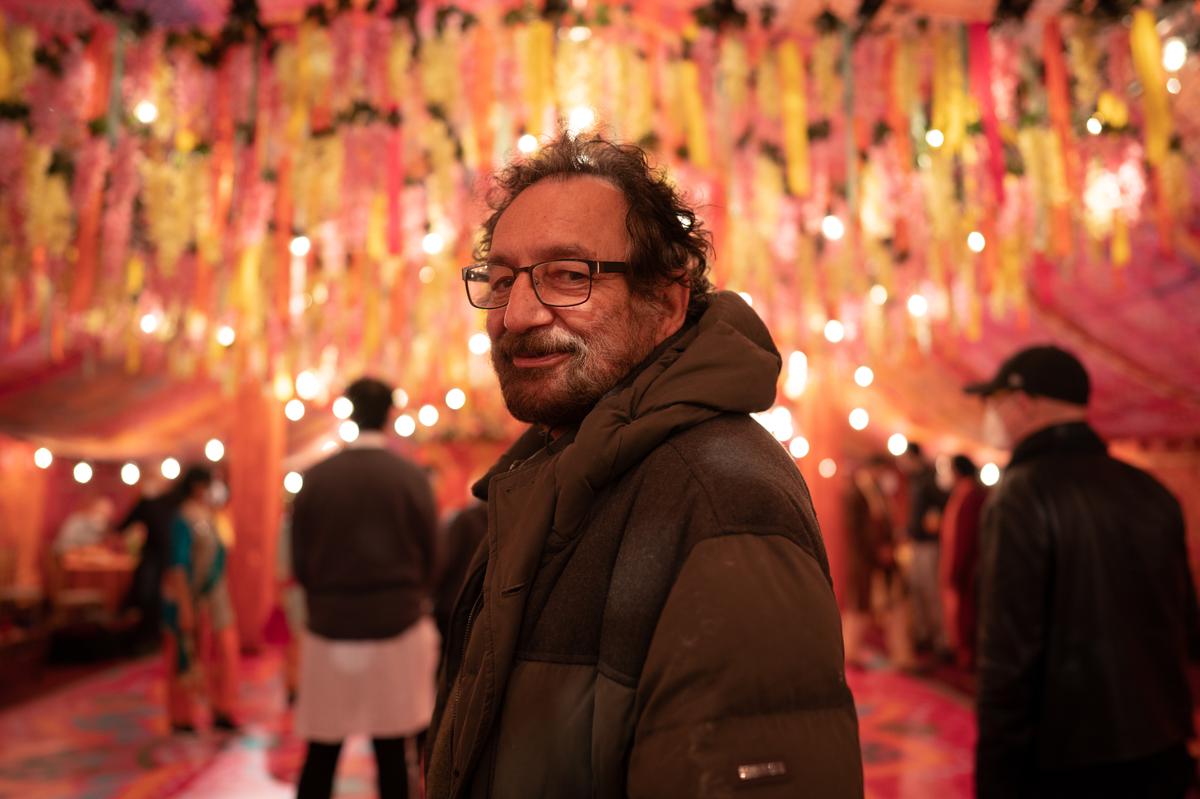
Filmmaker Shekhar Kapur returns with his first rom-com, ‘What’s Love Got to Do With It?’
The Hindu
Forty years after he made his first film, Shekhar Kapur is back with the romantic comedy What’s Love Got to Do With It? and a film on colonialism
A rare Indian filmmaker with a genuinely global profile, Shekhar Kapur has eked out only seven narrative features in a career spanning 40 years. He has never, however, been off the radar. His debut film, Masoom (1982), lives on in the collective memory of Hindi movie fans. So does his enormously popular 1987 sophomore venture, Mr. India.
His latest, What’s Love Got to Do With It?, set for worldwide theatrical release on January 27 next, is his first fiction feature since 2007’s Elizabeth: The Golden Age. “I did two big series in between,” the 76-year-old London-based director says during a television commercial shoot in Faridabad. “I worked on Damien [a follow-up to the classic 1970s horror film, The Omen] for Fox and on Will [a series on a young William Shakespeare] for TNT,” he says.
Several false starts and creative fallouts followed his two early successes. Unfinished or unrealised projects accumulated. The string of aborted Mumbai movies prompted him to go global. The move paid off. “It might sound arrogant. I left the B-Team and went to compete for a place in the A-Team,” he says about his departure from Bollywood in the 1990s. “I wanted to test myself. I wanted to see if I was good enough to play in a higher league.” He was. He imparted to his fourth film, Elizabeth (1998), a UK-funded production with an Australian star playing a British monarch, a pronounced, effervescent Bollywood style. It fetched Kapur heady global dividends.
What’s Love Got to Do With It?, a romantic comedy written by Jemima Khan — which has already picked up the Best Comedy award at the recent Rome Film Festival — is produced by Working Title, the outfit that backed Elizabeth and its sequel. “The script came to me through the producers. We were going to make it earlier, but COVID came. So, we had to wait,” he says of his first-ever digitally shot feature film.
The film unfolds between London and Lahore, where Kapur was born two years before India gained independence. Has the shift from film to digital impacted his aesthetic? “Digital has its advantages and disadvantages,” he replies. “You are not constrained by the cost of raw stock. Production is easier and cheaper.” But one of the challenges is achieving the ‘film look’. “Digital has such great depth of field that there is no out-focus,” he says, explaining how the ‘film look’ is an emotional way of telling a story. There are visual layers to it. “When we look at something, we constantly focus and re-focus. When we look at something, everything else is put out of focus. The film look is much more like how we look at the world.”
What’s Love Got to Do With It?, Kapur’s first rom-com, has been lit and shot by cinematographer Remi Adefarasin, who also lensed the two Elizabeth films. It features Shazad Latif, Lily James, Emma Thompson, Sajal Aly and Shabana Azmi (Kapur’s 1970s co-actor) in key roles.
Kapur’s acting career — he debuted in his maternal uncle Dev Anand’s Ishk Ishk Ishk (1974) after chucking a career as a chartered accountant in London — was rather uneventful in spite of the one film each that he did with Mani Kaul ( Nazar), Govind Nihalani ( Drishti) and Basu Chatterjee ( Jeena Yahan) and appearances in Kamal Haasan’s Vishwaroopam 1 and 2. As an actor, he knew exactly what he needed from his director. “I was screaming for it, but did not get it,” he says. But his on-screen experience impacted how he was to direct his actors.


Chuck Norris, iconic martial arts master and actor, dies at 86, leaving behind a legendary legacy and internet memes.

South African naturalist Steve Boyes speaks on ghost elephants, ancestral tracking, and Werner Herzog’s documentary exploring Angola’s elusive highland giants

Actor-director Amol Palekar will receive META's Lifetime Achievement award for 2026 on March 25 in New Delhi.

India's artists unite against rising censorship, advocating for creative freedom and support for marginalized voices in the arts.

Written and directed by Kunal, the film also stars Sparsh Shrivastava and Vanshika Dhir

This year, Bharatnatyam artistes will present the Tyagaraja Aradhane as a dance performance

This year, Bharatnatyam artistes will present the Tyagaraja Aradhane as a dance performance

The actor, along with director Sushant Shah, speak about their upcoming series ‘Chiraiya’, Divya’s process of working on the dialect, Sushant’s approach to telling a story about women, and more

An independent video, ‘Feel the Spark’ by Raleigh Rajan with vocals by Ciera Dumas that celebrates Tamil literary giants, garnered 1.4 million views in less than 36 hours.

In ‘Jack Ryan: Ghost War’, John Krasinski is back as the savvy CIA analyst, diving headfirst into a high-stakes mission that unravels a deadly conspiracy and pits him against a rogue black-ops unit

Shriram Bharatiya Kala Kendra’s Shankarlal festival showcased rare ragas, radiant artistry, and inclusive performances, from Pt Madhup Mudgal’s serene morning ragas to Ramana Balachandran’s Saraswati veena.

Explore "Threads that Bind: The Kantha Project," an exhibition in Delhi reimagining kantha as a medium of repair and renewal.

Sean Penn skips the Oscars to meet Ukraine's Zelenskyy, who praises him as a "true friend" amid the war.