Festive period vehicle sales grow 12% led by 2Ws, PVs
The Hindu
FADA reports 11.76% increase in automobile retail sales during festive period, driven by strong two-wheeler and passenger vehicle demand.
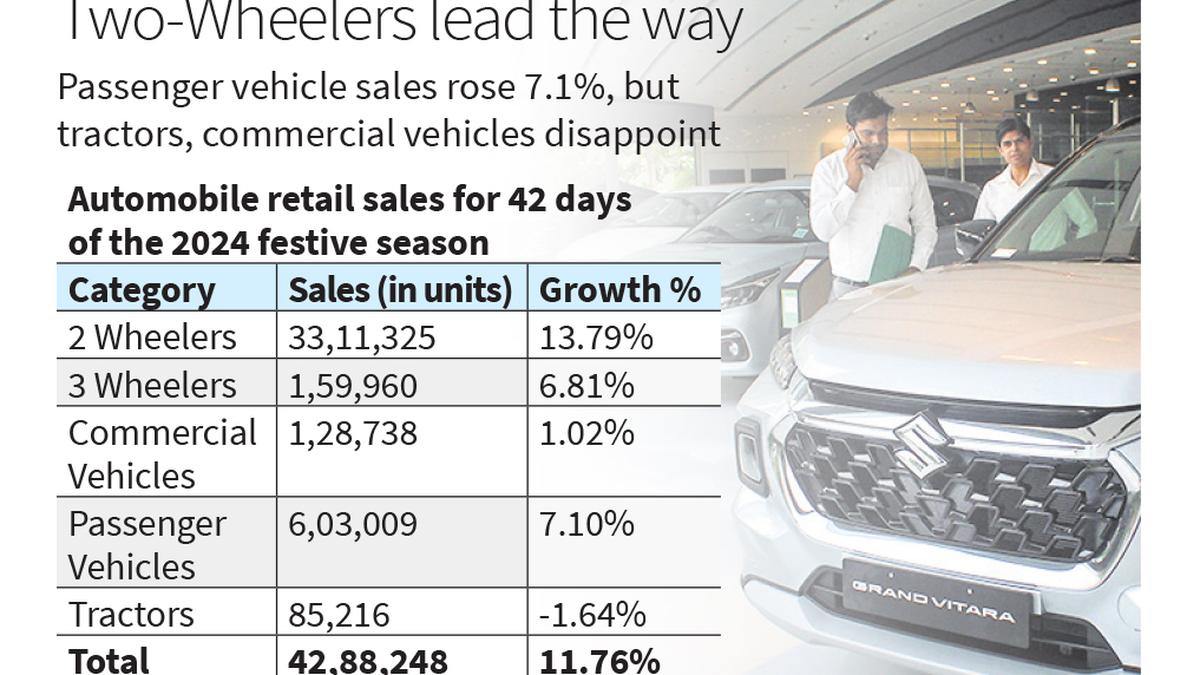
Automobile retail sales during the 42-day festive period (from 1 day of Navratri to 15 days post Dhanteras) of 2024 increased 11.76% to 42.88 lakh vehicles compared with 38.37 lakh units registered in the same period last year, according to data released by The Federation of Automobile Dealers Associations (FADA) on Friday.
Two-wheeler sales were particularly robust, registering a 13.79% growth year-on-year to reach 33.11 lakh units, largely driven by strong rural demand.
Passenger vehicles segment bounced back after a lull, growing by 7.10% to 6.03 lakh units, supported by pent-up demand and unprecedented discounts available in the market, FADA said.
At 1,59,960 units of retail sales, the 3-wheeler segment reported a growth of 6.8% and the Commercial Vehicles segment reported marginal growth of 1.2% to 1,28,738 units.
Tractors sales during the period de-grew 1.64% to 85,216 units as compared with the year ago festive period.
C S Vigneshwar, President, FADA said, “The automobile retail sector has achieved a new milestone, surpassing last year’s festive records. We witnessed a remarkable surge in numbers since the beginning of Navratri, nearly hitting our forecasted target.”
“While we celebrate these achievements, we acknowledge that we could have fully met or even exceeded our targets of 45 lakh units if not for the unseasonal heavy rains in South India, especially in Bengaluru and Tamil Nadu, and the cyclone Dana that affected Odisha,” he said.


Union Minister Ashwini Vaishnaw launches three initiatives to enhance India's creative economy through AI training, citizen platforms, and advanced tech access.

Two Indian-flagged LPG tankers approach the Strait of Hormuz, navigating safely amidst regional tensions to reach Indian ports.

Gold and silver prices plummet over 7% due to West Asia tensions, inflation fears, and a stronger dollar.

Asian shares fall as rising oil prices and escalating Iran conflict diminish hopes for U.S. interest rate cuts.

Japan's SoftBank Group said Saturday it plans to build a huge new gas-fired power plant in the US state of Ohio

Silver prices plunge 9% to ₹2.06 lakh per kg in futures trade amid weak global cues and rising macroeconomic pressures.

OpenAI plans to nearly double its workforce to 8,000 from 4,500 by the end of 2026, the Financial Times reported on Saturday, citing two people with knowledge

Global equity markets plummet as West Asia tensions rise and oil prices surge, triggering significant investor anxiety.

The rupee hits a record low of 93.94 against the dollar amid foreign fund outflows and a crashing equity market.

The Thane police have arrested two co-founders of cryptocurrency exchange platform CoinDCX in connection with an alleged fraud of Rs 71.6 lakh, officials said

Meta Chief Executive Mark Zuckerberg is building a CEO agent to help him do his job, the Wall Street Journal reported

Insurance penetration and density are often misunderstood and do not reveal how many families are insured or whether they would be financially secure if the main earning member were to die. The real issue is not reach but adequacy, as households may have life insurance but not enough cover to replace lost income, leaving them financially vulnerable.

Five top firms lose ₹1 lakh crore in market value, with HDFC Bank experiencing the largest decline of ₹56,124.48 crore.