FEMA search and rescue teams take days to reach Texas after flooding as agency faces overhaul
CNN
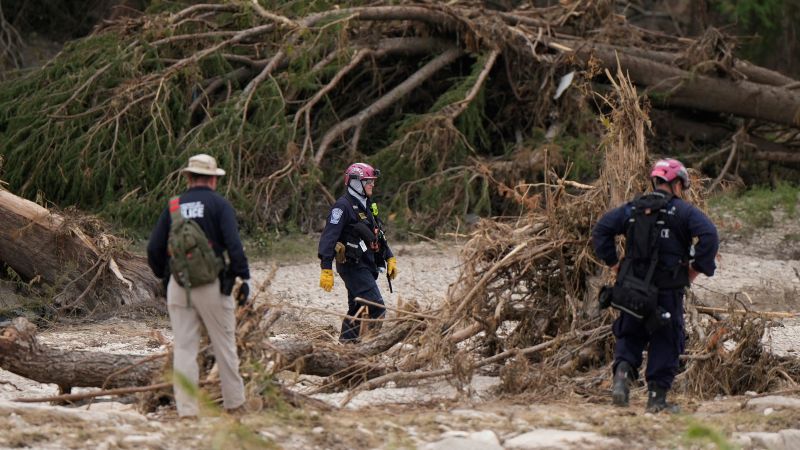
Multiple urban search and rescue teams from across the country that responded to the deadly floods in central Texas told CNN they were not deployed by the Federal Emergency Management Agency until at least Monday evening — days after any victim had been found alive.
Multiple urban search and rescue teams from across the country that responded to the deadly floods in central Texas told CNN they were not deployed by the Federal Emergency Management Agency until at least Monday evening — days after any victim had been found alive. Three of the teams, which are typically tasked with helping local first responders to urgently find survivors, were dispatched on Tuesday, more than four days after the Guadalupe River surge that has left more than 120 dead and scores missing. No victims have been found alive since last Friday, July 4. Teams from Indiana, Arizona, Colorado, Missouri and Nevada left their states with crews which included searchers, dogs, boats and equipment to drive across the country in a race against time to reach Texas. They were among a number of search and rescue teams from around the US coalescing in the state. Driving some 20 hours, the team from Nevada arrived on Wednesday and began setting up camp on Thursday, an official for the team told CNN. The teams, which are involved in large area searches, water rescues and finding human remains, began their first day of field work July 11, a week after the flood, the spokesperson said. A complex network of federal, state and local emergency personnel, including search and rescue workers from inside and outside Texas, raced to help in the immediate aftermath of the deadly flood. But CNN has previously reported that the decision to authorize deployments from a federal network of Urban Search and Rescue teams more than 72 hours after the calamity frustrated FEMA officials.


Jeffrey Epstein’s longtime employee and attorney Darren Indyke testified on Thursday that he “had no knowledge whatsoever” of the convicted sex offender’s wrongdoing and rejected “any suggestion” he assisted or facilitated his former boss’ crimes.

Democratic Sen. John Fetterman cast the deciding vote Thursday to advance Markwayne Mullin’s nomination to serve as US Department of Homeland Security secretary, crossing party lines to send President Donald Trump’s nominee to the full Senate for consideration.

A US F-35 fighter jet made an emergency landing at US air base in the Middle East after it was struck by what is believed to be Iranian fire, according to two sources familiar with the matter.

In 2025 a record number of more than 22,000 Cubans arrived in Uruguay, according to to the National Migration Agency. CNN’s Dario Klein reports.

For over a month, Transportation Security Administration employees have been showing up to work at US airports without getting paid.

CNN’s 5 Things AM brings you the news you need to know every morning.

Both President Donald Trump and first lady Melania Trump have encouraged Susie Wiles to take the time she needs away from the White House to deal with her treatment, but Wiles argued she does not plan to do so, people familiar said.

A transparency law passed by Congress has forced the release of more Epstein files than ever before, but some lawmakers and victims are exploring ways to push the Justice Department to disclose even more information from the voluminous trove that’s being withheld.

Former US National Counterterrorism Center Director Joe Kent sat Wednesday for an extensive interview with former Fox News host and right-wing podcaster Tucker Carlson, his first public comments since he resigned from his post, citing concerns about the war with Iran.

When Attorney General Pam Bondi and Deputy Attorney General Todd Blanche arrived on Capitol Hill Wednesday afternoon, they hoped to boost members’ confidence on their handling of the Jeffrey Epstein investigation. Within half an hour, Democratic lawmakers had walked out.

Cuba is going dark under US pressure. How the crisis unfolded and why its troubles are far from over
Almost three months after the US effectively imposed an oil blockade on Cuba that worsened its energy crunch, nearly every aspect of Cuban society has been feeling the strain.

The Department of Homeland Security has been ensnared by a partial government shutdown as Congress did not act to fund the agency by the end of Friday. But nearly all DHS workers will remain on the job — even if many won’t get paid until the lapse ends — and the public probably won’t notice much of a change.

The USS Gerald R. Ford aircraft carrier is moving away from operations tied to the Iran war and sailing to the US Navy’s base in Crete for repairs after a fire broke out in the ship’s laundry area last week, a US official said.