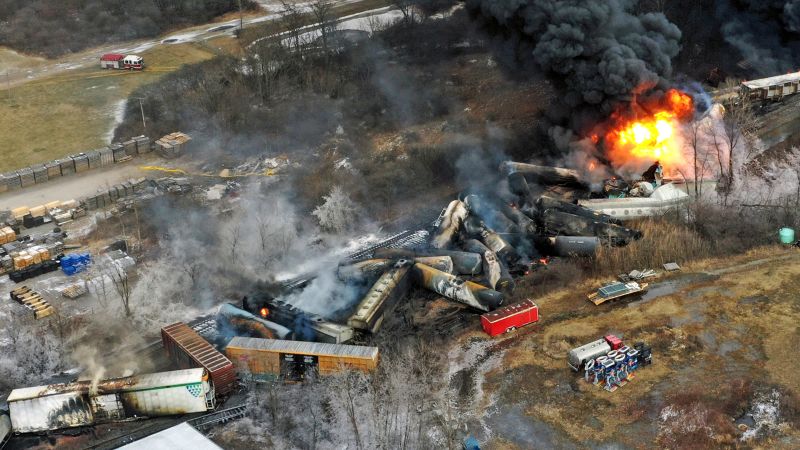
Feds reach $310M settlement with Norfolk Southern after toxic Ohio train derailment. Here’s what else the company has to do
CNN
The Environmental Protection Agency and the Department of Justice have reached a $310 million settlement with Norfolk Southern after last year’s train derailment that spilled more than a million pounds of hazardous chemicals into the soil, water and air in Ohio.
The Environmental Protection Agency and the Department of Justice have reached a $310 million settlement agreement with Norfolk Southern after last year’s train derailment that spilled more than a million pounds of hazardous chemicals into the soil, water and air in Ohio. “If the settlement is approved by the U.S. District Court for the Northern District of Ohio, Norfolk Southern will be required to take measures to improve rail safety, pay for health monitoring and mental health services for the surrounding communities, fund long-term environmental monitoring, pay a $15 million civil penalty, and take other actions to protect nearby waterways and drinking water resources,” the EPA said Thursday. The February 2023 derailment ignited a dayslong inferno, spewed poisonous fumes into the air, killed thousands of fish and left residents wondering if it’s safe to live in East Palestine. In the weeks following the disaster, officials said tests showed the air quality and municipal water were safe. But some residents reported a variety of health problems after the derailment, including rashes, nausea, bloody noses and trouble breathing. Thursday’s announcement stems from a civil lawsuit filed in March 2023. The DOJ sued Norfolk Southern on behalf of the EPA, alleging violations of the Clean Water Act from the discharge of pollutants and hazardous materials into waters. Norfolk Southern issued a statement Thursday saying it has reached an agreement with the DOJ, the EPA and the US Department of the Interior “to resolve all their claims and investigations arising from the derailment in East Palestine, Ohio.”


The House Oversight Committee released videos Tuesday of closed-door depositions with two men in Jeffrey Epstein’s inner circle as part of its probe into the late convicted sex offender.

The House Intelligence Committee voted Tuesday to give federal prosecutors classified records related to John Brennan, according to a committee spokesperson, signaling the Justice Department’s investigation into the former CIA director may be heading towards possible charges.

North Carolina State Senate leader Phil Berger on Tuesday conceded his primary race to Rockingham County Sheriff Sam Page, a political earthquake that took down arguably the most powerful politician in a pivotal swing state.

It’s looking like the Department of Homeland Security shutdown could soon be over. The two sides seem to have made serious progress, and President Donald Trump hasn’t rejected anything, even if he’s a little sour. But it’s likely the resolution will disappoint many Democrats.

California Gov. Gavin Newsom said that he regretted using the word “apartheid” to describe the Israeli government’s treatment of Palestinians, though he warned “that’s a word you may hear others use” if Prime Minister Benjamin Netanyahu pushes for territorial gains.

Haiti is about to get a new set of foreign boots on the ground. The goal sounds simple: fight the gangs that have brought life to a standstill.

Oklahoma’s governor picks energy executive Alan Armstrong to fill US Senate seat through end of year
Oklahoma’s governor on Tuesday appointed energy executive Alan Armstrong to serve in the US Senate through the end of the year and finish the term of Republican Markwayne Mullin, the new homeland security secretary.

Newly confirmed Homeland Security Secretary Markwayne Mullin told senators during his confirmation hearing that he wanted to keep the department out of the headlines. That won’t be easy.

A trader made nearly $1 million since 2024 from dozens of well-timed Polymarket bets that correctly predicted US and Israeli military actions against Iran, according to an analysis shared with CNN.

Travelers have been dealing with worsening airport wait times as ICE agents deploy to more than a dozen airports. Follow for live news updates.

President Donald Trump voted in Tuesday’s state House special election by mail even as he suggested on Monday that “mail-in voting means mail-in cheating.”

CNN’s 5 Things AM brings you the news you need to know every morning.

The Supreme Court on Tuesday will consider the legality of a policy championed by President Donald Trump during his first term that prevented scores of migrants arriving at the southern border from starting the process of applying for asylum.