Federal Reserve cycle of rate cuts likely to be slower than markets expect
The Peninsula
Doha, Qatar: Policy rates expectations have swung significantly in recent months, revealing a rather fragile market consensus over the timing and size...
Doha, Qatar: Policy rates expectations have swung significantly in recent months, revealing a rather fragile market consensus over the timing and size of easing by the US Federal Reserve (the “Fed”) over the next year. After keeping the rate on hold since the end of 2024, an incipient softening of labour markets began to shift the balance of risks.
Unprecedented trade and fiscal policy volatility drove uncertainty measures to record highs, putting policy makers on “wait-and-see” mode as they assessed the major risks to the economy. Finally, the Fed cut the benchmark rate by 25 basis points (b.p.) to 4.25% in September, QNB said in its economic commentary.
The Fed recognizes that near-term risks to inflation are tilted to the upside, with the headline figure fluctuating around 2.9%, markedly above the 2% target of monetary policy, while risks to employment point to the downside. This puts the Fed in a difficult position, as the two targets of the Fed’s mandate, i.e., low inflation and maximum employment, come into direct conflict.
Currently, markets discount close to 125 b.p. in additional rate cuts until end-2026. In our view, although the Fed would eventually bring interest rates to the neutral level close to 3%, there is not an alarming deterioration in the economic growth outlook that would call for a rate cutting cycle of this speed. In this article, we discuss three main factors that support our outlook.
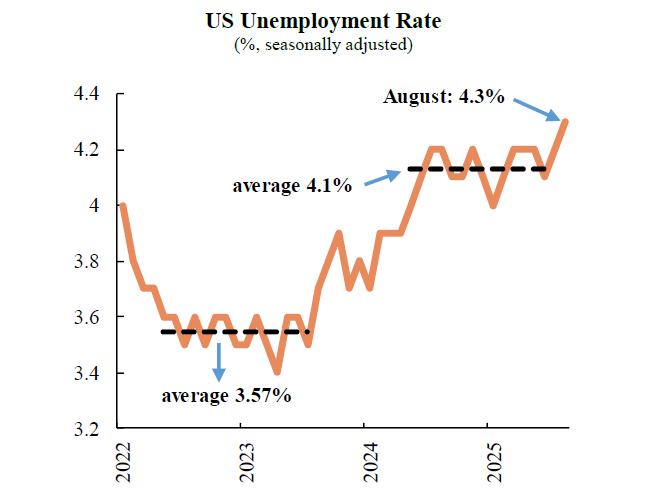
First, labour markets are weakening gradually, in line with a soft-landing of the economy. Labour markets are at the core of monetary policy, explicitely being part of the mandate of the Federal Reserve, and therefore provide guidance regarding the direction of policy rates. Importantly, labour markets are an informative gauge of the state of the overall economy, and a sharp deterioration in employment has historically anticipated a recession. The widely recognized “Sahm Rule” states that a recession is imninent when the unemployment rate increases by 0.5 percentage points (p.p.) relative to the minimum in the last year. This rule has signalled the start of every US recession since the 1970s, but the current progression of the unemployment rate is overly moderate to raise the alarms of a downturn.


Beirut: The number of casualties from the ongoing Israeli attacks on Lebanon has risen to 1,029 dead and 2,786 injured, the Lebanese Ministry of Healt...

Riyadh:Secretary General of the Gulf Cooperation Council (GCC), Jasem Mohamed Albudaiwi, expressed his deepest condolences and sincere sympathy to the...

Washington, United States: Immigration agents will be deployed in US airports beginning Monday, aiming to alleviate soaring congestion at security scr...

Berlin: Borussia Dortmund sporting director Sebastian Kehl has ended his tenure by mutual consent , the club said in a statement released Sunday....

Amman: Jordan has expressed its deepest condolences to the State of Qatar and the Republic of Turkiye following a helicopter crash in Qatari territori...

Cairo: Egypt has extended its deepest condolences and sincere sympathy to the State of Qatar and the Republic of Turkiye over a helicopter crash in Qa...

Abu Dhabi: The United Arab Emirates has extended its deepest condolences to the State of Qatar and the Republic of Turkiye over a helicopter crash acc...

Baghdad, Iraq: Iraq has extended its airspace closure for an additional three days, the country s aviation authority reported in a statement on Sunday...

Havana: Cuban authorities scrambled Sunday to restore power to the island after the second nationwide blackout in less than a week, as the grid strugg...

Doha, Qatar: Qatar Airways has said it is working to process and resolve refund requests as quickly as possible, while signalling that some cases may...

Doha, Qatar: Qatar Airways has said it is working to process and resolve refund requests as quickly as possible, while signalling that some cases may...

Doha, Qatar: On the initiative of Her Highness Sheikha Moza Bint Nasser, Chairperson of Education Above All Foundation, the foundation, in partnership...

Doha, Qatar: On the initiative of Her Highness Sheikha Moza Bint Nasser, Chairperson of Education Above All Foundation, the foundation, in partnership...